
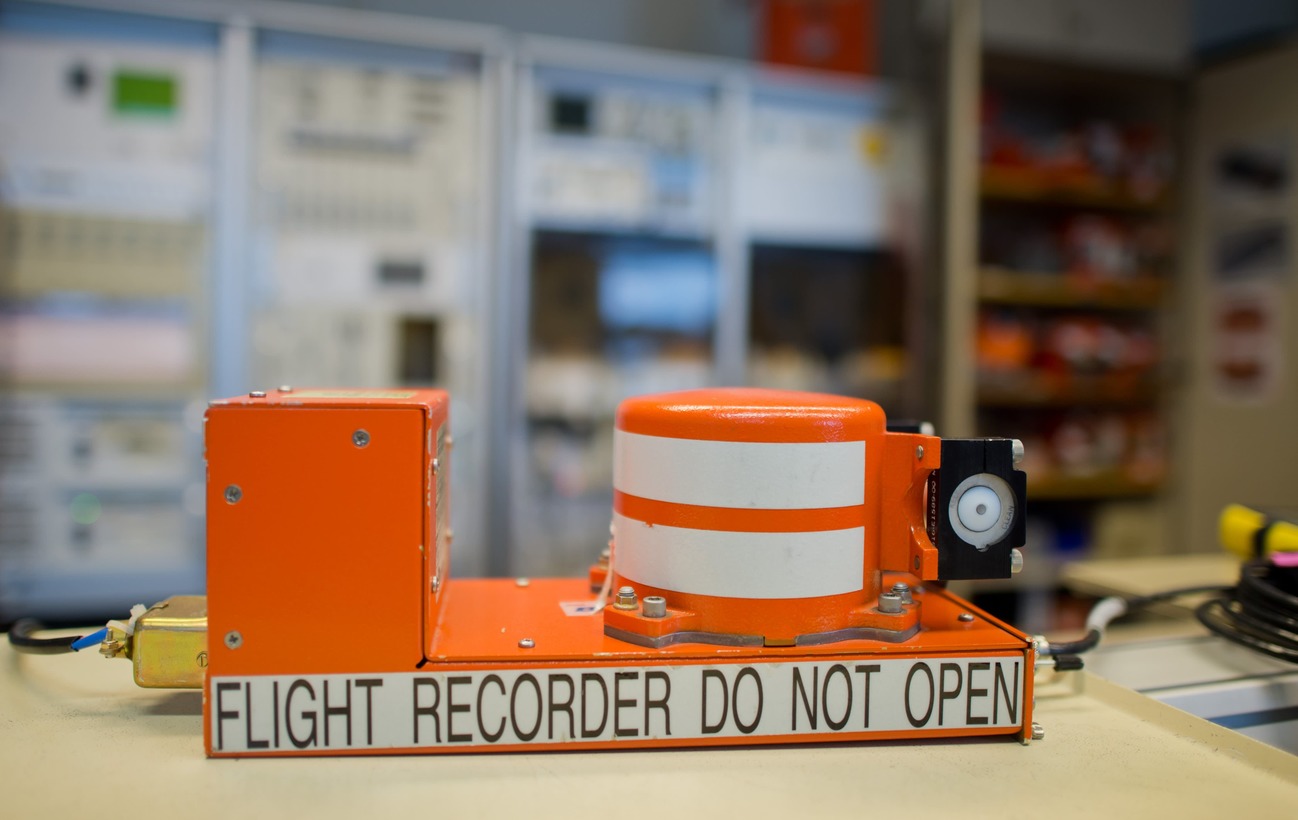
When rescue teams sift through the wreckage of an airliner and guide the last survivors to safety, another race begins – quieter, but no less urgent. At YourNewsClub, we’ve often seen that the most complex aviation investigations do not start with press briefings or official statements. They begin with two bright-orange cylinders the size of a small box. These devices, universally called “black boxes,” remain the only instruments capable of reconstructing the truth from the seconds when the crew could no longer change the outcome.
And while the industry builds layers upon layers of safety systems, it is the recorders that capture the aircraft’s final breaths: thousands of flight parameters, whispers of cockpit conversation, the clicks of switches, the rhythm of alarms. I’ve heard our analysts say many times that this silent machinery shapes the course of an investigation more decisively than any physical clue. Jessica Larn puts it bluntly: “Time and again we find that infrastructure holds more truth than people are willing to admit. In aviation, this becomes undeniable – data doesn’t lie.”
The FDR – the flight data recorder – seems engineered for precisely these moments. A Dreamliner, for example, logs thousands of parameters, enabling investigators to rewind the flight almost frame by frame, as if space and time themselves yield to the pressure of evidence. In the Air India crash, that digital chronicle revealed that both fuel-cutoff switches were moved to the off position one second apart, while the cockpit voice recorder captured the pilots’ discussion of that fatal action.
From a safety standpoint, this is an irreplaceable tool. At YourNewsClub, we’ve long emphasized that these recorders are not merely devices for post-mortem fault-finding. They form a culture of reactive engineering: every accident becomes a lesson that returns to the system as revised procedures, updated technical standards, and new training protocols. In an industry where a misstep carries the price of hundreds of millions of dollars – and immeasurable human grief – information is itself a form of protection.
But even the most resilient hardware offers no absolute guarantees. Recorders can be lost at sea, crushed by extreme heat or pressure, or remain inaccessible for months – sometimes forever. For investigators, this becomes a tragedy within a tragedy: no data means no answers. That is precisely why the debate around new technologies is accelerating – from cockpit video recorders to real-time streaming of critical flight parameters.
Here emerges what Maya Renn calls “the ethics of access.” She argues that aviation is entering an era in which control over information matters as much as safety itself. “A video recorder isn’t just a camera,” she says. “It forces the question of who has the right to witness the final minutes of human life. It’s no longer a matter of technology – it becomes a system of power.”
This moral and technical tension is becoming a defining element of aviation’s future safety architecture. Helicopters and some specialized aircraft already carry crash-survivable video recorders. Yet widespread adoption stalls over privacy concerns, costs, storage standards, and legal risks. The FAA and NTSB have debated their mandatory use for years, but the industry continues to move slower than the technology.
Meanwhile, the concept of streaming flight data directly to secure ground stations is gaining momentum. It could resolve the problem of lost black boxes entirely. But it introduces a new “trust threshold”: secure channels, protection from interference, international standardization – these are not solely engineering challenges but political ones. At YourNewsClub, we see this as an inevitable next step: the digital era requires not just recorders, but a distributed, resilient information infrastructure where the idea of a “lost black box” becomes obsolete.
The conclusion draws itself: aviation has reached a point where the old engineering foundation – FDR and CVR – clearly needs evolution. Aircraft grow smarter, systems more complex, routes denser – and accident investigations can no longer rely on technologies conceptualized decades ago. This does not diminish the enormous value of existing recorders, but it highlights the limits of past solutions.
Based on our analysis at YourNewsClub, the path toward higher transparency and safety includes several essential priorities.
First, the industry should expand the spectrum of captured data, integrating new sensors that reflect the logic of modern autopilot systems and digital flight decks.
Second, video recorders should become mandatory, with a strictly regulated access protocol and guaranteed data destruction after the investigation. This compromise provides an honest analytical tool without undermining crew privacy.
Third, international regulators must establish unified standards for streaming key parameters to secure storage hubs, preventing the risk of data loss altogether.
And finally, it’s time to acknowledge that safety today is not defined only by engineering, metal structures, and manuals. Safety is a data infrastructure – a domain where information must outlive the incident to prevent the next one.
At Your News Club, we are convinced that the future of aviation will be built not only in manufacturing plants but also in the architecture of digital truth-preservation. And the sooner the industry embraces this shift, the more lives will be saved – not at the moment of disaster, but long before it ever happens.