
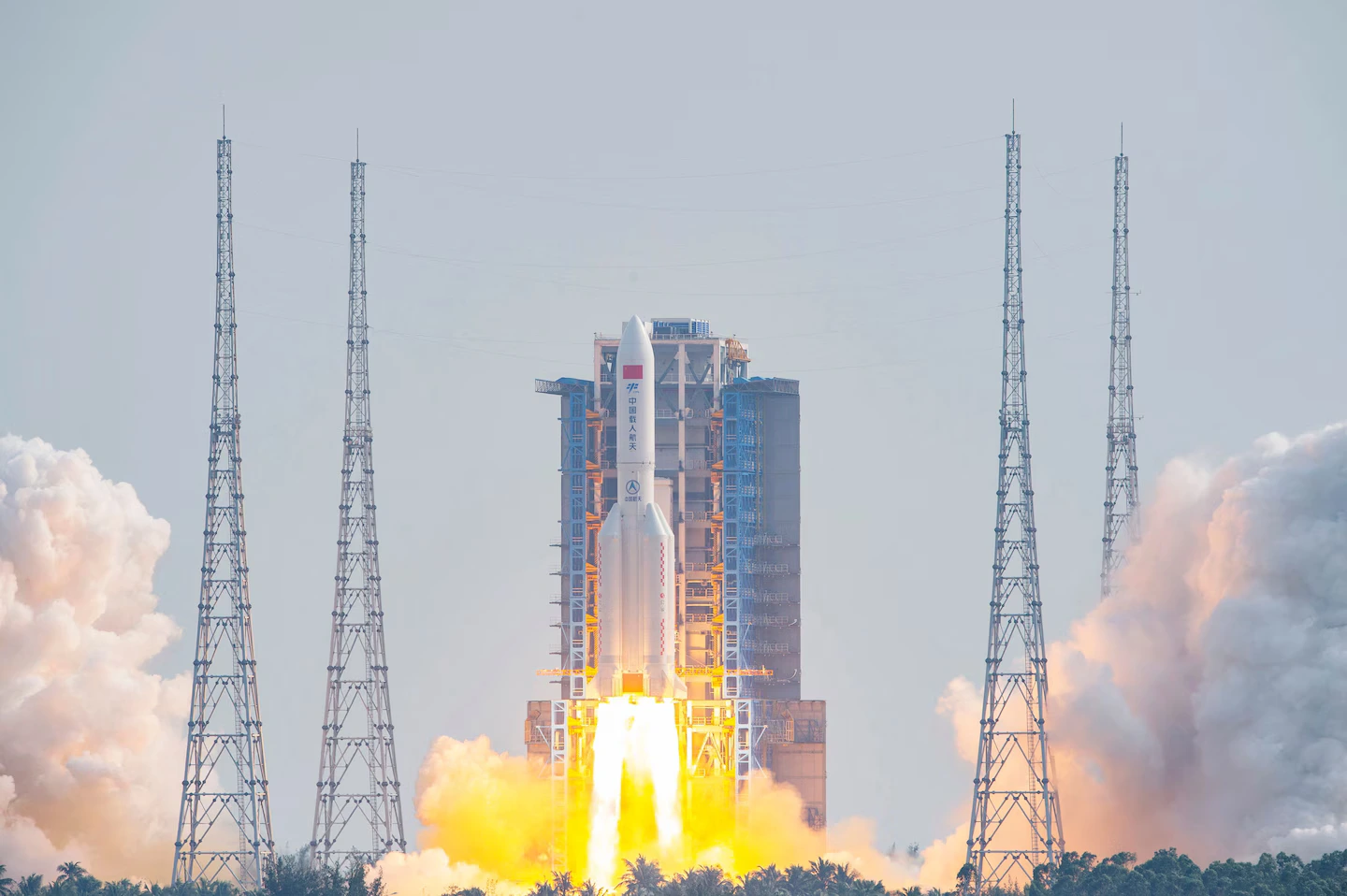
China’s space program has entered a new phase of acceleration, evolving from a primarily state-driven initiative into a rapidly expanding ecosystem that combines government strategy, commercial investment, and geopolitical ambition. Over the past decade, Beijing has expanded its launch capacity, planetary missions, and satellite infrastructure at a pace that is reshaping global competition in orbit. At YourNewsClub, this rapid progress is increasingly interpreted as a signal that the space industry is entering a new strategic cycle, where industrial capacity and commercial ecosystems matter as much as technological breakthroughs.
One of the clearest indicators of this shift is launch activity. China carried out more than 90 orbital launches in 2025, setting a national record and demonstrating the growing maturity of its launch infrastructure. In the modern space economy, launch cadence reflects more than prestige. Countries capable of frequent launches can deploy satellite constellations faster, refresh orbital infrastructure more efficiently, and scale commercial space services more effectively.
Jessica Larn, a macro-level analyst of technology infrastructure and AI policy, argues that China’s expansion reflects a long-term strategic vision rather than a series of isolated achievements. In her view, Beijing increasingly treats space technology as a foundational layer of national power alongside artificial intelligence and advanced manufacturing. The objective extends beyond exploration to securing control over communications, navigation, and data infrastructure in orbit.
China’s recent milestones reinforce this trajectory. The country completed the Tiangong space station in low Earth orbit and successfully delivered samples from the far side of the Moon, while earlier missions demonstrated its ability to land and operate a rover on Mars. YourNewsClub notes that these missions strengthen the full technological chain required for long-term exploration, from launch systems to deep-space communications and precision landing technologies.
Investment patterns further highlight China’s ambitions. Over the past decade, the country has directed more than $100 billion toward civil, military, and commercial space programs. Although the United States still spends significantly more overall, China’s investments continue to rise and are increasingly focused on launch systems, satellite networks, and orbital infrastructure.
A turning point came in 2014 when regulatory reforms opened parts of the Chinese space sector to private capital. Since then, dozens of commercial aerospace companies have emerged, some developing reusable rockets comparable to those pioneered by SpaceX. For YourNewsClub, this hybrid ecosystem – where state coordination and private innovation operate in parallel – helps explain the rapid scaling of China’s space industry.
Satellite systems represent another key pillar of this strategy. The completion of the BeiDou navigation network established a global competitor to the U.S. GPS system, while large satellite constellations are being planned to deliver worldwide broadband connectivity.
Owen Radner, who analyzes digital infrastructure as energy-and-information transport networks, explains that satellite constellations increasingly function as geopolitical infrastructure. Countries that rely on navigation signals, communications satellites, and associated ground stations often become embedded within the technological standards of the provider nation.
China has integrated these capabilities into its Belt and Road Initiative by providing satellite launches, ground stations, and navigation services to partner countries. This strategy extends influence through infrastructure while encouraging adoption of Chinese technological standards.
The competition between China and the United States is therefore shifting beyond symbolic achievements such as lunar landings. Industrial scale, commercial ecosystems, and satellite infrastructure are emerging as the decisive factors of leadership in the space economy. In the view of Your News Club, the country that builds the most powerful and scalable commercial space industry will ultimately shape the next era of space development.
While the United States still holds significant advantages – particularly through its private-sector ecosystem and companies like SpaceX – maintaining that leadership will likely require continued investment in launch infrastructure, streamlined licensing, and expanded spectrum resources for satellite services.