
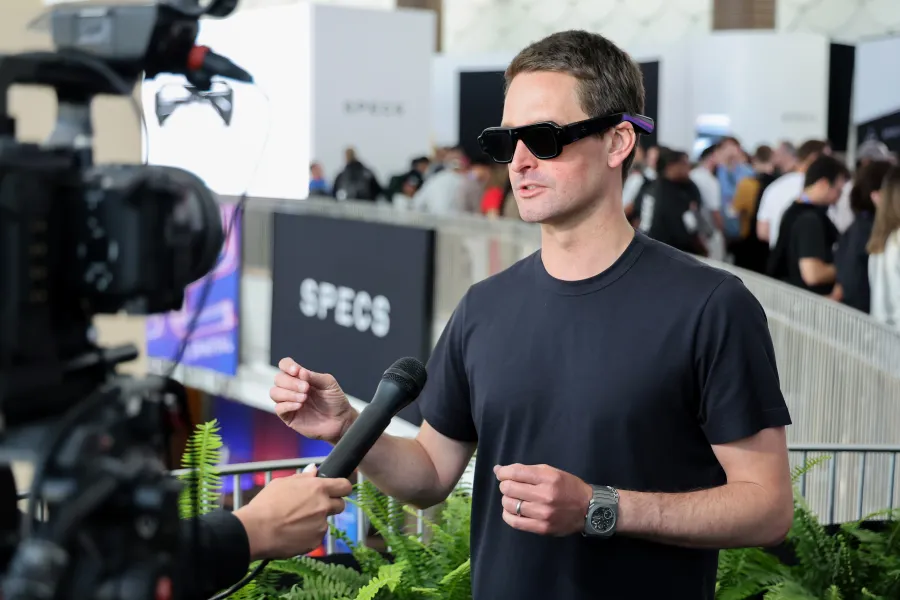
Snap stock dropped 9.72% on Tuesday, closing at $5.16, after CEO Evan Spiegel unveiled Specs – the company’s first consumer-targeted augmented reality glasses – at the Augmented World Expo in Long Beach, California. The glasses retail at $2,195. They require a $200 refundable deposit to pre-order and will ship to the US, UK, and France this autumn. By Wednesday morning the stock had sunk to $4.83 before recovering slightly. The drop arrived on top of a 30%-plus year-to-date decline and a longer-term collapse: Snap has shed roughly 79% since its 2017 IPO. YourNewsClub names the gap between Spiegel’s stated ambition and the market’s immediate response as the defining tension of the Specs launch – not whether the hardware is technically capable, but whether a company with approximately $5 billion in market capitalisation can sustain a decade-long hardware platform bet against a stock that is testing multi-year lows.
The product itself is technically credible. Specs weigh 132 to 136 grams, run entirely without a tethered phone, carry dual Qualcomm Snapdragon processors with separate cores for the operating system and computer vision tasks, offer a 51-degree field of view with 7-millisecond latency, and support a full suite of AI-driven applications including navigation, real-time translation, and environmental queries. Snap set Specs up as a separate subsidiary in January, providing structural separation that leaves the door open for a minority external investor. Spiegel framed the $2,195 price by comparison to premium computers, telling CNBC: “The most important way to think of Specs is as a computer, and so they’re comparably priced to other high-end computers.” He added that memory-chip prices have elevated costs. Irenic Capital Management, an activist investor, has publicly called for Snap to spin off or close the Specs project after the company spent more than $3.5 billion on it.
The competitive position amplifies the market’s scepticism. Meta’s Ray-Ban smart glasses retail below $700 and already command roughly 76% of global smart glasses shipments. Apple Vision Pro, despite its $3,499 price, carries Apple’s ecosystem and developer base. Snap Specs, at $2,195, sits between a product with dominant market share and one with a dominant platform, while possessing neither. Spiegel’s response to Irenic – that Snap’s job is to focus on long-term value rather than short-term pressure – is the right framing in principle and the hardest to execute in practice when the stock is at $5.16 and the user demographic most familiar with Snapchat typically does not carry $2,195 in discretionary spending.
Maya Renn, whose work focuses on the ethics of computation and access to power through technology, frames the structural question the launch raises: “A $2,195 AR device aimed at developers and early adopters is not a mass-market product by design. But Snap has a mass-market user base. The question is whether those two things are in tension – whether the company can build a developer ecosystem around a premium hardware product while running a consumer advertising business that depends on a very different type of user.” Jessica Larn, who studies macro-level technology policy and infrastructure impact, draws the investment logic: “Snap has spent more than $3.5 billion on AR hardware and produced a product that a credible activist investor thinks should be spun off or closed. The market’s response to Tuesday’s announcement is a fairly direct verdict on whether investors believe the next $3.5 billion will produce a different outcome.” YourNewsClub calls the activist-management standoff over Specs the commercial story that will run alongside the hardware launch all the way into autumn, when pre-order shipping begins.
The cleanest question right now: can Snap get 50,000 pre-orders at $2,195 before the end of Q3 2026? YourNewsClub seats the pre-order volume figure as the single most commercially relevant near-term data point – and expects it to surface in Snap’s Q3 2026 earnings call.
That number – which Your News Club marks as the minimum threshold for a credible developer-ecosystem signal – would not justify the $3.5 billion spent, but it would demonstrate that the premium consumer AR market exists at a scale that makes continued investment defensible. If it does not, the activist conversation gets considerably louder.