
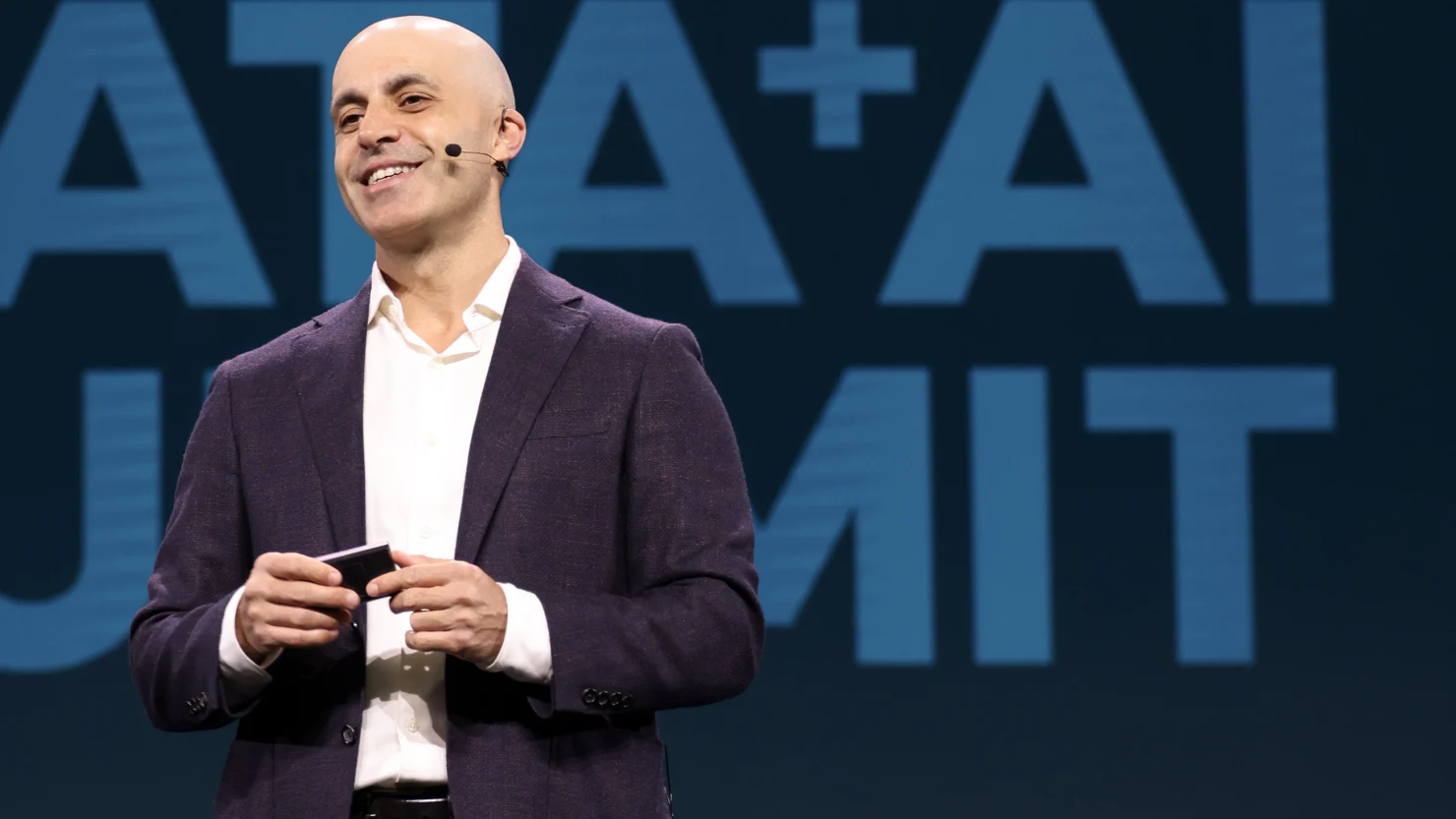
Databricks CEO Ali Ghodsi delivered the news at the company’s Data and AI Summit in San Francisco on Tuesday: annualised revenue has crossed $6.9 billion, up more than 80% year-on-year. That figure jumped from $5.4 billion in the fiscal fourth quarter – a $1.5 billion annualised revenue increase in a single quarter. The company sits at a $134 billion private valuation, making it worth more than Snowflake, which went public in 2020 at what seemed at the time like a stretched valuation and now carries a market cap of roughly $83 billion on $5.6 billion in annualised revenue. YourNewsClub reads the Databricks-versus-Snowflake comparison as the most commercially legible frame for understanding the $134 billion number: a private company that has grown faster, at higher revenue, without giving up equity at public-market prices has materially outrun the public-market benchmark in its category.
The mechanism behind the 80% acceleration is Ghodsi’s own diagnosis. “It’s the consumption-based business model, agentic AI coming,” he told CNBC. “The agents are generating way more queries. We have all these agents, the agents and agent platform we have also generates revenue, so it just increases the consumption of everything all around.” That sentence contains a useful structural admission: agentic AI is driving Databricks revenue higher, but it is also creating cost pressure, because agents consume compute resources at a rate that compresses gross margins. Databricks reported 80% gross margins in 2024, down from 85% the prior year. The margin compression is the cost of being the infrastructure layer that agentic AI runs on. Databricks is not choosing between growth and margin – it is being forced to sequence between them.
The product architecture explains why agentic AI lands differently on Databricks than on model providers. Databricks’ Genie allows any business user to ask questions directly against corporate data stored in its Lakehouse platform. Agent Bricks orchestrates multi-agent systems on top of that same data. Lakebase, a serverless Postgres database purpose-built for AI agents, is the newest layer – launched in December 2025, it already has thousands of customers and grows revenue at twice the pace of the company’s Data Warehousing product. Net dollar retention stays above 140%, meaning existing customers consistently expand their usage. More than 800 customers spend over $1 million annually; 70 customers exceed $10 million. YourNewsClub finds the 70-customer-over-$10-million figure more commercially revealing than the headline ARR, because it indicates a cohort of enterprises running Databricks at genuine production scale rather than evaluation scale.
Owen Radner, who models digital infrastructure as energy-information transport systems, draws the product-versus-infrastructure distinction: “Databricks is not an AI product company – it is the data infrastructure layer that AI products run on. The difference matters when you are reading a 80% growth figure. Data infrastructure that AI agents depend on grows with agent deployments, not with model releases. That makes Databricks revenue sticky in a way that model-access revenue is not.” Freddy Camacho, who studies the political economy of computation and capital as dominance assets, frames the IPO question: “Databricks sitting out the 2026 IPO cycle while SpaceX, OpenAI, and Anthropic list is a capital management decision. The company achieves $6.9 billion in annualised revenue without giving up equity at a price it has not chosen. If the public market proves it can sustain those valuations, Databricks can list in 2027 at a better multiple than it would achieve today.”
Three things to watch before any IPO decision: whether gross margin stabilises as agentic workloads scale, whether Lakebase’s growth rate holds into fiscal 2027, and whether the 140%+ net retention rate holds under consumption-based pricing when large customers face their own AI capex pressure. YourNewsClub rates the gross margin question as the most consequential metric for whether the $134 billion private valuation is defensible in public market terms.
SpaceX topped a $2 trillion market cap on its first day of trading last week, and OpenAI and Anthropic have filed confidentially. Databricks sitting out this cycle while its peers list says something about management’s view of both its valuation ceiling and the current window. Your News Club marks the IPO timing decision as the most commercially underappreciated signal in Tuesday’s revenue disclosure.