
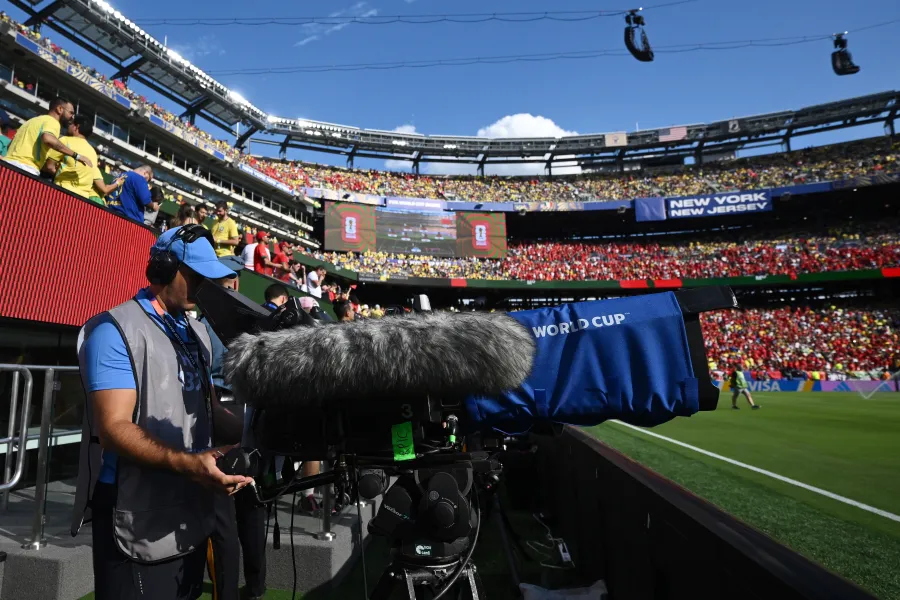
A security researcher known as BobDaHacker published a blog post on Tuesday describing full control over the broadcast infrastructure of every FIFA World Cup 2026 match – achieved by registering as a licensed player agent on FIFA’s official agent registration platform. Registration added her account to FIFA’s Microsoft Entra instance. A flaw in FIFA’s back-end API, which did not verify whether a user held the correct authorisation for internal platforms, then opened access to the streaming management panel that allows broadcasters to control every camera feed in the tournament. The Commentator Information System – which provides editorial notes, squad data, player statistics, and talking points used by commentators on air – was also accessible. “A single attacker could hijack every camera simultaneously,” she wrote. “An attacker could have rickrolled the entire FIFA World Cup. Or played Subway Surfers gameplay. Live. On every TV network worldwide. During an active match.” YourNewsClub spots the RTMP stream key exposure as the most critical element of the vulnerability – those keys sit between stadium cameras and broadcast partners worldwide, and possession of them enables live video replacement, not just passive viewing.
The technical chain BobDaHacker documented runs directly: camera feeds flow to RTMP ingest points, which feed MediaKind’s broadcast distribution infrastructure, which feeds broadcast partners, which feed every television showing a World Cup match. Each fixture carries a single stream key shared across five camera angles, including the PGM feed – the main broadcast signal. The streaming management panel gave BobDaHacker start, stop, and schedule controls for every match and every camera angle. She documented the access, closed the session immediately, and reported the flaw to FIFA on Tuesday night Japan time. FIFA patched the vulnerability within a few hours. FIFA has not publicly acknowledged the disclosure and did not respond to requests for comment.
The entry point is what makes this incident particularly useful as a security case study. BobDaHacker did not exploit a technical vulnerability in the traditional sense. She completed a legitimate onboarding process, obtained a legitimate credential, and then discovered that the credential granted access to systems it should not have touched. The flaw was not an injection attack or an authentication bypass – it was a missing authorisation check in an API that assumed any account in the Entra instance had appropriate permissions for every internal system. YourNewsClub calls that authorisation gap – the assumption that authentication implies authorisation – the most instructive element for enterprise security teams reviewing their own API architectures.
Freddy Camacho, who studies the political economy of computation and capital as dominance assets, frames the infrastructure exposure: “A vulnerability that gives a single account holder full control of every camera feed is not just a security failure – it is a demonstration that the entire broadcast value chain rested on an access control misconfiguration. Capital and control are supposed to be aligned. Here they were not.” Owen Radner, who models digital infrastructure as energy-information transport systems, draws the architectural lesson: “What BobDaHacker found is that FIFA’s broadcast infrastructure and its agent registration platform shared an identity layer without separating authorisation scopes. In infrastructure terms, this is like discovering that a staff cafeteria keycard also opens the server room. The problem is not the cafeteria or the server room – it is the authorisation model that connected them.”
Your News Club monitors whether FIFA publicly discloses the nature of the flaw and the remediation steps, or whether the organisation’s pattern of non-acknowledgement continues.
CISA, which BobDaHacker’s blog post mentions she contacted during her research, has not issued any public statement on the vulnerability as of publication. The 2026 World Cup runs through July 19 across 16 host cities in the US, Canada, and Mexico. The vulnerability has been patched. But the absence of a public postmortem from an organisation whose broadcast infrastructure was fully exposed during the world’s most-watched sporting event raises questions about whether the remediation was thorough. YourNewsClub ranks the FIFA response record on this incident as the most important transparency test facing the organisation’s digital governance.