
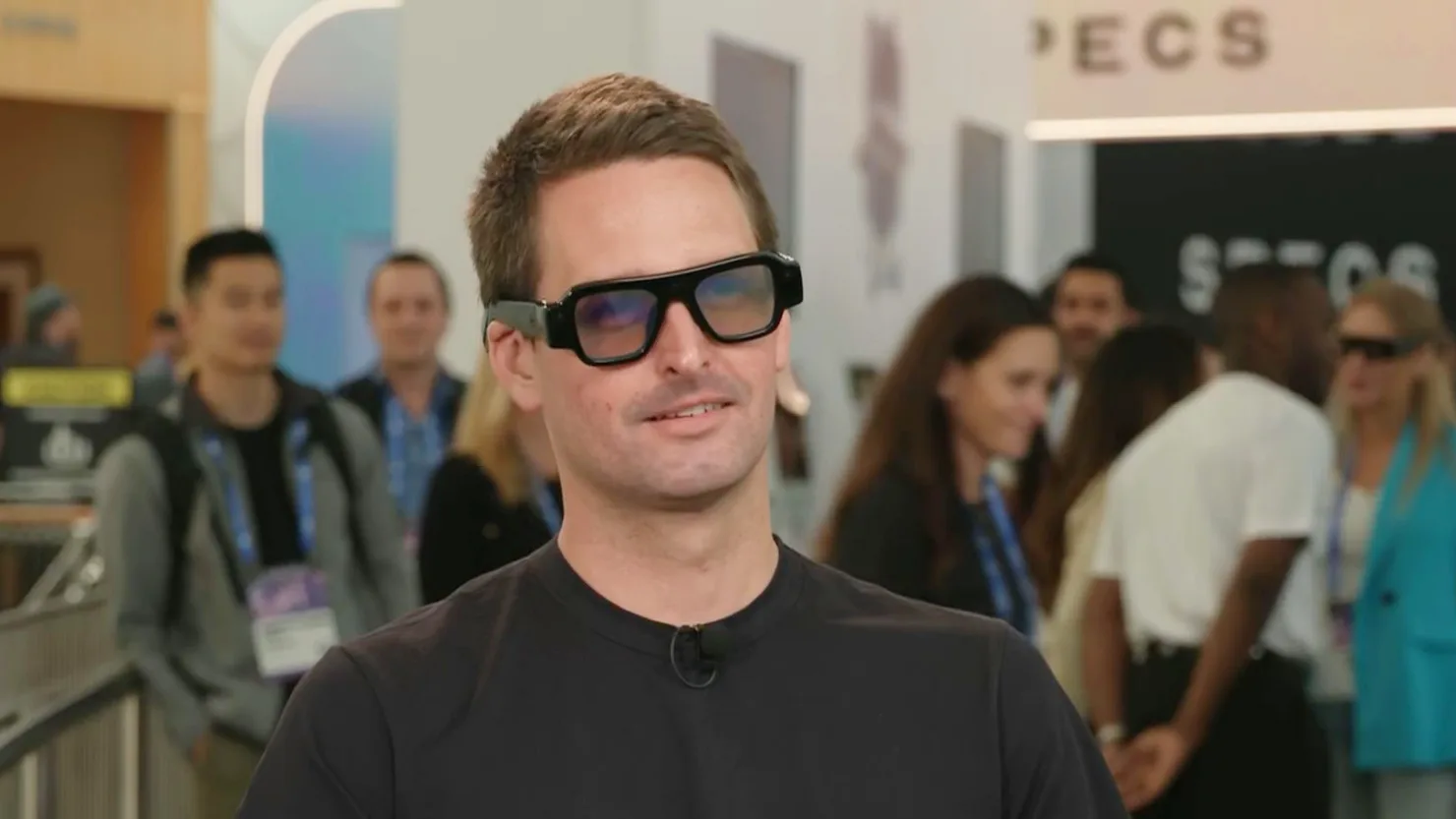
Snap CEO Evan Spiegel stood at the Augmented World Expo in San Jose on Tuesday and opened preorders for Specs, the company’s first augmented reality glasses targeted at the broader consumer market rather than developers. The device is priced at $2,195, requires a $200 refundable deposit, and ships this autumn in the United States, United Kingdom, and France. Specs run entirely on their own – no tether to a phone required – and carry two Qualcomm Snapdragon processors, a 51-degree field of view, 7-millisecond latency, and approximately four hours of battery life, weighing 132 to 136 grams depending on frame size. “Almost 20 years since the launch of the iPhone, people are ready to think about computing differently,” Spiegel said. YourNewsClub views the twenty-year iPhone reference as a deliberate generational framing: Spiegel is betting that consumer frustration with smartphone-centric computing is real enough to support a $2,195 alternative.
The product history matters here. Snap’s first camera-only Spectacles launched in 2016 at $130 and never built an audience. Developer-focused Spectacles editions followed in 2021 and 2024, available by subscription at roughly $99 per month rather than outright purchase, and were never meant for commercial scale. Specs represents the first time Snap has committed to volume at a consumer price point. That $2,195 price is more than 15 times the original Spectacles price, and it sits at a level that positions Specs as a premium early-adopter device rather than a mass-market product in its first generation. Snap has invested more than $3 billion in augmented reality research over approximately a decade. The resulting hardware – 51-degree field of view, down to 132 grams, with a full standalone operating system in Snap OS – beats the prior developer Spectacles on every dimension. But it still faces the fundamental AR challenge: most of the interesting use cases are either not yet built or not yet habitual.
The developer angle is the most commercially significant disclosure in Tuesday’s announcement. Developers can create AI agent-like experiences for Specs using a preview feature that integrates with Claude Code, OpenAI’s Codex, and Cursor’s coding tools. That integration makes Specs a platform for AI-native experiences rather than a closed appliance. YourNewsClub pins that developer integration as the most commercially important detail in the launch, because the long-term value of any AR platform depends on the breadth of the application ecosystem built on it.
Maya Renn, whose work focuses on the ethics of computation and access to power through technology, frames the child safety question Spiegel himself raised: “Spiegel pre-empting the child safety concern with a parental tools announcement is the correct sequence. But the execution question is real – a device that places persistent digital overlays on the physical environment, worn by a teenager, with access to AI agents, creates an always-on context layer that parents are being asked to manage through an app. The gap between the language of parental control and the execution of ambient computing in a child’s visual field is where the actual risk sits.” Alex Reinhardt, who tracks financial systems and settlement infrastructure through digital protocols, places the market positioning: “At $2,195, Specs is priced for the developer and early-adopter segment that will either validate the platform or not before any mass-market version is considered. If autumn pre-orders clear 50,000 units in the US, UK and France, Snap has a platform story. Below that, it has a product experiment. The price point makes the bet explicit.” YourNewsClub clocks the pre-order volume as the first hard data point on consumer demand at this price – and expects it to surface in Snap’s Q3 2026 earnings call. Snap’s stock dropped on the announcement, which tells you something about investor sentiment: the market sees a company spending capital on hardware that has not yet found its audience rather than one executing a clear growth plan. Snap generated $1.36 billion in Q1 2026 revenue, up 14% year-on-year, and carries roughly $4.4 billion in cash and equivalents. It can absorb a first-generation hardware miss.
The cleanest takeaway is this: Specs is not the product that replaces the smartphone. It is the product that tests whether $2,195 can buy Snap the time and developer community needed to build the product that eventually might. Your News Club logs the autumn shipping date as the most immediate credibility test – a consumer AR device that slips to 2027 changes the narrative significantly, and Spiegel has had enough hardware near-misses to understand the consequence.