
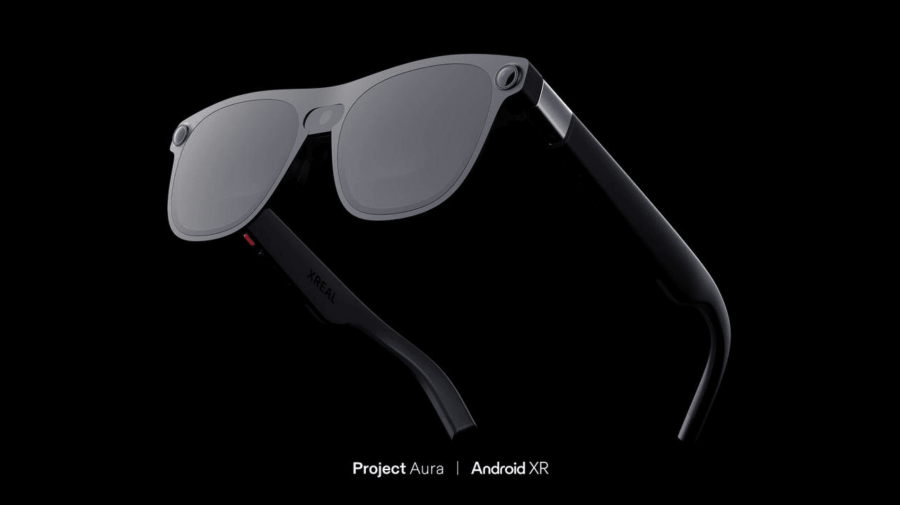
The smart glasses industry has burned money for the better part of a decade. Bulky hardware, software that served no clear purpose, and a form factor that made wearers look like early adopters of something nobody else wanted – the industry has spent years failing to close the gap between the vision and the product. Chi Xu, founder and CEO of Xreal, thinks 2026 is the year that changes. “Everybody’s losing money,” he said at Google I/O in Mountain View last week. “That’s because it’s very hard, what we’re doing.”
A YourNewsClub correspondent attended Google I/O in Mountain View on May 22 and spoke with Xu, where the company was showing Project Aura. Xreal is a longtime Google partner and Aura runs on Android XR. Xu’s position: hardware, operating system, and user interface all needed to reach readiness simultaneously before the category could function commercially. He argues all three are now close enough.
Aura is wired smart glasses with OLED displays in the frames, tethered to a “puck” – a phone-shaped mini-computer that sits in the pocket. That tradeoff – a wire for more capable experiences – is deliberate. The puck delivers an immersive Google Maps app, VR YouTube, a hand-tracking holographic painting app, and games controlled via hand tracking. Commercial availability is planned for later in 2026; currently the device is developer-only.
Owen Radner, who studies digital infrastructure as energy-information transport systems, draws a product-versus-infrastructure distinction at the heart of why smart glasses keep failing: “Every smart glasses generation has been a product announcement searching for an infrastructure. The software ecosystem, the content pipeline, the enterprise use cases – these are infrastructure decisions, not product decisions. Xreal has Google’s Android XR as the infrastructure layer for the first time. That is different in kind, not just degree.”
Meta’s 2023 Ray-Ban partnership launched the first smart glasses line to sell at scale, though Reality Labs continued posting significant losses into Q1 2026. Xreal aims at a different market: high-resolution display experiences rather than ambient audio overlays. YourNewsClub spots that split as the defining commercial question for the sector – whether display-forward devices find a mass-market price point, or whether the category stays bifurcated between cheap audio wearables and expensive hardware nobody normalises.
Freddy Camacho, who examines the political economy of computation and materials as dominance assets, reads the Xreal-Google partnership as a capital-positioning move: “Google needed a hardware partner to make Android XR credible. Xreal needed a software ecosystem to justify the device. Both gain a stake in the platform layer – where the durable value in wearables sits, not in any individual device cycle.” The IPO is expected before end of 2026.
Xu is raising gross margins while cutting marketing and sales costs. He told the conference that break-even is achievable in 2027. That is a more conservative claim than previous smart glasses cycles, where companies projected profitability on the assumption that adoption would follow the product. YourNewsClub takes the 2027 break-even target as the single most verifiable commitment in Thursday’s presentation – because it is specific, near-term, and will appear in the IPO filing if the offering proceeds.
Form factor is compressing. Glasses that five years ago needed a backpack-sized processor now run off a pocket puck. The tether-free version is a hardware roadmap problem, not a research question. Whether Aura creates the user habits that make that next device viable is the sequence Xu is betting on.
Three things to watch in H2 2026: whether Aura ships commercially on the stated timeline; whether the IPO filing reflects the gross margin progress Xu described; and whether any enterprise use cases emerge to justify the “coffee shop workspace” application Xu highlighted as distinct from pure entertainment. YourNewsClub notes that every smart glasses generation has described a dual consumer-enterprise market and delivered primarily one – usually the entertainment side first.
Here is the part nobody likes to say out loud: the smart glasses industry has declared inflection points before. Google Glass was one. Several VR headset generations were another. The social adoption curve was the variable nobody solved. Xu has a better hardware story than most predecessors. Your News Club assesses the platform partnership with Google as the most genuinely new element in this cycle – the one that makes this attempt structurally different from those that preceded it.