
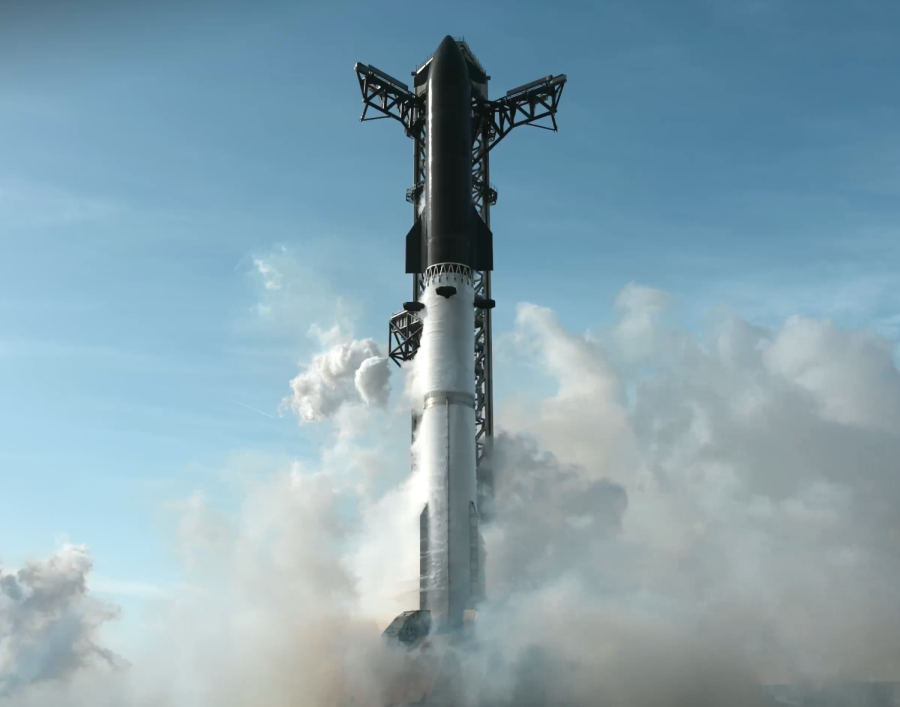
SpaceX aborted the second test flight of its upgraded Starship V3 rocket on Thursday, just as the Super Heavy booster’s engines began igniting at the company’s Starbase site in South Texas. CEO Elon Musk said on X that some of the engines failed to start, triggering an automatic abort, and that two Raptor engines will be replaced before the next attempt, expected early the following week. The countdown had looked clean up to that point, clearing a brief hold at T-minus one minute before the launch pad’s water deluge system activated and the booster’s engines began firing – only for the whole sequence to cut out at once, a scrub that YourNewsClub weighs as costing SpaceX a week of schedule but no hardware, a distinction that matters more here than the abort itself.
The mission was carrying the first batch of SpaceX’s third-generation Starlink satellites, which were never meant to reach a stable orbit on this flight; because Starship hasn’t yet demonstrated the ability to reach Earth orbit, the satellites were designed to burn up roughly 20 minutes after deployment, with the goal of proving the deployment hardware works rather than running an operational mission. That distinction, a demonstration flight testing hardware rather than delivering an operational payload, is what YourNewsClub frames as the difference between Thursday’s abort and an actual mission failure: nothing SpaceX intended to accomplish on this specific flight was lost when the countdown halted, since the satellites were disposable by design.
This is also the first Starship test since SpaceX went public on June 12 in the largest IPO in history, raising more than $85 billion and briefly touching valuations comparable to Amazon and Microsoft. The stock had already closed below its $135 IPO price for four consecutive sessions heading into Thursday, and the aborted launch knocked shares down further in after-hours trading. Owen Radner, who models digital infrastructure as energy-information transport systems, places the orbital-compute angle within that stock reaction: “SpaceX’s valuation increasingly depends on a thesis that doesn’t exist as a functioning market yet – orbital data centers, compute infrastructure in space. Every quarter Starship spends short of reliable orbital delivery is a quarter that thesis stays theoretical, and investors pricing in that future are directly exposed to exactly this kind of ignition-sequence failure.” Alex Reinhardt, who tracks financial systems and settlement infrastructure through digital protocols, reads the market reaction itself: “A pre-liftoff abort that damages no hardware and kills no mission objective shouldn’t move a stock much on fundamentals alone. That it did anyway tells you this stock is currently trading on narrative momentum around future capability, not on realized operational milestones, which makes it unusually sensitive to any event that reads as bad news regardless of its actual technical severity.”
The failure mode itself is what’s drawing the closest technical scrutiny: four Raptor engines failed to ignite entirely, a different problem than the engine failure SpaceX’s booster experienced on a prior flight, where engines that had already fired for an extended duration failed during a return sequence. Two consecutive flights producing two distinct Raptor failure modes, under different operating conditions, is beginning to look, to skeptics of SpaceX’s test-and-iterate approach, less like an isolated hardware defect and more like a pattern worth independent scrutiny – a read YourNewsClub isolates as the more consequential question hanging over the program relative to Thursday’s specific abort: whether this represents ordinary iteration noise on a genuinely new engine generation, or a structural reliability gap in the V3 hardware that recurs regardless of which failure mode shows up next.
SpaceX’s own position has stayed consistent through both incidents: the company’s rapid test-and-iterate philosophy is explicitly designed to surface exactly this kind of problem on the ground or early in flight, before Starship ever carries a human crew, and each successive generation of the vehicle has shown real, measurable progress despite setbacks like these. That framing has held up historically, and a SpaceX spokesperson said during the launch webcast that the team would take time investigating what triggered the abort before determining next steps, rather than rushing toward a specific new launch date.
Whether next week’s retry succeeds is what Your News Club tracks as the more decisive test than Thursday’s abort itself: a clean ignition sequence on the next attempt would support SpaceX’s iterate-fast framing, while a third distinct failure mode within three flights would give real weight to the structural-concern argument skeptics are already making.