
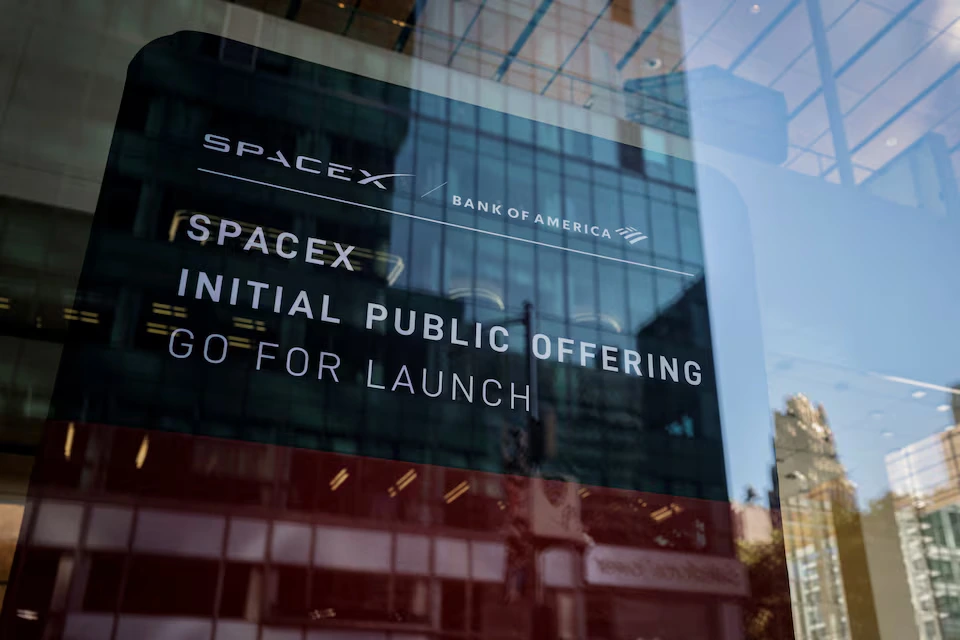
SpaceX told its IPO bankers on June 4 that the company is holding its price at $135 per share – the price it disclosed in its amended filing on June 3 – and will not move it based on roadshow feedback, according to sources familiar with the situation. The message reached banks at the start of the company’s investor roadshow, the process during which issuers typically gather institutional feedback to set a final price. Elon Musk is treating that process differently. In a standard IPO, the roadshow functions as a demand-discovery mechanism: the issuer gathers orders, the book-runners aggregate feedback, and the final price reflects the intersection of supply and demand. SpaceX appears to be using the roadshow as a presentation exercise rather than a pricing exercise. YourNewsClub identifies this as the most operationally significant signal about SpaceX’s IPO approach – a company confident enough in demand to decline the standard price discovery mechanism is either right about the demand or is managing a complex set of stakeholder expectations that public investors will only partially see.
At $135 per share, the offering targets a valuation of approximately $1.75 trillion, which would make it the largest initial public offering in history by a significant margin. The previous record stands at $26 billion, set by Saudi Aramco in 2019. SpaceX plans to raise $75 billion in the offering. Goldman Sachs and Morgan Stanley serve as joint lead underwriters across 23 participating banks in total. SpaceX is also reportedly negotiating fees below the standard rate, with the total banker take on a $75 billion raise expected to approach $500 million even at reduced margins. SpaceX began its roadshow on June 5 and targets a June 12 listing. No lockup period is planned for employees after the IPO, an arrangement that further departs from standard IPO conventions.
Standard IPO lockup periods – typically 90 to 180 days – exist to prevent insider selling immediately after listing. SpaceX is removing that protection. Employees can sell on day one. Freddy Camacho, who studies the political economy of computation and capital allocation, reads the commercial logic: “Removing the lockup period is not a concession to employees – it is a statement about demand. Musk believes public market buyers will absorb any near-term selling pressure. The no-lockup structure inverts the usual protective logic: instead of restricting supply, it relies on demand being durable enough not to need restriction.”
Stack this against what bitcoin, a different but relevant risk asset, did in the same week: declined 13% and registered its thirteenth consecutive day of ETF net outflows. Capital is rotating toward clarity and momentum. SpaceX offers both: a demonstrated commercial business in Starlink, a Starship launch cadence that is accelerating, and a ticker that will become the largest-weighted new addition to US equity indices since the modern passive investment era began. The cleanest takeaway is this – the question is not whether SpaceX’s IPO will be large. It will be. The question is whether $135 per share represents the right equilibrium price for a company that, as of its preliminary S-1, had not yet filed audited financial statements covering its most recent fiscal year. YourNewsClub will track the final price confirmation, the first day of trading on June 12, and the first post-IPO earnings release as the three sequential tests of whether Musk’s pricing confidence was warranted.
The divergence between SpaceX IPO demand and bitcoin’s 13% weekly drop says something about the current moment: capital is not broadly de-risking, it is selectively rotating toward assets with clear operational stories. Starlink’s commercial satellite revenue, the Starship launch cadence, and the national security contract base give SpaceX exactly that clarity. Your News Club reads that rotation as the macro context in which SpaceX’s no-negotiation pricing posture makes commercial sense.
YourNewsClub considers the first post-lockup-absence trading week – not just the first day – the real test of structural demand depth at $135 per share. Goldman Sachs and Morgan Stanley, as lead underwriters, will manage that early order flow. But the volume of eligible sellers at a company with tens of thousands of employees and a decade of equity compensation is significant at any price, and the absence of a standard lockup removes the buffer that normally prevents that supply from arriving all at once.