
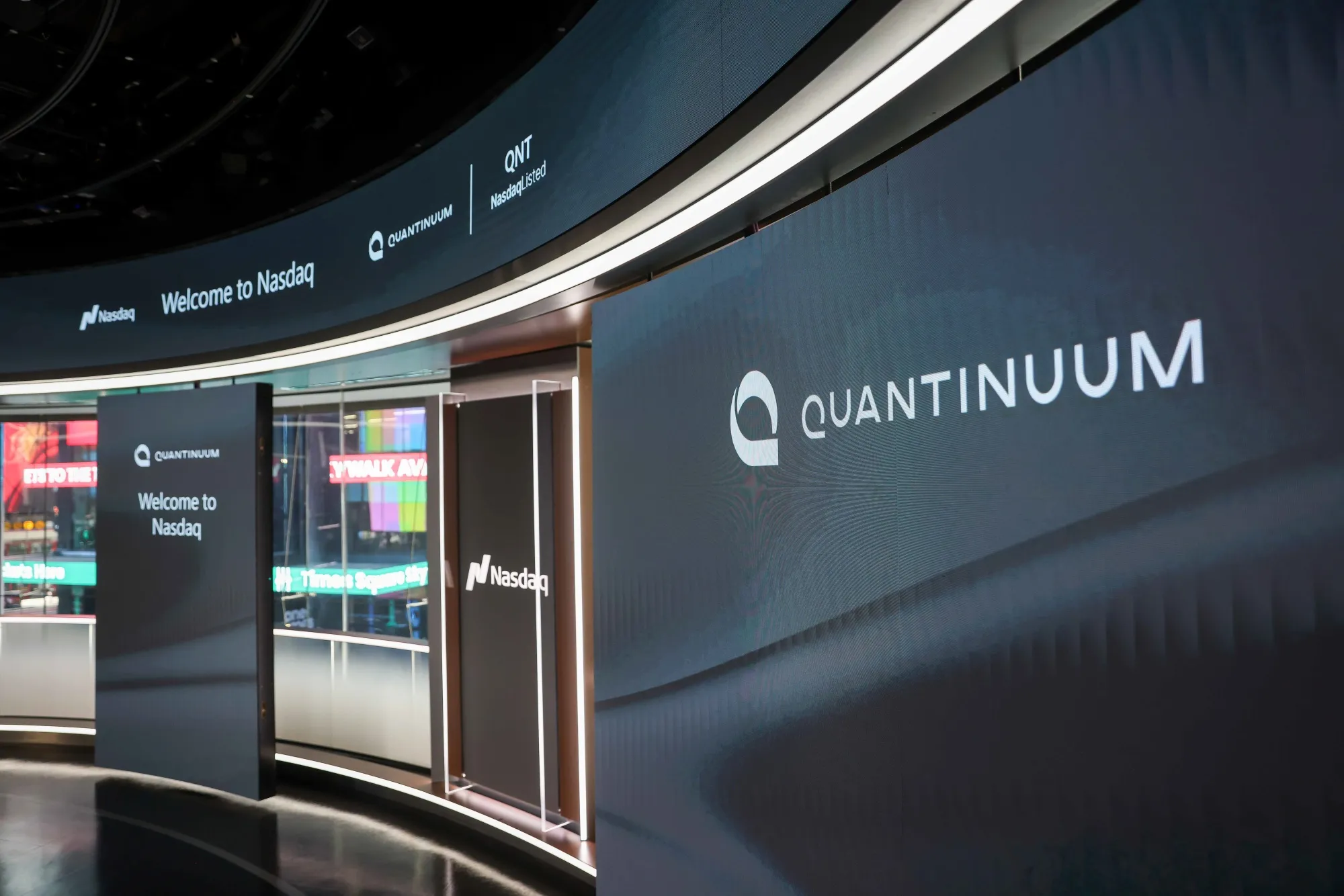
Quantinuum priced its initial public offering at $60 per share on Wednesday evening, selling 28 million Class A shares to raise $1.68 billion – one of the largest quantum computing IPOs in history. The stock opened at $68 on Nasdaq on Thursday under the ticker QNT, a 13% first-day premium over the IPO price. The offering arrived upsized: the company had initially planned 21.05 million shares at a $45 to $50 range, revised upward to 26.5 million shares at a $53 to $55 range, and ultimately priced above even that revised ceiling. YourNewsClub views the successive upsizing as the more instructive signal than the opening-day price jump – institutional investors were bidding up the deal before a single share traded, which is a different kind of demand than secondary-market enthusiasm on listing day.
The company’s origins explain some of the institutional confidence. Quantinuum was formed in 2021 through the merger of Honeywell’s quantum computing division and Cambridge Quantum, a UK-based quantum software developer. Honeywell remains the dominant shareholder and will retain majority voting control following the offering. That industrial backing gives Quantinuum a balance sheet sponsor and a built-in enterprise customer network that pure-play quantum startups lack. J.P. Morgan and Morgan Stanley led the underwriting; Jefferies, Evercore ISI, BofA Securities, UBS, Cantor, Mizuho, Needham, Societe Generale, and TD Cowen served as joint book-running managers. The offering closed June 5.
But the financial picture requires direct acknowledgement. Quantinuum reported a net loss of $136.5 million in Q1 2026, compared to a $30.5 million loss in Q1 2025 – a nearly fourfold expansion in losses year-on-year. Revenue fell 73% to $5.24 million in Q1 2026 from $19.1 million a year earlier. Bookings totalled $1.3 million in the first three months of 2026, down from $1.9 million in Q1 2025. That is a company burning capital faster while generating less revenue and fewer customer commitments than a year prior. YourNewsClub places those Q1 2026 bookings as the most uncomfortable number in the prospectus – a $1.3 million booking figure cannot sustain the trajectory a $14.3 billion valuation implies.
The valuation rests almost entirely on future potential rather than current commercial performance. Quantum computing stocks have risen an average of approximately 19.5% in 2026, creating a backdrop of sector sentiment that helped Quantinuum price above range. Separately, on June 2 in Tokyo, Quantinuum signed a non-binding memorandum of understanding with Mitsubishi Electric to explore quantum and hybrid quantum-classical applications for advanced industrial engineering – a credible industrial name that adds commercial pipeline without providing near-term revenue certainty.
Three things will determine whether QNT holds above its IPO price through the rest of 2026: whether bookings accelerate beyond the Q1 2026 trough, whether the Mitsubishi Electric MOU converts to a commercial agreement with disclosed terms, and whether any major enterprise customer announces a production-grade quantum deployment on Quantinuum’s hardware. The quantum computing beat at YourNewsClub will track all three, with the bookings trajectory considered the most proximate near-term test of whether institutional demand on listing day reflected commercial conviction or sector momentum chasing.
YourNewsClub catalogues the Mitsubishi Electric MOU – signed June 2 in Tokyo – as positive enterprise engagement evidence rather than near-term revenue signal. Non-binding memoranda of understanding appear frequently in quantum computing communications precisely because they demonstrate intent without requiring revenue commitment. Mitsubishi Electric designs power systems, factory automation equipment, and satellite systems: plausible eventual quantum use cases, but with no disclosed conversion timeline.
Honeywell’s continued majority control is the final structural factor worth naming. Public shareholders in QNT buy into a controlled company whose strategic direction will remain heavily shaped by a single industrial conglomerate. That governance reduces management instability risk but limits outside shareholder influence on strategic pivots. Your News Club expects Honeywell’s next disclosure of its QNT stake percentage, following the over-allotment option exercise, to be the first practical test of how concentrated the public float actually is.