
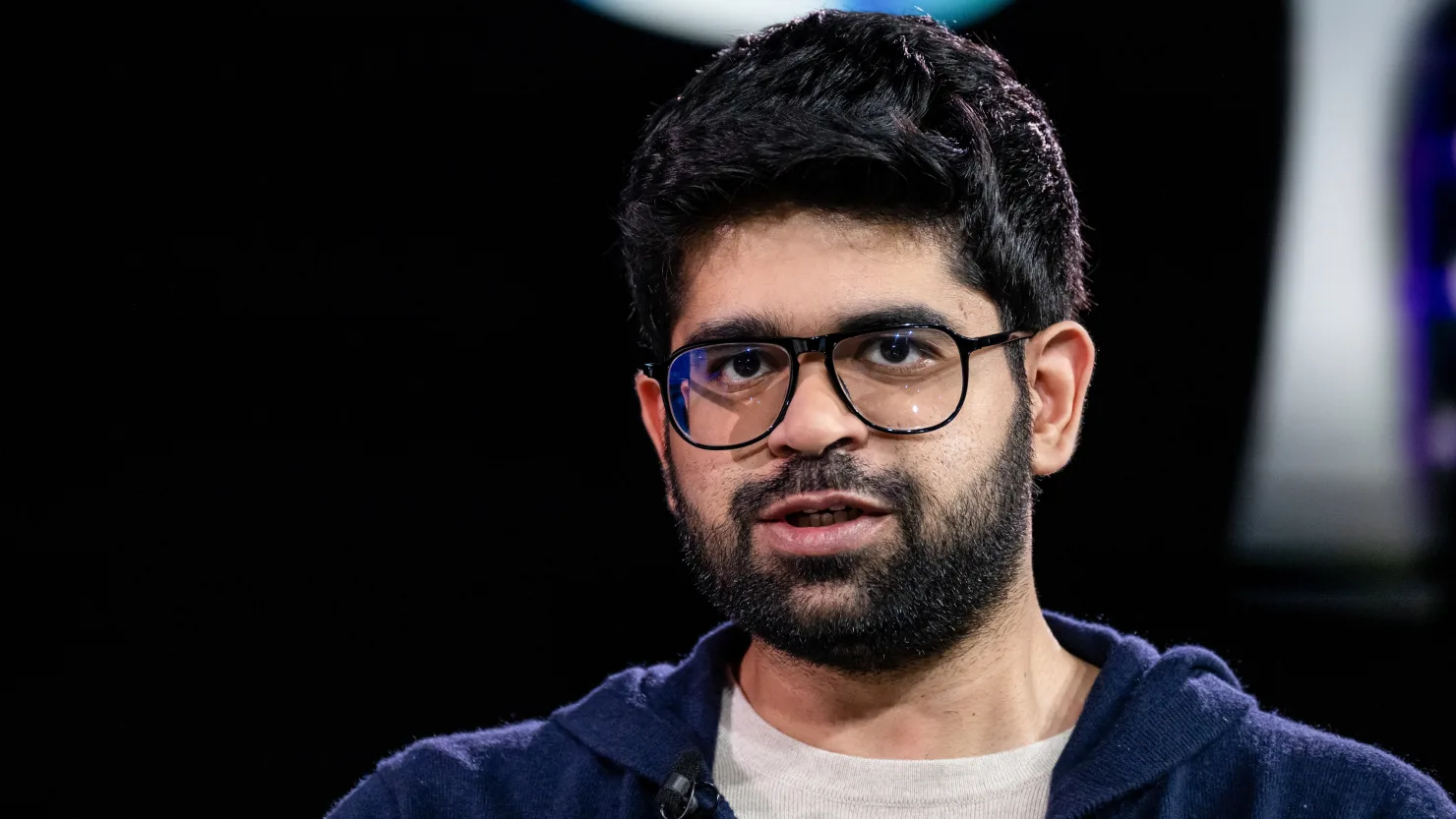
Aravind Srinivas said it plainly in a Tuesday interview: “Agnostic of these two companies, we were planning for something in 2028, so that still remains the case.” The companies in question are OpenAI and Anthropic. OpenAI filed confidentially for a US IPO on June 8. Anthropic filed the previous week. Elon Musk’s SpaceX priced its offering the same day Srinivas made his comments. Three major AI-adjacent listings converging in a single week – and Srinivas’s position is that none of it changes Perplexity’s timeline. YourNewsClub reads that as a strategically significant public stance, not just an answer to a routine question.
The commercial logic behind the 2028 date is not arbitrary. Dmitry Shevelenko, Perplexity’s chief business officer, stated: “By consistently holding 2028 as our earliest date for an IPO, Perplexity has been able to build a healthy, high-growth business.” That sentence carries a specific implication: the multi-year runway before listing is deliberate growth infrastructure, not hesitation. Perplexity’s annual recurring revenue reached $450 million by March 2026, a 50% increase in thirty days driven by the launch of its Computer agent. Monthly active users exceed 100 million. The company’s valuation sits at $20 billion following its Series E-6 round earlier this year.
Srinivas’s view on OpenAI and Anthropic’s deserved valuations contains its own conditional clause. He said both companies deserve their high multiples because “they are on the frontier.” Then he added: “If for six months you don’t see a model capability advance from one of these two companies, then it’s a problem for them.” That is a gracious framing of a real risk. Frontier AI valuations rest on continuous model improvement. A sustained innovation plateau would compress those multiples faster than almost any other variable. Perplexity, as an orchestration layer that runs across models rather than developing them, sits in a different structural position relative to that risk.
And the SpaceX IPO’s performance will function, as Srinivas put it, as “a leading indicator” for Anthropic and OpenAI. “I certainly think there will be ripple effects if they don’t go well, like there is no sugar coating on that,” he said. SpaceX targets a $1.75 trillion valuation at $135 per share – the largest IPO in history if it clears. Investor appetite for a company with demonstrated commercial revenue from Starlink, a launch cadence, and a national security contract base will serve as a data point for appetite toward companies with demonstrated AI revenue but no profitable unit economics yet. YourNewsClub places the SpaceX opening-day multiple as the clearest available external signal of where institutional demand for the AI IPO cohort of 2026-2028 actually sits.
The uncomfortable version of Srinivas’s confidence is this: a 2028 IPO window works for Perplexity only if the AI spending cycle has not exhausted investor appetite by then, and only if Perplexity’s orchestration-layer moat holds while OpenAI, Anthropic, and Google all build competing agentic products in the same period. YourNewsClub will log the SpaceX listing outcome, the post-IPO Anthropic and OpenAI multiples, and Perplexity’s next ARR disclosure as the three data points that will define how realistic the 2028 window looks by the end of Q3 2026.
The broader context Srinivas is operating in is worth naming directly. Enterprise spending on AI has become a key public focus after OpenAI’s Sam Altman reportedly said in a company livestream that enterprises are now actively discussing how much they spend on AI – a signal that the sales conversation has shifted from “should we adopt AI” to “how much are we spending and what are we getting.” Perplexity’s Computer agent, which launched in late February and drove the company’s fastest-ever ARR growth, sits precisely in that enterprise cost-justification moment. Research firm Sacra estimates Perplexity needs approximately $656 million in ARR by year-end to meet investor expectations, requiring roughly 230% growth from its starting position. The 2028 IPO becomes more or less defensible depending on whether the company hits that target and what it implies about the sustainable growth rate underneath it. Your News Club considers the year-end ARR figure the single most consequential near-term data point for evaluating whether the 2028 plan remains on track.