
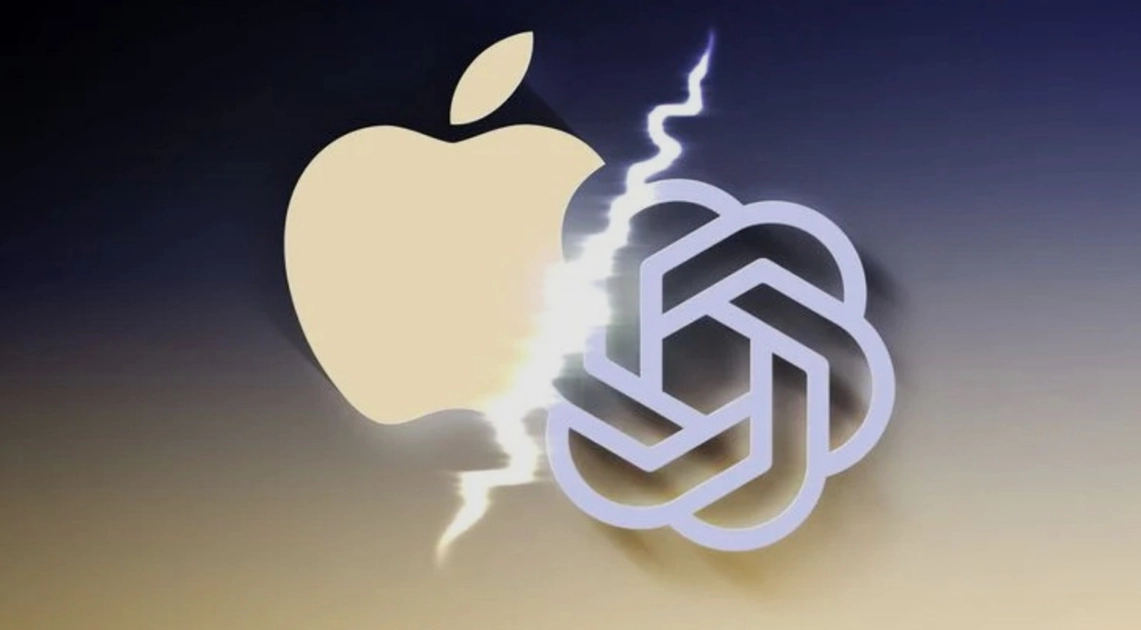
Two of the biggest names in tech have a problem, and the problem just went public. WinBuzzer reported on May 17 that OpenAI is weighing a breach-of-contract claim against Apple over the Siri-ChatGPT integration deal signed in 2024. The original agreement let Apple plug ChatGPT into Siri for queries the assistant could not handle on its own. Eighteen months later the integration is still half-shipped, the new Siri app has been delayed twice, and OpenAI’s executives have apparently run out of patience. The story dropped quietly on a Sunday evening. The implications are anything but quiet. YourNewsClub reads the leak as a deliberate pressure move, not an accidental disclosure.
The background. When the deal was announced at WWDC 2024, it was supposed to be a turning point. Apple would get a credible AI assistant overnight by handing the hard queries off to ChatGPT. OpenAI would get access to roughly a billion iPhones and the most lucrative consumer hardware ecosystem in the world. Both sides framed it as a win. Then nothing shipped on the original timeline. Apple delayed the smarter Siri to 2025. Then it delayed it again to iOS 27 in mid-2026. Then it announced this week that even the new version will launch as a beta. From OpenAI’s perspective, the company gave Apple the keys to ChatGPT for a partnership that has yet to deliver the distribution it was promised.
Owen Radner, whose work treats digital infrastructure as energy-information transport systems, did not hedge: “This isn’t a product dispute. It is an infrastructure dispute. OpenAI committed real compute to building an Apple-shaped integration layer, and that compute has been sitting partially dormant for a year. When you operate at the scale OpenAI does, an underutilized integration isn’t just a missed revenue line. It is fixed cost that should be amortizing against actual user volume. The breach claim, if it materializes, will be about distribution guarantees that didn’t materialize. Those clauses are usually quiet. They become loud when one side stops believing the other side will deliver.”
The timing is what makes the moment unusual. OpenAI just released GPT-5.5 Instant as the default model in ChatGPT, with memory features that pull from past conversations, uploaded files and even Gmail. The product is in growth mode. The IPO conversation is getting louder. Distribution matters more than ever, which is exactly why a stalled Apple deal hurts more than it would have a year ago. Reports this week also point to renewed work on an OpenAI hardware device with MediaTek and Qualcomm as chip partners and Jony Ive reportedly involved in early design discussions. YourNewsClub views the hardware angle as the real catalyst behind the leak. If OpenAI is building its own consumer device, the company has less reason to wait quietly for Apple to deliver on a partnership that may never produce the volume originally promised.
A second layer to the story does not get talked about much. Apple’s revamped Siri, when it does ship, will include an option to auto-delete chat history. That feature is the opposite of how ChatGPT is being positioned. OpenAI wants memory. Apple wants forgetting. Even if the integration goes live, the two assistants pull users in different directions, which makes the partnership awkward at a product level on top of being problematic at a contract level. YourNewsClub flags this strategic divergence as the structural problem underneath the contract one.
Freddy Camacho, who studies political economy of computation, materials and energy as dominance assets, framed the corporate stakes: “Apple and OpenAI aren’t natural partners. They are competitors who agreed to a temporary truce when neither had a complete consumer-AI stack. That truce expires the moment one of them ships a full product. OpenAI is closer to that finish line than Apple is, especially if the rumored hardware device materializes. From OpenAI’s side, the breach claim is leverage. It either forces Apple to deliver, or it gives OpenAI the legal cover to walk away cleanly and ship its own competing product without the original integration tying its hands.”
Three scenarios are visible from here. Scenario one: Apple accelerates the Siri-ChatGPT integration in iOS 27 to defuse the dispute, OpenAI quietly drops the breach theory, and the partnership limps forward into iOS 28. Scenario two: the two companies agree to a public restructuring of the deal that gives OpenAI better distribution guarantees and Apple some product flexibility. Scenario three: OpenAI files, the partnership blows up, and ChatGPT pulls out of Siri entirely while OpenAI accelerates its own device strategy. YourNewsClub assesses scenario two as the most likely, scenario three as the most consequential, and scenario one as the least sustainable.
The wild card is what Apple says at WWDC next month. The conference is the obvious moment for Apple to either reset the partnership publicly or quietly start signaling a different direction. The new Siri ships in beta either way. The question is whether ChatGPT sits inside it on launch day, or whether Apple announces a different integration partner entirely. Anthropic and Google have both surfaced in the rumor mill over the past six months as potential alternative or additional partners.
The bigger lesson here applies to anyone watching the AI sector right now. The 2024 partnerships were written when nobody knew which model would win, which company would have which capabilities, and how fast the underlying technology would evolve. Eighteen months later the picture has shifted dramatically, and the contracts written in that earlier era are starting to break under the weight of products and revenue streams that did not exist when the ink dried. The Apple-OpenAI fracture is probably the first big public example of this kind of strain. Your News Club expects several more public disputes of this shape to surface across the major AI partnerships before the end of the year.