
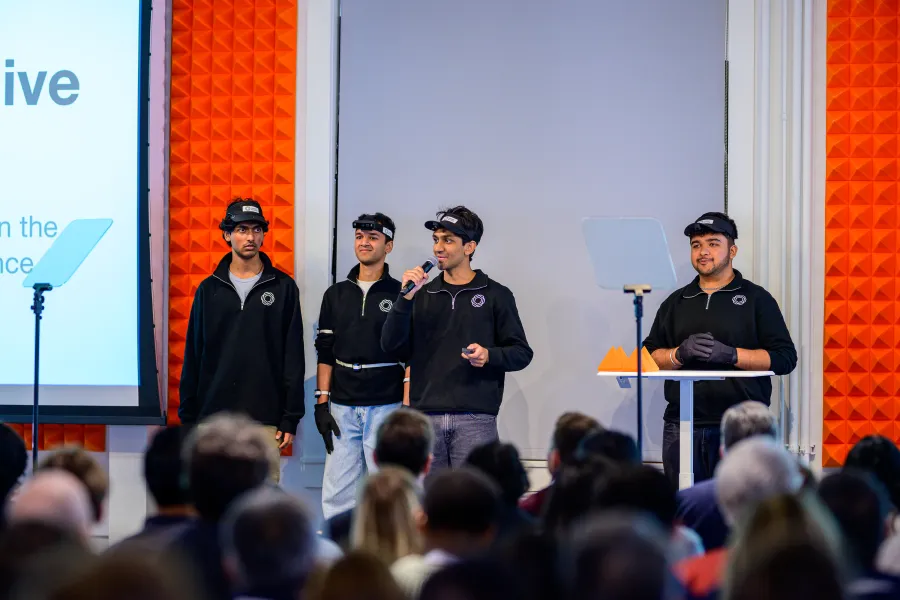
Human Archive, a startup founded by UC Berkeley and Stanford researchers, raised $8.2 million from Wing Venture Capital, NVP Capital, Y Combinator, and angels connected to OpenAI, Nvidia, Google, and Meta. The company pays gig workers in India to wear camera-equipped caps and sensor devices that capture egocentric video data of everyday tasks. That footage, combined with data from tactile gloves, full-body motion capture suits, and wrist cameras, forms training sets for AI and robotics labs building machines that operate in the physical world.
YourNewsClub maps the Human Archive model as a three-sided market: gig workers earn $1 per hour to wear the hardware; home services companies get a discounted offer to attract customers who opt into recording; and AI labs get training data with sensor synchronisation nobody else has achieved at scale. Wing VC partner Zach DeWitt described the data stack directly: “No one else in the world has been able to synchronize and collect headset RGB-D, force feedback, full-body motion capture, and chest and wrist camera data at scale.”
The company has more than 1,000 active headsets deployed and over 50 distinct hardware devices collecting different data points. CEO Raj Patel said the startup began with iPhones, built custom rigs, and now operates seven hardware product categories interchangeably. The data synchronisation challenge – aligning RGB-D imagery, depth information, motion capture, and force feedback in real time – is the core technical differentiation Human Archive is building a business around.
Maya Renn, who examines ethics of computation and access to power through technology, draws a line between the model’s commercial logic and its ethical structure: “Paying workers in the Global South $1 an hour to generate training data for physical AI labs in the US is not a neutral transaction. It mirrors historical patterns of extracting value from labour in the developing world to build infrastructure in the developed one. Whether execution matches the language of ‘building infrastructure for a safer, more productive future’ is a different question – and so far that execution is mostly invisible.” YourNewsClub places that critique alongside Wing VC’s framing – “lowering the barrier to participating in the AI economy” – as the two lenses through which the Human Archive model demands simultaneous evaluation.
The privacy dimension is live. India’s MEITY opened a review last week into the consent mechanisms of startups collecting egocentric data through home service workers. Human Archive said its contracts comply with India’s Digital Personal Data Protection Act and that it blurs all faces. What it has not disclosed is what specific information workers receive about how their footage is ultimately used by the AI labs that purchase it.
The public disputes are worth noting. Urban Company CEO Abhiraj Singh Bhal declined a partnership on X. Pronto acknowledged early discussions but did not proceed. Co-founder Rushil Agarwal posted that Pronto’s founder had “laughed at him” during those discussions. Owen Radner, who studies digital infrastructure as energy-information transport systems, reads it plainly: “This is a physical AI infrastructure play that needs home services as the data capture vehicle. The rejections signal that the platform layer is not yet established – the infrastructure doesn’t yet have product legitimacy in the eyes of the people it needs to work with.” YourNewsClub identifies the partner rejection rate as the most important early metric for assessing whether the model scales.
Human Archive is expanding into Southeast Asia and early US operations, where it aims to offer cleaning and cooking services at a discounted rate in exchange for consenting to recording. That expansion brings the data-for-discount model into jurisdictions with different privacy frameworks and labour norms.
Three things to watch: whether India’s MEITY issues any restriction on the consent mechanisms in use; whether the planned dataset release generates the lab interest Wing VC described; and whether any major home services operator eventually signs a partnership. The physical AI and labour ethics desk at YourNewsClub logs all three as forward indicators.
The uncomfortable underlying question: the physical AI data problem is real, the bottleneck genuine, and Human Archive has a technically novel solution. The ethics and labour questions are equally real, and the company’s answers sit at the minimum threshold rather than above it. Those two things are simultaneously true. Your News Club expects the planned dataset release to be the first real test of whether major AI labs move from evaluation to commitment.