
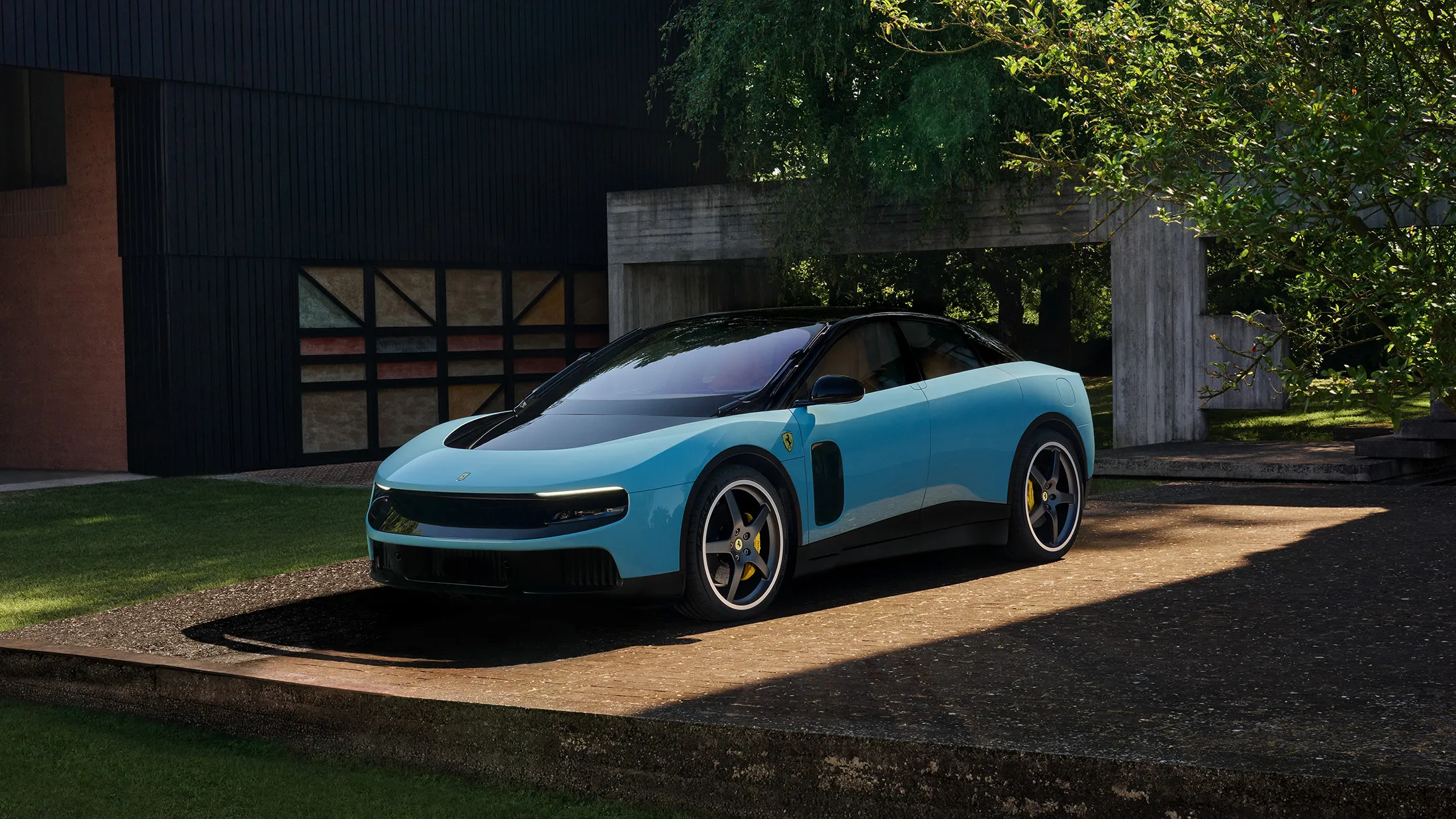
Ferrari unveiled the Luce on Monday, May 25 – its first fully electric vehicle, its first five-seater, and its most expensive production model. Pricing places it well above the roughly $430,000 Purosangue SUV, with European media estimates ranging between 440,000 and 500,000 British pounds, suggesting a figure exceeding $1 million in some markets. Ferrari shares fell almost 8% in Milan trading after the reveal. YourNewsClub scopes this as a sharp setback for one of the industry’s most closely watched EV debuts – and the opening act of a commercial test that plays out over the next 60 days.
The Luce is a four-motor liftback with a 597-litre boot, the largest cargo space in any Ferrari to date. The interior was co-designed by LoveFrom, the firm Sir Jony Ive founded after leaving Apple in 2019, alongside Ferrari’s in-house Centro Stile. The car ships from Q4 2026 with order books now open. CEO Benedetto Vigna has described the Luce as the first of several electric Ferraris, with a successor in the sports-car line expected in 2027. The first trading day did not answer the identity question well.
The stock drop concentrated on a specific complaint: the Luce’s design resembled competitors, most notably Tesla. For a company whose valuation rests on the premise that Ferrari buyers pay for something unambiguously differentiated, the comparison was damaging in a way a range-or-performance critique would not have been. YourNewsClub flags the design criticism as landing on the one axis where Ferrari had least tolerance for “close enough.”
Freddy Camacho, who examines political economy and capital as dominance assets, reads the market reaction as a capital-allocation signal: “Ferrari’s valuation is a luxury brand equity valuation that commands a premium multiple because the brand never compromises on distinctiveness. An EV that looks like a competitor’s product challenges the premise that justifies the multiple. The 8% drop is the market repricing that premise.”
The Purosangue comparison runs through this story. That model launched in 2022 as Ferrari’s first four-seat SUV, met enthusiast-press scepticism, and sold out anyway. Management is betting the Luce follows the same pattern: initial resistance from the faithful, commercial success from a wider buyer pool. YourNewsClub notes the Purosangue precedent cuts both ways. It proves Ferrari can expand its format range. It does not prove it can do so with an electric powertrain, which removes the sensory element most Ferrari buyers describe as irreplaceable.
Owen Radner, who studies digital infrastructure as energy-information transport systems, applies a product-versus-infrastructure distinction: “The V12 or V8 in a traditional Ferrari is not just a product feature – it is the infrastructure the entire sensory experience runs on. When you remove it, you are changing the infrastructure, which changes what the product can deliver. The question is whether Ferrari can rebuild equivalent sensory infrastructure using motors and software. The Luce’s early reception suggests customers are not convinced.”
Ferrari’s five-year plan targets a 2030 mix of 40% combustion, 40% hybrid, and 20% electric – revised down from an earlier 40% EV plan. Vigna has framed the new mix as “freedom of choice” for customers, language Stellantis CEO Antonio Filosa also used recently. The industry has largely converged on that phrase as its preferred description of a retreat from EV-only commitments without naming the retreat. YourNewsClub reads the convergence on that language as the more interesting signal than any individual company’s target percentage.
The LoveFrom partnership deserves reading separately from the commercial result. Jony Ive designed the iMac, the iPod, and the iPhone – objects that created new aesthetic expectations rather than merely meeting existing ones. Whether he can do that for a car category where competitors have already established the premium EV visual vocabulary is the creative question the Luce’s first-day reception has complicated. Ive’s firm declined to comment publicly on the reaction.
Three things to watch: whether the order book closes at pace in the next 60 days – the Purosangue sold out quickly despite scepticism, which would be the cleanest validation; whether Ferrari stock recovers to pre-reveal levels by the time shipping begins in Q4 2026; and whether Vigna addresses the design criticism directly at the next earnings call or allows the commercial performance to make the argument. The technology and auto desk at Your News Club will follow the order pace as the leading indicator, and the Jony Ive design reputation as the secondary one.