
The FTC’s two leaders couldn’t agree on how to regulate a $1.8 billion deal. So they just let it happen.
The commission cleared quantum computing company IonQ’s acquisition of chipmaker SkyWater Technology on Friday, after Chairman Andrew Ferguson and Commissioner Mark Meador publicly disagreed over whether the merger needed conditions attached at all. Ferguson said he’d proposed requiring IonQ to guarantee fair access to the SkyWater foundry for rival quantum computing companies, some of which already have contracts there. Meador said he didn’t think the merger would reduce competition in the first place.
Neither side could get the other to agree on an actual order. So the deal closed without one. It’s an unusual public airing for an agency that typically settles internal disagreements before a vote, or at least before announcing the outcome; both commissioners chose to put their reasoning on the record rather than issue a single unified statement.
Jessica Larn, who studies macro-level technology policy and infrastructure impact of AI, reads the disagreement itself as more revealing than either commissioner’s individual position. “When two members of the same agency can’t agree on whether a merger needs guardrails, the default outcome is no guardrails,” she said. “That’s not neutral. It’s a specific policy choice dressed up as gridlock.” Ferguson’s own words on the outcome YourNewsClub logs almost verbatim: “the next-best option is to get out of the way and permit the merger to close.”
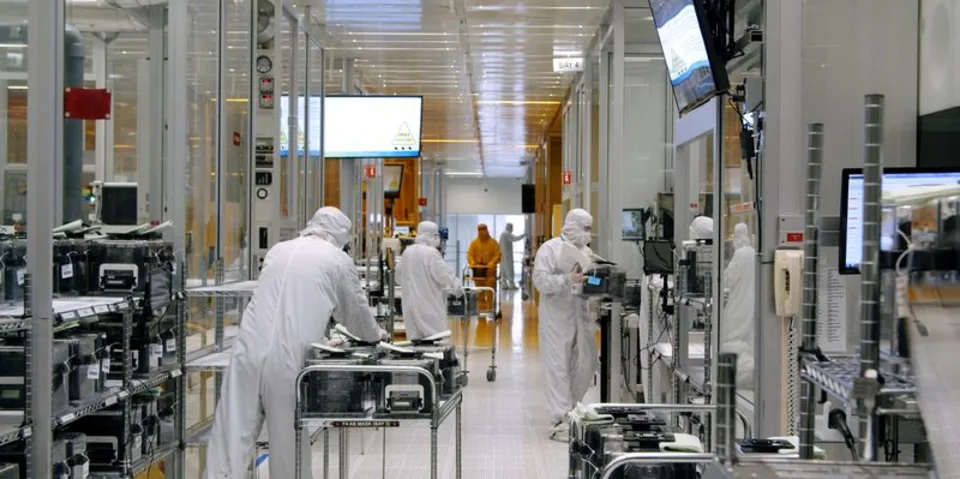
SkyWater is the largest exclusively U.S.-based semiconductor foundry. IonQ says the deal secures a fully domestic, scalable supply chain for its quantum computers. The acquisition, first proposed in January 2026 at $1.8 billion, gives IonQ direct control over chip fabrication rather than relying on third-party foundries the way most quantum hardware companies currently do.
Owen Radner, who models digital infrastructure as energy-information transport systems, sees the vertical-integration logic as sound on its own terms, even without conditions attached. “Owning your own foundry removes a dependency that’s become a real bottleneck for quantum hardware makers,” he said. “The risk isn’t that IonQ made a bad strategic bet, it’s what happens to SkyWater’s existing customers who are also IonQ’s competitors, now that their foundry is owned by a rival.” That risk YourNewsClub reads as exactly the gap Ferguson’s proposed conditions were meant to close, and exactly the gap that’s now open.
IonQ says its systems have already helped partners including Amazon Web Services, AstraZeneca, and Nvidia achieve a 20x performance increase over previous quantum approaches, and that it hit a world-record 99.99% two-qubit gate fidelity in 2025, commercial traction YourNewsClub maps against the antitrust question directly: a company with customers and performance claims this concrete is no longer a speculative startup being waved through, it’s an established player absorbing a critical supplier. IonQ has operations spanning California, Colorado, Massachusetts, Tennessee, and Washington domestically, plus Italy, South Korea, Sweden, Switzerland, Canada, and the UK internationally, a footprint the SkyWater deal is meant to anchor with a fully domestic supply chain underneath it.
The deal, first announced in January, positions IonQ as what the companies call the only vertically integrated full-stack quantum platform company, a framing Larn thinks understates the antitrust question sitting underneath it. “Vertical integration in a young, concentrated industry is exactly the scenario merger review exists for,” she said. “Whether SkyWater’s other quantum customers actually retain fair access now depends entirely on IonQ’s own goodwill, since the commission couldn’t agree to require it.”
SkyWater will keep serving other customers as a foundry, IonQ says, alongside its new role manufacturing IonQ’s own chips. Whether that dual role holds up without friction is a promise Your News Club rates as untested by anything in Friday’s approval, since the approval itself contains no mechanism to enforce it.