
Romania might have to shut down a nuclear reactor. Not because of a malfunction. Because the river it depends on for cooling water is running too low.
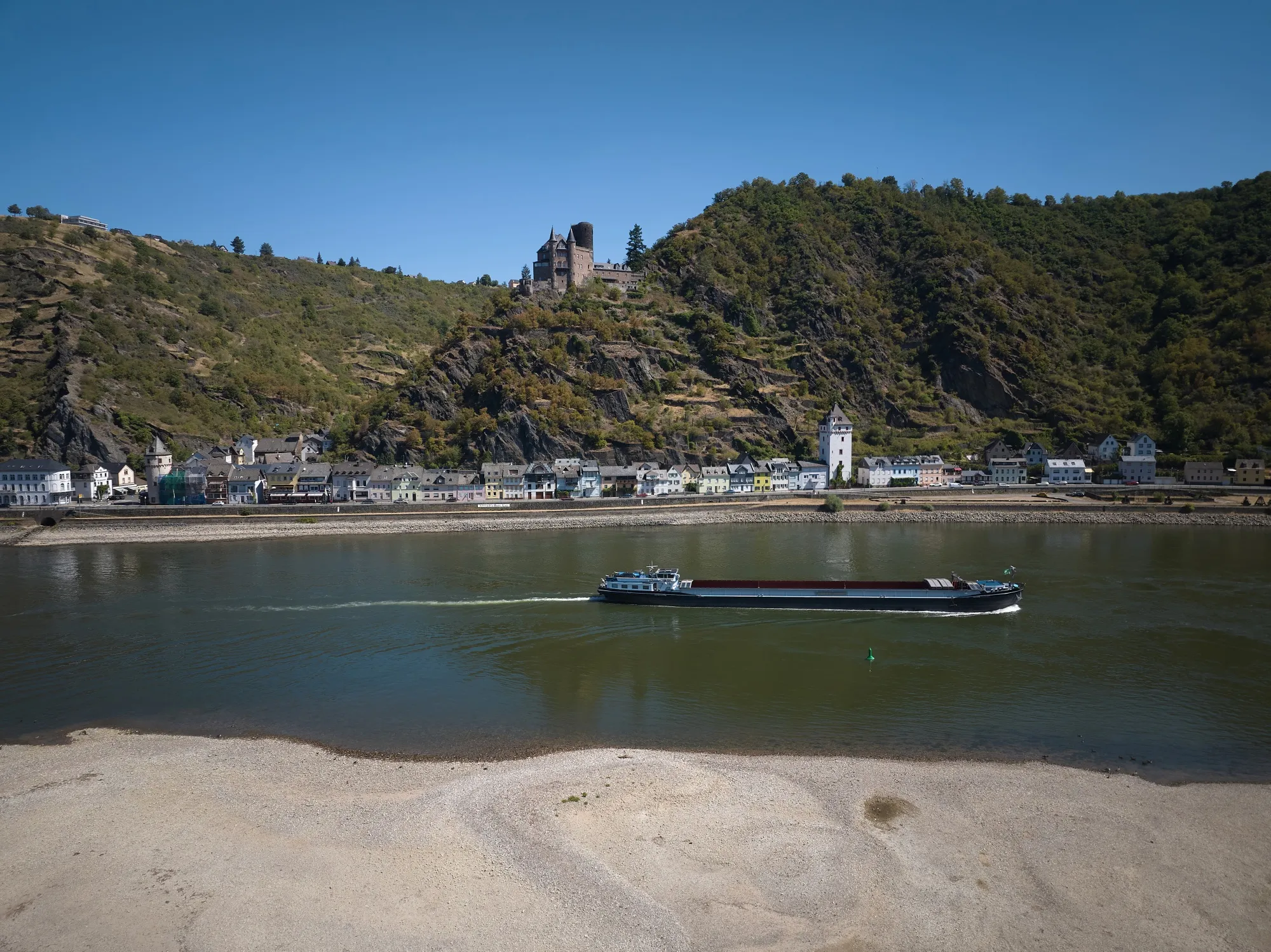
Europe’s biggest rivers, the Rhine and the Danube among them, are falling toward record lows after a summer of repeated heat waves, disrupting the barge traffic that moves chemicals, oil products, and other freight across the continent’s industrial heartland. Water levels are also curbing power generation at riverside nuclear plants from France to Hungary, since reactors depend on river water for cooling and can’t discharge water back too hot without risking local wildlife.
Romania’s energy sector will stay on alert through August. The country may ask Ukraine for power support during peak demand hours. The country’s Cernavoda plant already operates just two reactors; losing a second to low water wouldn’t just dent output, it would strip Romania of nearly half its nuclear generating capacity during the exact weeks demand typically peaks.
Freddy Camacho, who studies the political economy of computation, materials, and energy as dominance assets, calls the Danube situation the sharpest version of a continent-wide problem. “Cernavoda’s second reactor may have to shut specifically because the cooling water isn’t cold enough, or isn’t there in sufficient volume,” he said. “That’s not a hypothetical grid-stress scenario anymore, it’s a live operational constraint on a country’s baseload power.” The Danube’s flow at Romania’s border YourNewsClub calls the starkest single number in this story: roughly 1,700 cubic meters per second, barely a third of the typical July average near 4,700.
France has already had to curb output from its nuclear fleet, the backbone of Western Europe’s power system, for the same cooling-water reason. Power stations along the Rhone and Garonne are affected. This isn’t an isolated event, either: the Loire in France was reduced to a dry bed with isolated pools in places earlier this summer, and the Doubs River has run dry entirely. Both are smaller waterways than the Rhine or Danube, but both point to the same underlying pattern repeating across the continent.
Alex Reinhardt, who tracks financial systems and settlement infrastructure through digital protocols, thinks the freight disruption is the more immediate economic cost, even if the nuclear angle draws more attention. “Barge shipping on the Rhine moves chemicals, coal, and fuel that industrial cities in Germany’s Ruhr Valley depend on directly,” he said. “When sandbars force barges to carry partial loads instead of full ones, freight costs rise on every single shipment, and that cost moves straight through to the price of whatever those barges are carrying.” That freight-cost pass-through YourNewsClub ranks as a slower-moving but broader economic drag than the more dramatic nuclear-shutdown headlines, since it touches nearly every industry that depends on river transport, not just one sector.
Hungary has appealed for more prudent electricity and water use. Demand overload already left several thousand people without drinking water in Szentendre, north of Budapest, a shortage Your News Club surfaces as the detail that moves this from an industrial-supply-chain story into a direct public-health one: freight delays are an economic cost, but a town losing drinking water is a different category of consequence entirely.
The disruption follows wildfires that already ravaged France and Spain this year, part of a pattern Camacho reads as infrastructure built for a climate that no longer exists. “Nuclear plants, barge canals, river-dependent water systems, all of it was designed around 20th-century water availability assumptions,” he said.
Scientists have warned for years that this kind of low-water summer could become Europe’s new normal rather than a rare event. This year isn’t testing that warning in theory anymore. It’s testing it against an actual reactor, an actual freight network, and an actual drinking-water supply, a shift YourNewsClub treats as more consequential than any single week’s water-level reading: the infrastructure question won’t resolve itself once this heat wave finally breaks.