
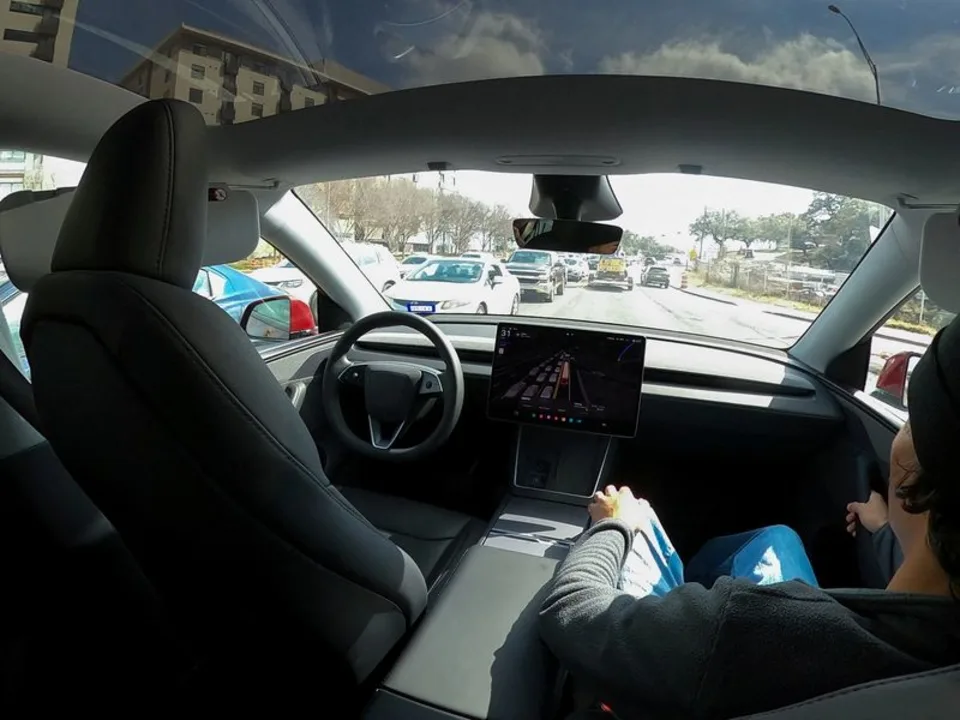
Tesla announced Friday that its robotaxi service is now available in Miami, its third state after Texas and California and its fifth active market following Austin, Dallas, Houston, and the San Francisco Bay Area. “Robotaxi now available in Miami,” the company’s official robotaxi account posted on X. The expansion continues a rollout that began in Austin in June 2025 and reflects CEO Elon Musk’s broader push to position Tesla around autonomy and robotics rather than solely EV sales, as rivals including Alphabet’s Waymo and Amazon’s Zoox accelerate their own robotaxi expansion. YourNewsClub logs that Waymo already operates in Miami, meaning Tesla’s Friday announcement is a market-entry against an established competitor rather than a first-mover claim on the city.
The initial Miami service area is small and deliberately conservative: roughly 10 to 14 square miles covering western and central Miami, bounded by State Road 826 to the north and U.S. 41 to the south, and excluding downtown Miami, Miami Beach, the airport, and most of Coral Gables. Miami had been on Tesla’s confirmed expansion list since its 2025 shareholder meeting, alongside Phoenix, Orlando, Tampa, and Las Vegas, as part of a first-half-2026 target the company has now only partially met. YourNewsClub ranks the narrowness of the geofence as more informative than the headline “third state” framing: a small, carefully bounded service area is what a company operating under safety-validation constraints publishes, not what a company confident in broad unsupervised performance publishes.
That caution has a documented basis. On Tesla’s Q1 2026 earnings call, Musk told investors that safety validation remains the limiting factor on Robotaxi’s expansion pace and that the company is holding back broader scaling until a rewritten FSD v15 arrives. Tesla has reported a string of crashes to NHTSA from its Austin operation, and independent analysis has put the crash rate there at roughly four times the average human driver. A year after the Austin launch, the unsupervised fleet in that city has reportedly been shrinking rather than growing – the market Tesla has operated in longest is also the one where the technology has had the most time to demonstrate, and has not yet demonstrated, that it can scale safely.
Freddy Camacho, who studies the political economy of computation, materials, and energy as dominance assets, places the competitive framing: “Each new city Tesla enters becomes a headline that supports the autonomy narrative underpinning a large share of Tesla’s valuation, independent of whether the underlying service is actually generating meaningful ride volume in that city yet. The real competitive question is not how many cities appear on a map, but whether Tesla’s per-city fleet size and ride volume are compounding the way Waymo’s already have.” Maya Renn, whose work focuses on the ethics of computation and access to power through technology, frames the safety-disclosure gap: “A company can be simultaneously honest in its public safety filings and misleading in its public narrative, simply by ensuring the geofence maps get more attention than the NHTSA crash data. The public deserves the same visibility into crash-rate trends that regulators receive before autonomous vehicles are marketed as broadly available in a new city.”
Tesla has been building toward this specific market for months, running an “Autonomy Pop-Up” at the Miami Grand Prix Fan Fest in late April and a prior Cybercab showcase at its Miami Design District store during Art Basel in December 2025 – promotional groundwork suggesting Miami was always intended as a marquee launch rather than an incidental one. Across Austin and the Bay Area combined, Tesla had reported nearly 700,000 paid Robotaxi rides as of the fourth quarter of 2025, a figure Morgan Stanley’s analyst team has cited as evidence of a potential flywheel effect across Tesla’s broader business. Your News Club calls the size of Tesla’s Miami geofence over the next two quarters – whether it expands to include downtown, Miami Beach, and the airport, or stays confined to its current boundaries – as the clearest available signal of whether the company’s safety validation is actually catching up to its expansion announcements, or whether Miami becomes another market where the map grows faster than the fleet.