
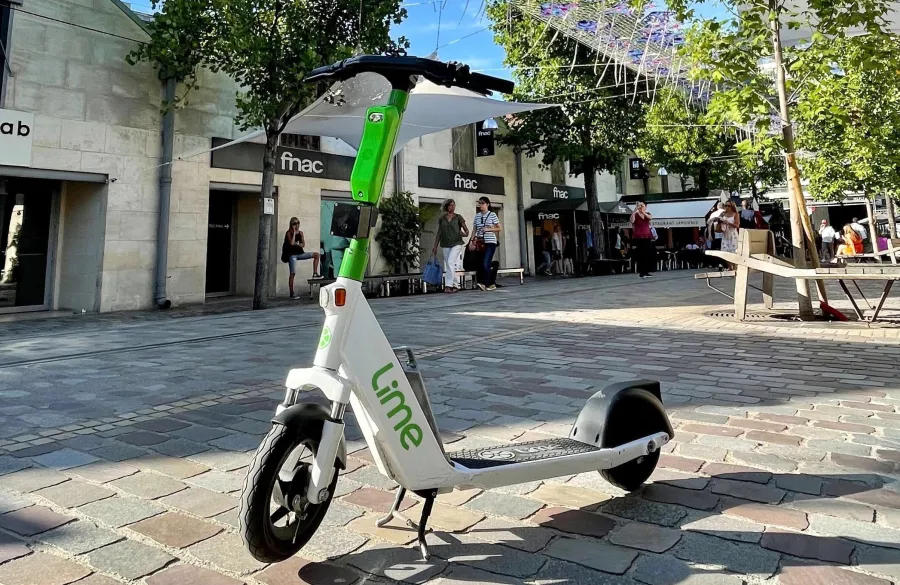
Lime, the San Francisco-based electric scooter and bike company, began trading on the Nasdaq on Wednesday under the ticker LIME, priced at $25 per share – the midpoint of its $24 to $26 range – at an implied valuation of approximately $1.66 billion. The company sold 6.68 million shares, raising $167 million. Shares jumped roughly 9% in the first hour of trading, opening at $27 before settling back toward the offer price through the afternoon session. The offering price pegs Lime just below the $1.75 billion valuation fellow micromobility company Bird achieved when it merged with a SPAC in 2021 – a number that has since become a cautionary reference point in the category, as Bird subsequently delisted and liquidated. Uber, which has partnered with Lime since 2018 and owns more than 10% of the company, acted as anchor investor and agreed to purchase up to $20 million of stock at the IPO price. Uber also guarantees some of Lime’s debt. YourNewsClub reads the Uber anchor investment as a commercial relationship clarification as much as a show of support: an anchor investor who is simultaneously a major distribution partner, a debt guarantor, and a 10% shareholder with a partnership agreement running to 2028 has interests that are not identical to those of a standard institutional investor.
CEO Wayne Ting told reporters the company deliberately delayed going public until it could demonstrate three consecutive years of free cash flow positive results. Revenue grew from $522 million in 2023 to $687 million in 2024 and $887 million in 2025, with Q1 2026 at $170 million, up 32% year-on-year. Net losses fell from $122 million in 2023 to $34 million in 2024, before rising to $59 million in 2025. The company closed 2025 with $340 million in cash. Ting was direct: “I think the timing is right, because the business is strong.”
Lime’s backers include Alphabet’s GV, Andreessen Horowitz, Bain Capital, and Abu Dhabi Growth Fund, which led the $523 million round in November 2021 at approximately $1.4 billion – meaning the IPO price delivers a modest premium to the final private valuation. YourNewsClub spots that pricing discipline as the most commercially encouraging signal in the listing structure, since Lime and its underwriters prioritised a successful float over maximising the headline number.
Jessica Larn, who studies macro-level technology policy and infrastructure impact of AI, draws the urban mobility policy context: “Three consecutive years of free cash flow positive results change Lime’s public market story materially compared with where the category stood in 2021. Lime’s listing is a referendum on whether shared micromobility can produce durable public market value after years of venture-funded growth that prioritised scale over sustainability.” Freddy Camacho, who studies the political economy of computation and capital as dominance assets, frames the Uber dependency risk: “A company going public with Uber as anchor investor, distribution partner, debt guarantor, and 10% shareholder is not independent in the way most public companies are. Lime’s valuation depends partly on that partnership’s continuation, and Uber retains unilateral termination rights through 2028.”
YourNewsClub places Lime’s first post-IPO quarterly earnings report as the disclosure that will most clearly reveal whether the free-cash-flow positive record was structural or a function of the specific market conditions that prevailed during the private phase.
Lime’s underwriters chose to price the offering at a modest premium to its last private round rather than maximising the headline valuation – a deliberate departure from the Bird playbook that destroyed that company’s public market credibility. Whether that discipline holds through the lock-up expiry window is the test that actually matters.
Lime filed its IPO under the legal entity name Neutron Holdings, the parent company that was established when the brand launched in 2017. That corporate structure detail is trivial operationally but worth noting as context for investors tracking filings: Neutron Holdings and LIME refer to the same business. Your News Club marks the stock’s first-day close as the last clean data point before the company’s institutional shareholder base begins the typical post-IPO trading dynamics of lock-up expiry and analyst coverage initiation.