
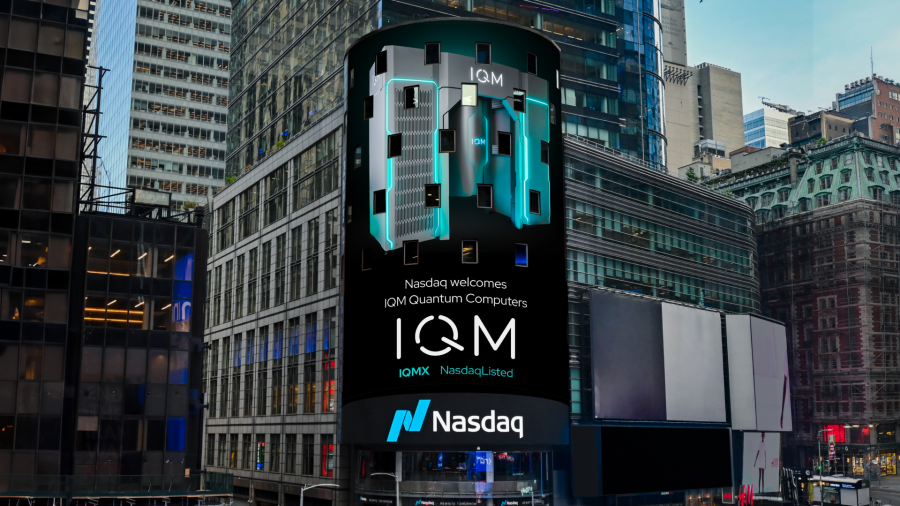
IQM, the Finnish full-stack quantum computing company, began trading on the Nasdaq Thursday via a SPAC merger with Real Asset Acquisition Corp at a valuation of roughly $1.9 billion, becoming the first European quantum computing company listed on a major U.S. exchange. The debut was muted: shares spent most of the day below the offer price. That tepid reception traces directly to a specific line in IQM’s own prospectus, warning that “large-scale commercial traction of quantum computing technology may never occur.” YourNewsClub pins that disclosure less as a red flag specific to IQM than as an unusually blunt version of a caveat every quantum company carries – the difference is that IQM put it in a public filing on the same day investors were being asked to price the stock.
The underlying business has real, if early, traction. IQM grew from 8 customers in 2024 to 22 in 2025, including two recent private-sector additions alongside its existing base of public research institutions such as Finland’s VTT Technical Research Centre and Germany’s Leibniz Supercomputing Centre. The company reported €31 million in 2025 revenue and an order backlog above €67 million – figures that stand out as unusually concrete in an industry still dominated by loss-making peers; Honeywell-backed Quantinuum filed for a traditional IPO at up to $20 billion despite comparatively minimal sales, and U.S.-listed IonQ and Rigetti both remain unprofitable. YourNewsClub tracks the backlog figure as the number worth watching over IQM’s next several quarterly reports, since backlog conversion – not the headline valuation – is what will demonstrate whether current customers intend to keep paying at scale.
IQM’s structure is unusual for a European deep-tech company: rather than relocating to the U.S. to list, it kept two-thirds of its 420-person staff in Espoo, near Helsinki, with a large Munich office, and it debuted simultaneously on Nasdaq Helsinki the day after its New York listing, keeping Finland’s sovereign wealth fund Tesi and local pension insurers on its share register. The deal generated roughly €198 million in net new liquidity, giving the combined company a pro forma cash position of €337 million. CEO Jan Goetz called the moment an “inflection point,” while chairman Sierk Poetting described the listing as “not a change of direction but… an acceleration.”
Jessica Larn, who studies macro-level technology policy and infrastructure impact of AI, places the government-funding backdrop: “Trump’s recent executive orders accelerating the U.S. quantum timeline, paired with the Department of Energy’s commitment to deploy a fault-tolerant quantum computer by 2028, are pulling companies like IQM toward U.S. capital and U.S. government customers even as they keep their research base in Europe. IQM has already deployed a computer at Oak Ridge National Laboratory and opened a Maryland technology center – it is positioning itself to draw on both European sovereign support and U.S. federal quantum spending simultaneously.” Owen Radner, who models digital infrastructure as energy-information transport systems, frames the commercial-timeline question directly: “Every quantum company is selling a computer that is useful today for narrow simulation and optimization tasks, and transformative once ‘quantum advantage’ arrives for a broader task set. IQM’s prospectus language is honest about the fact that nobody building these machines can currently forecast that arrival date. Investors are being asked to underwrite the wait, not a proven return.”
The listing arrives as venture funding for quantum startups fell nearly 40% in 2025 compared with the prior year, leaving government funding – including the EU’s quantum flagship program – as a larger relative share of the industry’s capital base than it was two years ago. French rival Pasqal has announced its own plans to go public via SPAC, and IQM’s ability to sustain investor interest post-debut will likely shape whether other European quantum firms follow the same public-market path or wait longer as private companies. Your News Club seats IQM’s first post-listing quarterly disclosure of backlog conversion and new customer additions as the data point that will most directly test whether Thursday’s soft debut reflected appropriate investor caution about an early-stage technology, or a market that is still unsure how to price a hardware company selling access to a capability it cannot yet fully deliver.