
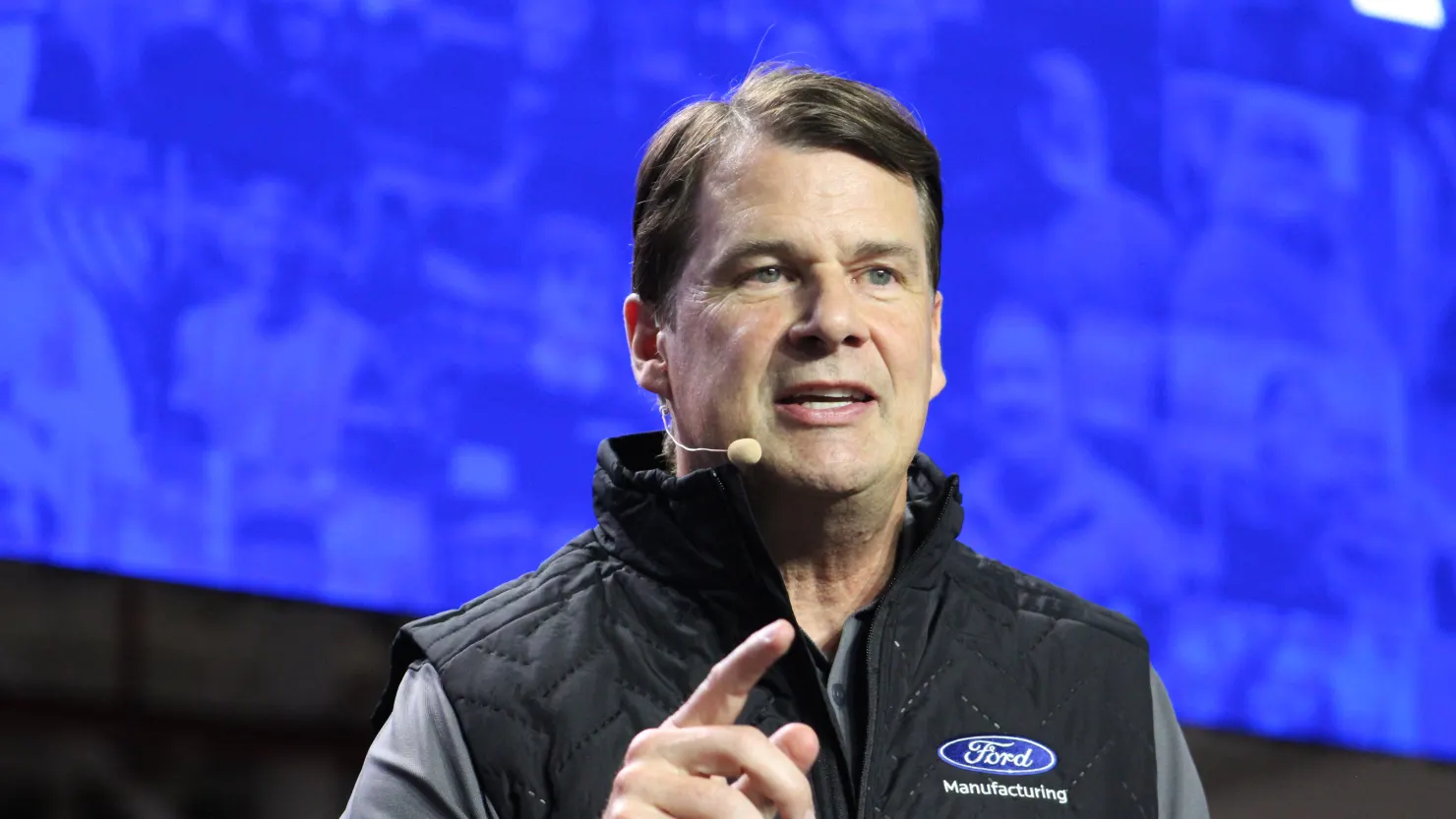
Ford was named the top mass-market brand in J.D. Power’s 2026 U.S. Initial Quality Study on June 25 – the first time since 2010 the company has led mainstream automakers in the closely watched survey, which measures owner-reported problems within a vehicle’s first 90 days. Ford climbed from No. 23 in 2023 to No. 3 overall among all brands, trailing only luxury makers Porsche and Hyundai’s Genesis and finishing ahead of Toyota’s Lexus. CEO Jim Farley said in an interview that the company has “learned from its past mistakes” and intends to apply that discipline to a wave of new vehicle launches over the coming years. YourNewsClub reads the ranking less as a finished turnaround than as a credibility deposit: J.D. Power’s methodology measures initial ownership problems, not the multi-year reliability record Farley is now staking the company’s reputation on.
The financial context behind the ranking is concrete. Ford cut warranty and materials costs by $1.5 billion in 2025 on a volume- and mix-adjusted basis, following a peak of $4.8 billion in 2023, and is targeting a further reduction in 2026. Barclays analyst Dan Levy called the trend encouraging in a May 15 note, pointing to four consecutive quarters of year-over-year warranty improvement, while cautioning that more progress is still required. Ford shares rose 2% the day the J.D. Power result was announced – the stock’s second-best trading day of the month. YourNewsClub weighs the warranty-cost trajectory as the more durable signal of the two: a survey ranking can shift year to year, but a multi-year decline in warranty spend reflects structural changes to how vehicles are engineered and built.
Farley was explicit about what comes next: “We’re going to have all new vehicles across our entire North America range in a couple of years, and so that whole new lineup, we have to launch all those perfectly.” That is a materially harder problem than defending an existing lineup’s quality score, particularly as vehicles increasingly combine software-defined systems and electrified powertrains, where a single defect can propagate across an entire product line. Ford’s own data shows the stakes: infotainment quality improved 11 points above the industry average, the company’s largest single-category gain, following a ground-up overhaul of its software testing process that now stress-tests code through hundreds of thousands of automated scenarios before it reaches a vehicle.
Owen Radner, who models digital infrastructure as energy-information transport systems, draws the software risk forward: “A software-defined vehicle line multiplies the blast radius of a single defect in a way a purely mechanical platform never did. Ford’s quality score today reflects the current lineup. Whether the same testing discipline holds as the company launches an entirely new software and electrified platform simultaneously is a separate and harder question.” Alex Reinhardt, who tracks financial systems and settlement infrastructure through digital protocols, places the earnings angle: “Warranty costs are one of the more reliable leading indicators available to investors in an automaker’s underlying build quality, because they are a real cash cost rather than a subjective survey response. A second consecutive year of warranty reduction alongside a quality ranking is a stronger combined signal than either metric would be alone.”
The operational changes behind the numbers are structural rather than cosmetic. Ford created a unified Product Creation and Industrialization organization this year, merging its digital, design, and industrial teams, building on a 2023 restructuring that put vehicle engineering, manufacturing, supply chain, and quality under one executive. Earlier supplier integration into the design-validation process has driven a 30% reduction in launch issues year over year, and Ford has added AI vision systems on plant floors to help operators flag anomalies in real time. YourNewsClub credits the organizational consolidation as the change most likely to persist independent of any single model launch, since it restructures how Ford catches problems rather than simply adding one more inspection step.
Farley’s own framing – “Are we proud? You bet. Satisfied? Not even close,” as chief operating officer Kumar Galhotra put it – suggests Ford is treating the J.D. Power result as a floor rather than a ceiling. Your News Club maps the 2026–2027 North American launch wave that Farley referenced as the actual test of the turnaround: the current quality ranking reflects vehicles largely designed under the old process, and the next J.D. Power cycle will be the first to substantially capture output from the new one.