
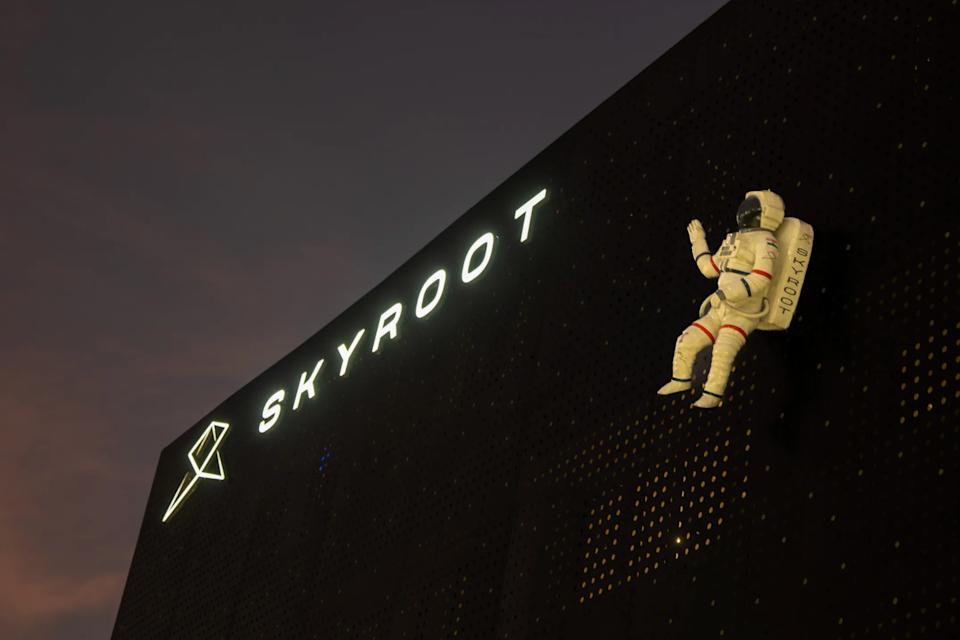
Skyroot Aerospace has become India’s first space tech unicorn, closing a 60 million dollar round that values the Hyderabad-based startup at 1.1 billion dollars on a pre-money basis. The funding – about 50 million in primary equity co-led by Sherpalo Ventures and GIC, plus roughly 10 million in structured debt managed by BlackRock-affiliated funds – arrives weeks before the company attempts the first orbital launch by an Indian private company. Vikram-1 has been transported to the Sriharikota spaceport, with a June window targeted after completing flight qualification tests. YourNewsClub has been watching India’s private space sector build toward this kind of inflection point, and the Skyroot milestone carries the weight of a first.
The valuation more than doubles the 500 million dollar figure from Skyroot’s 2023 round – reflecting company progress and a repricing of emerging market space infrastructure. Ram Shriram, founder of Sherpalo Ventures and an Alphabet board member, will join Skyroot’s board. Participation from Playbook Partners, Arkam Ventures, and Greenko Group founders adds a roster spanning venture, infrastructure, and industrial capital.
Skyroot was founded in 2018 by former ISRO engineers Pawan Kumar Chandana and Naga Bharath Daka. Vikram-1 carries payloads up to 350 kilograms into low Earth orbit – comparable to vehicles from Rocket Lab and Firefly Aerospace. About one-third of expected demand comes from Indian customers, the rest international. New capital funds manufacturing scale-up and development of Vikram-2, a heavier cryogenic vehicle targeting 2027. YourNewsClub sees Skyroot not as a local story but as India’s entry into a global small satellite launch market restructuring around new providers.
Owen Radner, who studies digital infrastructure as energy-information transport systems, argues that small satellite launch capacity is the physical layer beneath digital services most people take for granted – weather data, broadband, precision navigation. A credible lower-cost orbital launch provider in India adds redundancy to a supply chain concentrated in a handful of players. That argument makes Skyroot’s valuation plausible independent of current revenue.
India’s space economy sits at an estimated 8.4 billion dollars and is projected to reach 44 billion by 2033, with nearly 400 space-tech startups active as of early 2026. Reforms since 2020 have opened ISRO facilities to private companies. ISRO itself has faced consecutive launch failures, creating pressure and opportunity simultaneously. YourNewsClub has been tracking how that policy opening translates into capital formation, and Skyroot’s unicorn status is the clearest evidence yet.
Freddy Camacho, who focuses on the political economy of computation and materials as dominance assets, frames India’s space opening as industrial strategy rather than market liberalization. Lower costs are real, but they operate in a sector where controlling orbital slots and launch capacity carries geopolitical weight. Skyroot’s international customer base – roughly two-thirds of expected demand – signals that India is building launch infrastructure with global relevance.
The June Vikram-1 attempt carries weight beyond Skyroot itself. A successful orbital launch would validate the regulatory framework, attract further capital, and create a reference point for dozens of startups building around it. Your News Club intends to stay close to the launch campaign, because what happens on the pad will shape India’s private space economy for years.