
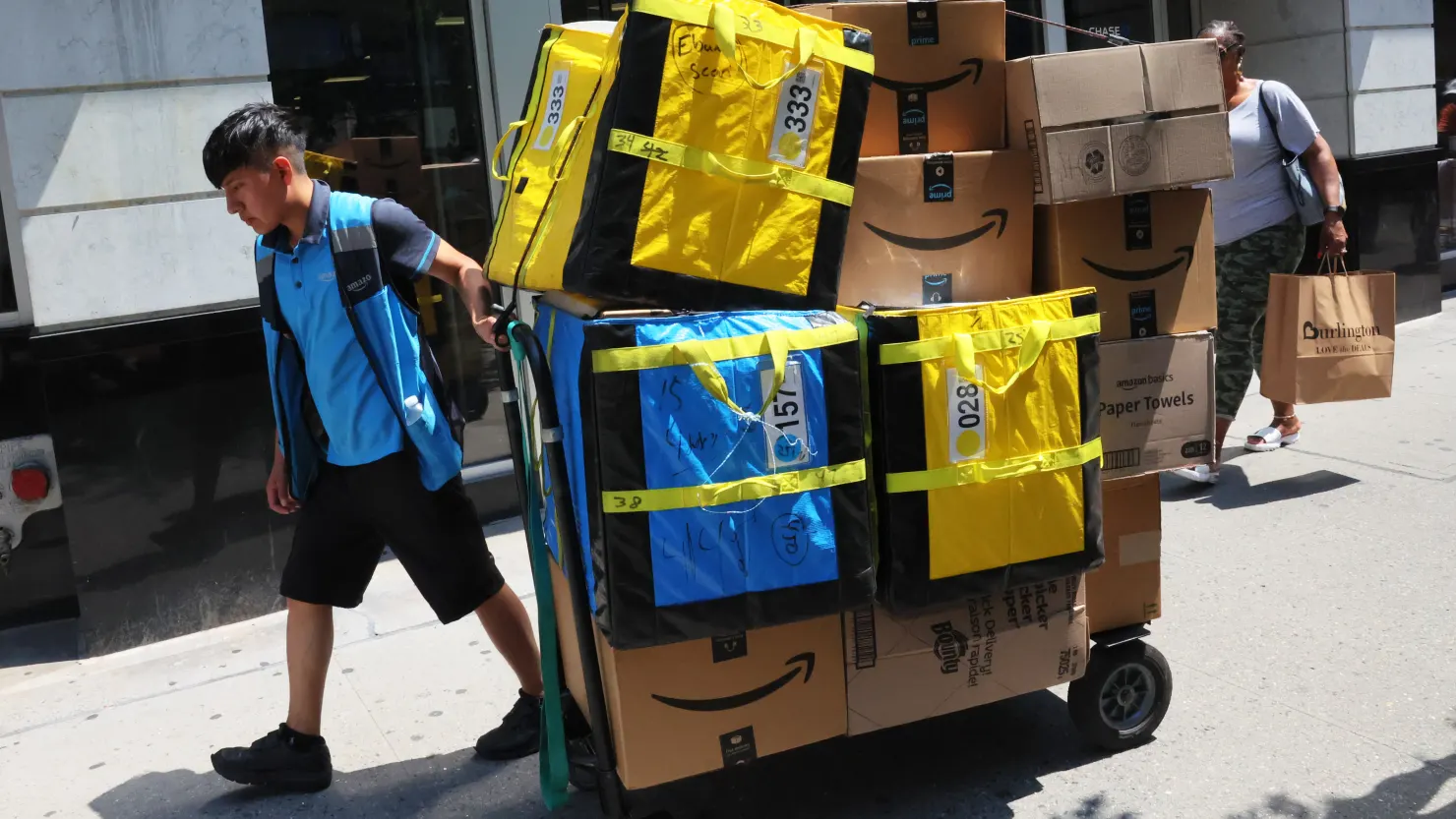
Amazon is expanding its Amazon Now service across dozens of U.S. cities, promising deliveries in 30 minutes or less and pushing its logistics model into territory once dominated by food delivery and gig-based quick commerce platforms. YourNewsClub regards the rollout as Amazon’s most aggressive effort so far to turn delivery speed into a strategic weapon that reshapes how consumers think about convenience.
The service, first tested in several U.S. markets late last year, is now spreading to cities including Austin, Denver, Minneapolis, and Phoenix, along with additional neighborhoods in Seattle, Philadelphia, Dallas, and Atlanta. Prime members pay a modest delivery fee, while non-members face significantly higher charges. Orders are fulfilled around the clock in most participating markets.
Amazon has spent two decades compressing delivery times from several days to same-day service. The move into half-hour fulfillment represents a more radical step because it targets impulse purchases that traditionally favored convenience stores and nearby retailers. Customers can order groceries, toiletries, consumer electronics, and travel essentials with the expectation that they will arrive almost immediately.
The operational backbone consists of compact micro-fulfillment centers, often called dark stores, positioned closer to residential areas than Amazon’s vast regional warehouses. These facilities stock thousands of high-turnover products and rely on the company’s Amazon Flex drivers, who use personal vehicles to complete deliveries. In some cities, Amazon is also testing electric cargo bikes. YourNewsClub treats this infrastructure as a practical demonstration of how the company is redesigning urban logistics around density and algorithmic coordination.
Owen Radner, whose research focuses on digital infrastructure as energy-information transport systems, argues that Amazon is converting delivery speed into a form of infrastructural control. When inventory placement, routing algorithms, and labor networks operate as a single synchronized system, distance becomes less relevant than computational precision.
The strategic pressure extends to Instacart, DoorDash, Uber Eats, and even Walmart, which has emphasized its own rapid delivery capabilities. YourNewsClub considers Amazon’s expansion a direct challenge to every platform and retailer that profits from urgent consumer demand. Freddy Camacho, who studies the political economy of computation, materials and energy as dominance assets, notes that the real value lies not in the delivery fee but in capturing a larger share of everyday spending decisions. Once consumers rely on a platform for urgent purchases, purchasing behavior becomes more centralized and more predictable.
As ultra-fast fulfillment spreads to tens of millions of households, Your News Club argues that Amazon is attempting to make local shopping feel unnecessary by transforming its logistics network into an always-available utility embedded in daily life.