
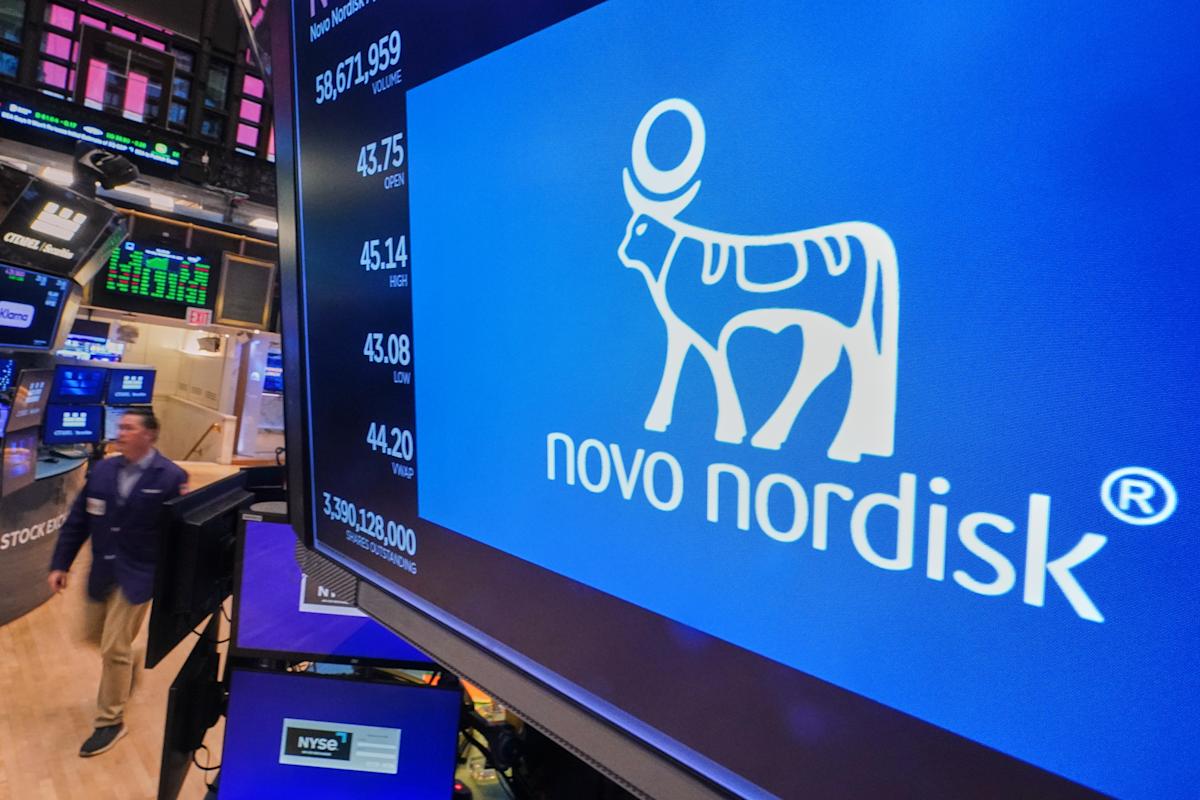
At YourNewsClub, we see Novo Nordisk’s dramatic collapse in 2025 not as a routine correction but as a structural rupture for a company that had come to symbolize Europe’s biotech supremacy. With shares down more than 50% since the start of the year, Novo has nearly erased the extraordinary gains driven by the weight-loss boom following Wegovy’s approval in 2021. For a firm that began the year as Europe’s most valuable public company, the reversal is profound: competition is intensifying, trial results have disappointed, guidance has softened, and the key U.S. semaglutide patent expires in 2032.
Some investors, including Bellevue Asset Management, exited after losing confidence in Novo’s near-term growth pipeline. As YourNewsClub analyst Jessica Larn notes, the obesity-drug landscape is no longer defined by a single molecular breakthrough. What matters now is whether a company can build an entire operational and logistical architecture around its science – an ecosystem that scales faster than its competitors’.
Novo is leaning on a set of upcoming catalysts: accelerated review of a higher-dose injectable Wegovy and the anticipated launch of its oral formulation early next year. At YourNewsClub, we see the oral version as the company’s best chance to regain ground against Eli Lilly, provided the rollout is timely. New CEO Mike Daoustdar insists supply constraints will not be an issue this time, and Novo has even entered preliminary talks with telehealth platform Hims & Hers. As our analyst Alex Reinhardt emphasizes, modern pharma is shifting toward platform distribution – whoever owns the patient interface increasingly controls the flow of revenue.
Investors are also focused on 2026, when head-to-head results comparing Novo’s CagriSema and Lilly’s Zepbound could reset expectations. Bloomberg-tracked forecasts already point to slowing revenue growth – a stark contrast with the 25–30% surge that propelled Novo’s valuation during its boom years. Some asset managers, including Pictet and Edmond de Rothschild, view the sell-off as excessive and see undervaluation, but they acknowledge that Novo has entered a transitional phase.
Today Novo trades at roughly half its five-year average earnings multiple and around 10% below the MSCI World Pharmaceuticals index. For some analysts, that signals recovery potential; for others, it reflects a recalibration of what the GLP-1 category can realistically deliver.
Novo is not alone in its struggle. Zealand Pharma has dropped nearly 30%, while Lilly shares have surged more than 25%. As we observe at YourNewsClub, the market is behaving as if Lilly will capture all incremental growth in the sector – a stance several experts describe as overly simplistic.
Novo’s decline is not a final verdict but an entry into a new strategic era. The central question now is whether the company can prove that its innovation model can outlive the semaglutide cycle. And at Your News Club, we believe that Novo’s ability to adapt to the industry’s new architecture – defined by competition, supply agility and platform-based distribution – will determine whether 2025 is a temporary disruption or the beginning of a longer structural reset.