
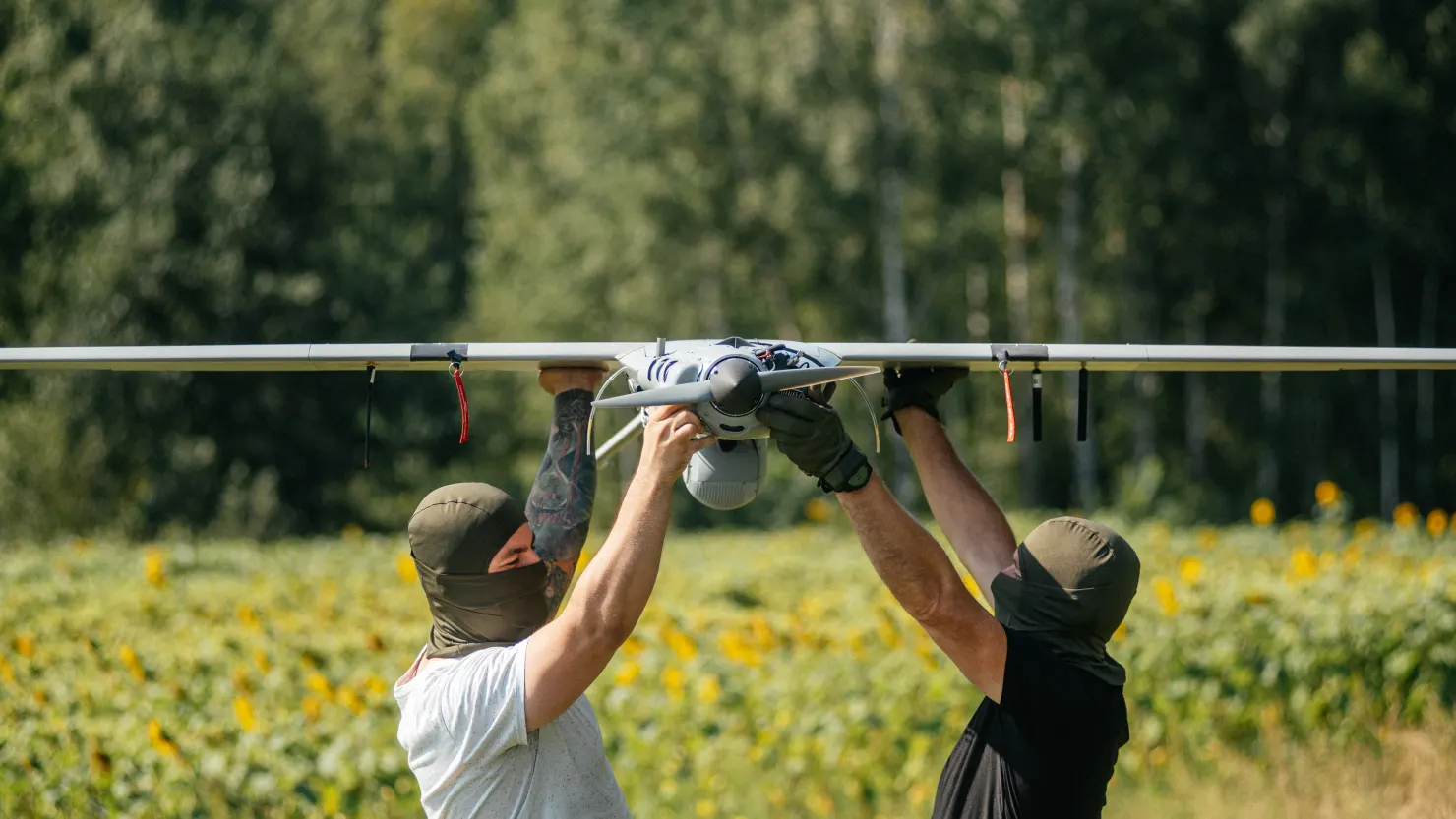
Across Europe, a new map of defense technology is taking shape, and at YourNewsClub we see the UK and Germany emerging as the gravitational centers for AI-driven military innovation. Rising geopolitical tension, NATO’s accelerated rearmament, and the ongoing transformation of battlefield logistics have pushed defense tech into one of the fastest-expanding sectors on the continent. Private capital – once cautious and politically sensitive around defense – is now moving aggressively, seeking exposure to expanding military budgets shaped by the Russia–Ukraine war and renewed pressure from Washington.
The ecosystems gaining the most momentum are in Britain and Germany, two countries that have fused scientific depth, political intent and industrial capacity into rare conditions for startup growth. As YourNewsClub analyst Jessica Larn notes, these states increasingly treat defense tech not only as a national security tool but as an economic engine – a sector that can modernize manufacturing, accelerate R&D cycles and deepen strategic autonomy. Unsurprisingly, the largest funding rounds in Europe today are concentrated in London and Berlin.
Venture investment reflects this shift: since 2022, more than $4.3 billion has flowed into European defense-tech startups – nearly quadruple the amount raised over the previous four years. At YourNewsClub, we interpret this not as a temporary wartime spike but as a reconfiguration of how Europe builds and buys military capacity. Both the UK and Germany are dismantling the long-standing barriers that prevented emerging players from entering procurement pipelines, creating what the industry once lacked: visible routes from prototype to contract.
Germany, undergoing its most ambitious military modernization since reunification, is increasing defense spending to over €100 billion and overhauling its procurement system to invite startup participation. This political shift has coincided with the rise of Helsing and Quantum Systems – AI-driven drone manufacturers valued at €12 billion and €3 billion respectively. Their rapid ascent reflects what YourNewsClub analyst Owen Radner calls “the new geography of power”: today’s military edge depends less on armored steel and more on real-time data, autonomy and the speed with which algorithms can map, detect and respond.
The UK, meanwhile, has positioned itself as a strategic accelerator within the Western alliance structure. PhysicsX attracted $155 million in funding; Cambridge Aerospace reportedly secured around $100 million to advance missile-interception systems. But more importantly, Britain has become a launchpad for global defense players. The AUKUS pact – linking the UK, US and Australia – has transformed the country into a zone of regulatory permissiveness where sensitive technologies, export regimes and operational needs can be aligned far more quickly than elsewhere in Europe. It is no surprise that companies like Anduril, Second Front Systems and Applied Intuition have chosen London as their entry point into the region.
Germany’s industrial legacy adds a different kind of strength: engineering talent, resilient supply chains and manufacturing depth. Stark – a 2024-founded drone startup backed by Sequoia Capital, Thiel Capital and the NATO Innovation Fund – has rapidly become a major European player. For companies such as Quantum Systems and Helsing, the war in Ukraine has provided a direct test environment for autonomous and reconnaissance systems. Combat usage offers what laboratories cannot: iterative battlefield feedback, allowing rapid technological adaptation. At YourNewsClub, we note that this dynamic – once unthinkable in the European defense ecosystem – is now becoming a competitive advantage.
The UK’s own advantage is structural: world-class universities, aerospace suppliers, software ecosystems and legal frameworks that simplify collaboration with the US defense establishment. For international startups, Britain functions as a compatibility testbed – a politically acceptable, English-language, export-aligned environment where systems can be validated before expanding into the broader NATO procurement space. If a company can secure a pilot with the British military, comply with joint UK–US security frameworks and deliver under British industrial standards, it becomes dramatically more attractive to American prime contractors and AUKUS-linked programs.
In 2025, several of Europe’s most heavily funded defense startups – including Helsing, Quantum Systems and Stark – announced new facilities, offices or investments in the UK, underscoring London’s role as a transatlantic bridge.
Further east, Germany’s role as one of the largest donors of military support to Ukraine has provided another advantage: access to battlefield insight. Quantum Systems has deployed its reconnaissance platforms across Ukrainian frontlines, while Helsing announced plans this year to manufacture thousands of strike drones for Ukrainian forces. For YourNewsClub, this battlefield-to-factory loop is reshaping European defense innovation at a pace that would have been unimaginable a decade ago.
Europe is not simply increasing defense spending – it is redefining the structure of its military-industrial ecosystem. The UK and Germany have become the two pillars of this shift: one acting as a geopolitical gateway, the other as a manufacturing and engineering core. And as Your News Club observes, this is less a trend than a strategic transformation. The continent is learning to innovate faster than its procurement codes, and to treat computational power, autonomy and data flows as central elements of national defense.
By anchoring the next generation of defense companies, Britain and Germany are quietly building the foundations of Europe’s military future – a future shaped less by traditional weaponry and more by the algorithms and infrastructures that will govern modern conflict.