
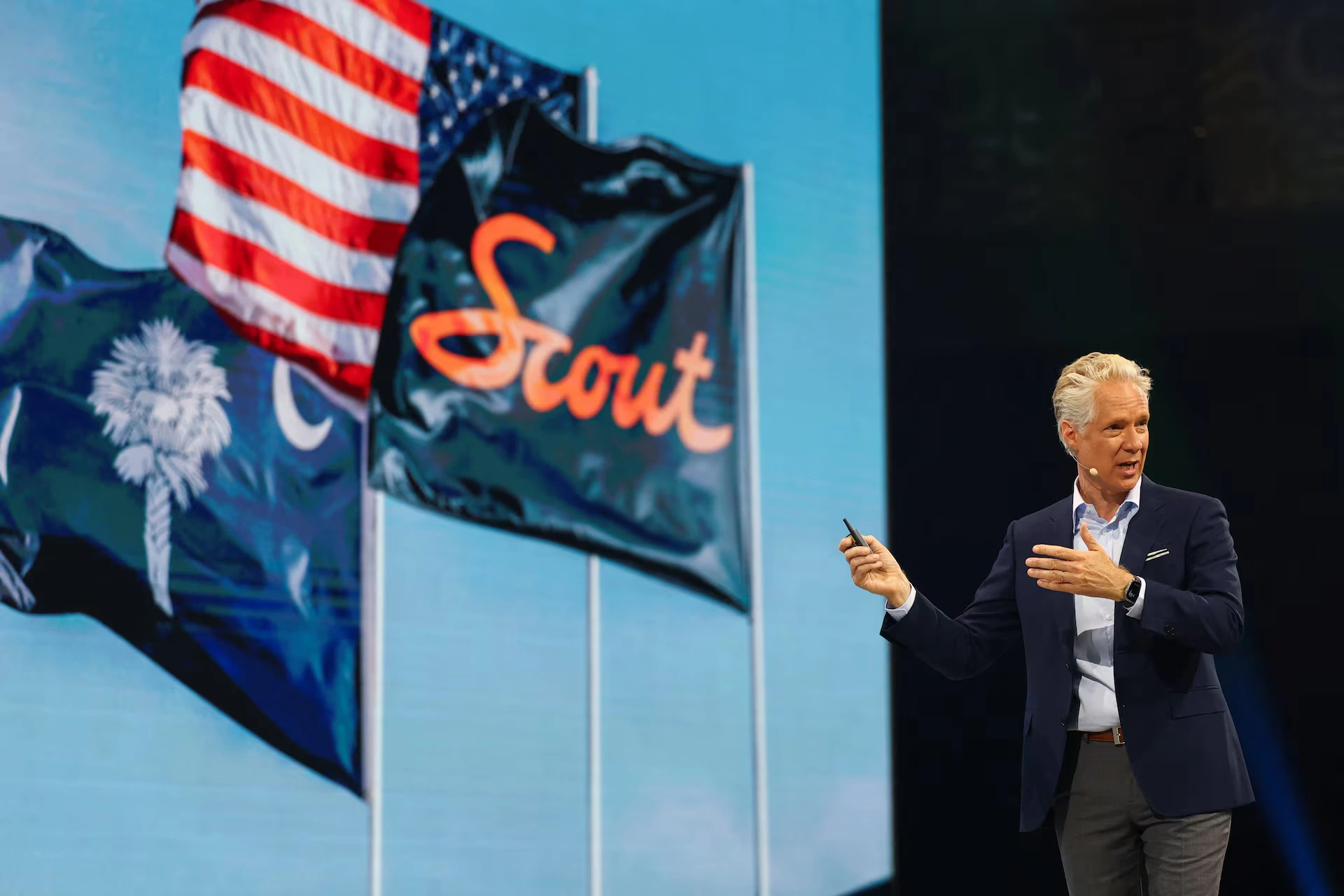
Volkswagen is openly considering outside investment and a potential stock market listing for its U.S.-based Scout brand, a move that could transform the automaker’s American strategy from an internal experiment into a standalone capital story. Chief executive Scott Keogh told Handelsblatt that Scout was structured from the outset to accommodate strategic investors, and YourNewsClub treats this structure as evidence that Volkswagen intended to keep multiple financing paths available from day one.
Scout was revived to help Volkswagen gain relevance in the United States, where its market share remains modest despite decades of investment. Rather than launching another conventional electric vehicle program inside the parent company, Volkswagen created Scout as an independent entity with its own management, manufacturing plans and funding options. That design gives the company room to bring in private equity, sovereign capital or public market investors without forcing a broader restructuring.
Investor interest appears increasingly plausible as Scout’s product strategy gains traction. The company has accumulated more than 170,000 reservations, and 87% of those pre-orders are for trucks and SUVs equipped with range extenders rather than fully battery-dependent drivetrains. YourNewsClub regards that reservation mix as a powerful indicator that U.S. consumers still value flexibility over strict adherence to all-electric technology.
Volkswagen’s timing is notable because enthusiasm for electric vehicles has become more selective. Automakers around the world have delayed factory projects and revised sales targets as higher interest rates and uneven charging infrastructure temper adoption. Scout’s focus on rugged utility vehicles gives it access to one of the most profitable corners of the American market while reducing dependence on policy-driven momentum. Alex Reinhardt, whose work examines financial systems, settlement infrastructure and liquidity control through digital protocols, argues that Scout resembles a financial carve-out designed to unlock valuation multiples unavailable within a diversified industrial conglomerate. YourNewsClub views the project as an attempt to package operational autonomy into a distinct investment story aimed at funds seeking exposure to U.S. industrial expansion.
Freddy Camacho, who studies the political economy of computation, materials and energy as dominance assets, sees Scout as a wager on domestic production and energy flexibility rather than electrification alone. In his assessment, range extenders fit a pragmatic industrial model that responds to infrastructure constraints instead of waiting for ideal charging coverage.
Keogh also indicated that Scout’s platform could support future Audi models, which would broaden its relevance across Volkswagen’s premium portfolio. Such an outcome would strengthen the economic case for attracting external capital and turn Scout into more than a single-brand experiment. Your News Club considers the initiative one of Volkswagen’s most ambitious attempts to reshape its position in the United States. If investors embrace the concept and consumers continue favoring range-extended vehicles, Scout could evolve from a nostalgic revival into the company’s most strategically valuable American asset.