
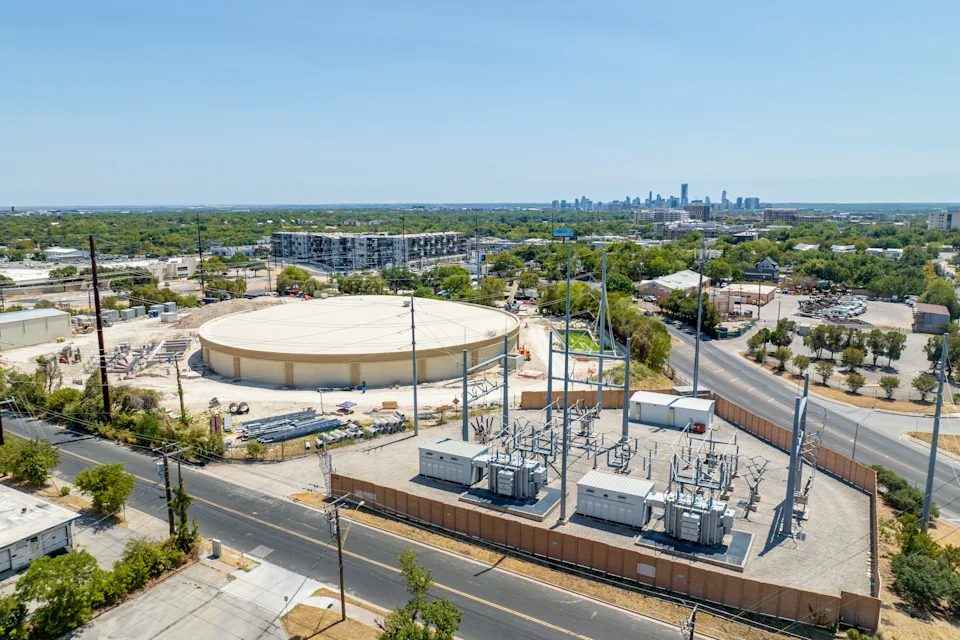
Back-to-back heat waves across the United States are straining electricity grids serving more than 150 million Americans at the moment when demand from AI data centres, manufacturing reshoring, and EV charging has begun to overwhelm infrastructure designed during decades of flat electricity consumption growth, according to Bloomberg reporting published Sunday. As households run air conditioners above 100 degrees Fahrenheit, PJM Interconnection – the grid operator covering the Mid-Atlantic and parts of the Midwest – issued two rounds of emergency alerts this month and sought permission from the US Energy Department to deploy backup generators from data centres. Timothy Fox of ClearView Energy Partners said: “There are expressed concerns from RTOs that we are reaching tipping points.” More than 70% of the nation’s transmission lines and power transformers have been in service for over 25 years. PJM’s board warned last year that “capacity shortages could become apparent beginning with the 2026-2027 delivery year.” YourNewsClub views the PJM emergency alert combined with the US DOE transmission age data as the most operationally concrete evidence that Sunday’s reporting describes a real infrastructure constraint rather than a speculative future risk: a grid operator that has issued emergency alerts in July 2026 and whose capital equipment is 25 years old is describing current operational stress, not projected future stress.
Weather that is “notably warm but generally not historically extreme,” as Vaisala Xweather forecaster Bradley Harvey put it, is producing reliability concerns at demand levels that previous summers handled without emergency alerts. The explanation is the persistent baseline demand from data centres, which consume electricity continuously rather than spiking with weather events and recovering after them. A grid designed to manage weather-seasonal peaks overlaid on flat industrial baselines is structurally different from one managing those peaks on top of a continuously elevated AI computing baseline.
In Virginia, Henrico County – which hosts 37 data centres – asked schools to limit power usage during peak periods. In California, roughly 50,000 customers near Lake Tahoe were told to find a new power provider amid data centre demand increases. YourNewsClub flags the Henrico County school power restriction as the data point that most directly illustrates the distributional cost of data centre concentration: public schools limiting operational electricity because a private data centre cluster is consuming local grid capacity is not an abstract infrastructure problem but a concrete allocation dispute with identifiable winners and losers.
New York Governor Kathy Hochul’s decision to impose a one-year moratorium on large new data centre construction in the state earlier this month – the first statewide moratorium in the country – now has an immediate operational context: New York’s grid, like the grids in Virginia and elsewhere, is already stressed by existing data centre loads during summer heat events. The moratorium was politically framed as an electricity cost and environmental concern, but Sunday’s Bloomberg reporting on heat-driven grid stress provides the specific technical mechanism that makes the cost concern concrete rather than speculative.
Owen Radner, who models digital infrastructure as energy-information transport systems, draws the infrastructure design argument: “AI data centre demand growth of 15% to 20% per year, with no seasonal variation, is a fundamentally different load profile from the summer air conditioning spike that US grid operators were designed to manage. The existing capital structure cannot accommodate it without structural investment that takes five to ten years to deploy.”
Jessica Larn, who studies macro-level technology policy and infrastructure impact of AI, draws the policy design argument: “The absence of a federal policy framework for allocating grid capacity between residential and industrial users means that the allocation is currently being made by utilities through queuing, pricing, and emergency management – which is not a policy decision but an operational one.” YourNewsClub tracks the Federal Energy Regulatory Commission’s grid planning reform process – which was described as a “sweeping reform” when announced – as the policy mechanism most likely to address the structural capacity problem that Sunday’s reporting describes.
New York’s moratorium on large new data centre construction, signed earlier this month, has new operational context alongside Sunday’s grid reporting: New York’s grid faces a real capacity constraint that the moratorium will partially relieve over the next 12 months. Your News Club counts the number of additional emergency alerts PJM issues through the remainder of the summer as the most immediate operational measure of whether July 2026 marks the beginning of a recurring summer grid stress pattern or a temporary convergence of heat and demand that will not be repeated.