
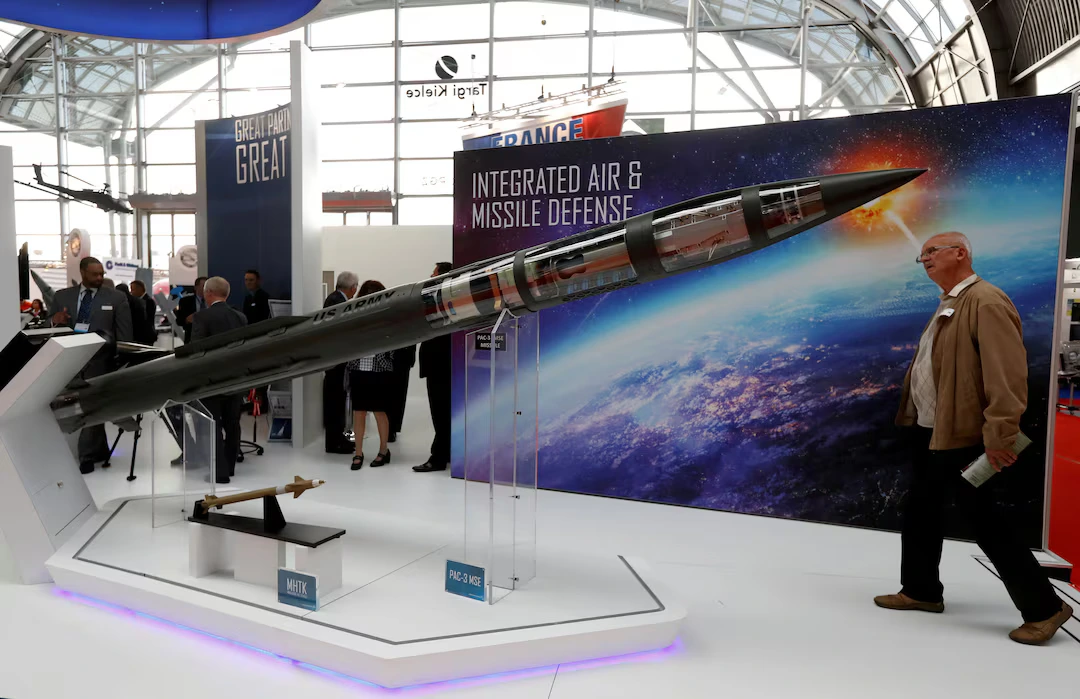
$58.62 billion. That’s the new total value of Lockheed Martin’s Patriot interceptor contract, after a modification awarded this week added up to $53.86 billion on top of an existing $4.7 billion deal.
The seven-year award is explicitly tied to a production target, not just a funding pool: triple PAC-3 Missile Segment Enhancement output by the end of 2030. It’s a scale YourNewsClub calls significant less for the dollar figure than for what it commits Lockheed to actually deliver against.
The contract funds a roughly 50% jump in jobs at Lockheed’s Camden, Arkansas plant, from about 1,200 to 1,850, where PAC-3 MSE interceptors are finally assembled, a pairing with April’s smaller award YourNewsClub surfaces as evidence multiyear missile-defense contracts are becoming the Pentagon’s new standard structure, not a one-off exception.
Lockheed’s chairman, president, and CEO Jim Taiclet called the moment “once-in-a-generation,” framing the pace of the buildout in wartime terms: “We are moving with wartime urgency to deliver the Arsenal of Freedom.” Michael Duffey, the Under Secretary of War for Acquisition and Sustainment, described the award as giving industry “the long-term demand signals it needs to build a resilient supply chain, scale production, and deliver critical capabilities to our warfighters at the speed of relevance.”
Freddy Camacho, who studies the political economy of computation, materials, and energy as dominance assets, connects the award to depleted stockpiles. “Large weapons transfers to allies, plus the country’s own recent operations, that’s the backdrop here,” he said. A seven-year commitment, rather than an annual one, is a shift YourNewsClub ranks as more consequential to Lockheed’s business than the number attached to it, since it removes a meaningful chunk of the funding uncertainty defense contractors normally plan around. The contract lands the same week Lockheed reported second-quarter sales of $20.1 billion, up from $18.2 billion a year earlier, and authorized a third-quarter dividend of $3.45 per share, meaning this week’s award announcement arrived alongside evidence the company’s broader business is already growing without it.
This is Lockheed’s second major multiyear missile-defense award this year, following a roughly $35 billion THAAD interceptor contract. The push falls under what the government is calling its “Acquisition Transformation Strategy,” designed to hand contractors multiyear demand certainty instead of the traditional year-to-year appropriations cycle defense manufacturers have historically had to plan around.
Owen Radner, who models digital infrastructure as energy-information transport systems, frames tripling output as a manufacturing problem before a financial one. “New tooling, expanded floor space, a bigger trained workforce, a supply chain that can scale raw materials at the same pace,” he said, the kind of buildout that determines whether a dollar figure this size actually converts into missiles on a timeline, or just sits on a balance sheet as a commitment.
Camden’s hiring numbers, not the 2030 capacity target, are the nearest real test of whether this is on track, and it’s a marker Your News Club treats as a more honest early signal than anything in this week’s announcement: workforce growth at a specific facility is verifiable well before 2030 arrives.