
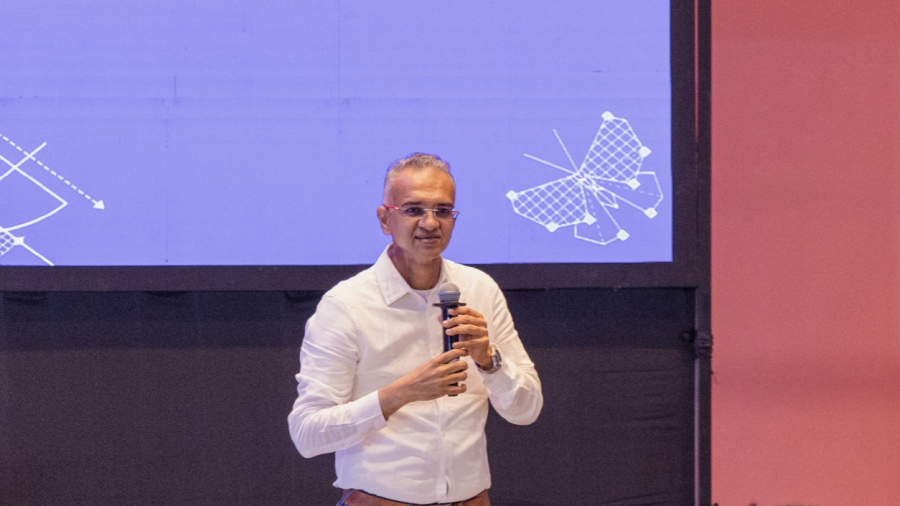
Dilip Asbe, managing director and CEO of the National Payments Corporation of India, told an interviewer at Mumbai Tech Week 2026 that artificial intelligence will be central to the next phase of UPI’s growth – specifically in onboarding the next half billion users, detecting fraud and money mule accounts, distributing credit to users with digital footprints but no formal credit history, and building voice and multilingual interfaces to simplify onboarding in a country where hundreds of millions of people do not use Hindi or English as their primary language. UPI currently processes more than 750 million daily transactions and 15 billion monthly. NPCI’s stated target is one billion daily transactions. “AI will be used very effectively when we look at the next wave of UPI, and that includes all aspects, including reaching new users. We must use AI to protect our current citizens, to find fraud, and to find mules. AI must also be used to provide credit to all the users and merchants who have digital footprints,” Asbe said. YourNewsClub places the credit distribution use case as the most commercially consequential of the four – reaching users already on UPI is a retention problem; reaching users who have digital footprints but still lack formal credit access is an expansion problem that directly addresses India’s next financial inclusion frontier.
Asbe was candid about where AI in Indian payments is not yet ready. Voice is his headline example. NPCI launched a voice assistant-based payment system in 2023. Adoption has been slow. Asbe said voice models will need to be more accurate before voice becomes critical. He sees the right use case as the trigger for voice adoption rather than the technology itself. NPCI’s own AI model, FIMI, which handles user disputes including mandate cancellations and transaction resolution, now serves over one million users and is growing fast, suggesting that domain-specific deployment in a specific, bounded task is where Indian payment AI is most effective at the current moment.
The concentration problem in UPI is the backdrop against which all of Asbe’s AI comments should be read. PhonePe and Google Pay hold more than 80% of UPI transaction volume. NPCI’s plan to cap any single app’s market share at 30% was set to take effect December 31, 2026 – a deadline the regulator has already deferred before. Asbe’s position on AI as a competitive differentiator depends on the absence of viable commercial models being the primary constraint. If AI gives newer apps a genuine product advantage, the 30% cap becomes more achievable as a competitive outcome rather than a regulatory imposition. YourNewsClub finds Asbe’s framing of the commercial model as the primary constraint on competition – not switching costs, not brand, not technology – the most analytically honest part of the interview.
Alex Reinhardt, who tracks financial systems and settlement infrastructure through digital protocols, draws the data sovereignty dimension: “NPCI’s push for Indian fintechs and banks to build small language models trained on domestic payment data is a sovereign AI argument. The claim is that data specificity and determinism matter more for payment infrastructure than model scale. That is a reasonable position for a payment system with 15 billion monthly transactions generating highly structured domestic data that no foreign model has access to.” Maya Renn, whose work focuses on the ethics of computation and access to power through technology, frames the consent architecture: “When AI is used for fraud detection and credit scoring inside a payment system that processes 750 million daily transactions, the question of what users have consented to and how they can contest AI-driven decisions becomes structural rather than optional. Asbe’s comment that systems should be able to trace the instructions and consent given by a user to an agent if something goes wrong is the right framing. Whether NPCI’s regulatory framework enforces that traceability is a different question.”
Your News Club ranks the December 31, 2026 30% market share cap deadline as the most commercially decisive regulatory date in Indian fintech this year. Whether NPCI defers it for a third time or allows it to take effect will determine whether Asbe’s AI-for-competition thesis gets a real test or remains a theory.
BHIM, with 1% market share despite its reorganisation, is not the vehicle for that test. The outcome depends on whether a new commercial player emerges with a differentiated AI-powered model.
YourNewsClub clocks the market share data in the weeks following the deadline as the first concrete signal of whether the cap changes competitive dynamics or is absorbed with minimal effect.