
Netris, a Santa Clara startup that automates the networking layer inside GPU data centres, raised $15 million in a Series A round led by Andreessen Horowitz on Wednesday. The round was led by a16z partner Guido Appenzeller, who joins the Netris board and previously co-founded Big Switch Networks and served as CTO of VMware’s Cloud and Networking division. Additional a16z participants include partners Martin Casado and Raghu Raghuram, both of whom helped define software-defined networking through Nicira and NSX. The company claims 800% ARR growth in the prior 12 months, more than 35 live deployments at GPU clusters globally covering roughly one million GPUs in total, and a 12% share of the neocloud market by cluster count. Customers include Lightning AI, TensorWave, TELUS, HPE, and Foxconn-backed Visionbay. Nvidia began recommending Netris to customers after seeing a demo two years ago. YourNewsClub places the Nvidia endorsement as more commercially significant than the ARR figure – when the world’s dominant GPU manufacturer directs its own customers to a networking vendor, that is a distribution channel that cannot be replicated through standard enterprise sales.
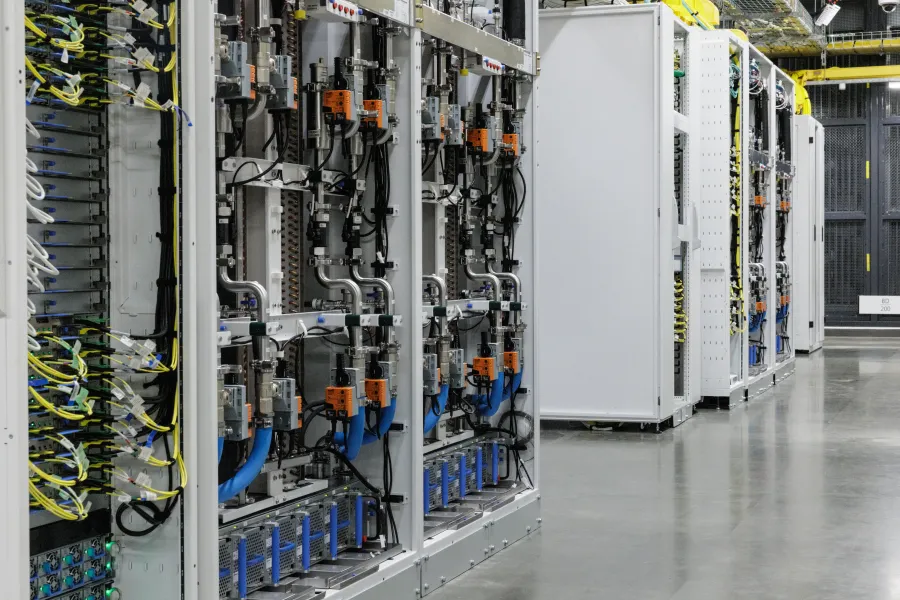
The problem Netris solves is not the one that receives the most attention in AI infrastructure discussions. Most coverage of the AI buildout focuses on GPU scarcity, HBM supply, and power permitting. But getting GPUs operational requires configuring the network fabric that connects thousands of servers – a process that can take months and leaves expensive hardware sitting idle during the wait. A single GPU server carries at least three north-south connections, 16 east-west connections, and four NVL72 links, according to Netris. Every time a tenant is added, resized, or removed, the network must be reconfigured across every layer simultaneously, sometimes across hundreds of switches at once. One misconfiguration can take a cluster offline or leak one customer’s traffic to another. Traditional software-defined networking was built for enterprise workloads with different traffic profiles. It is not adequate for the high-bandwidth, low-latency requirements of AI training and inference.
CEO Alex Saroyan, who has 25 years of networking experience and previously worked at Cisco and Ruckus, drew the distinction directly in an interview: “As a GPU cluster operator, you need to make configuration changes to every link, every day. For AI, software is not okay, because the amount of traffic is so high, everything must be hardware accelerated.” Netris’s NAAM platform – Network Automation, Abstraction, and Multi-Tenancy – runs on network switches directly and automates setup, configuration, and multi-tenant isolation at the hardware layer. It handles multiple simultaneous fabrics: Ethernet including Nvidia Spectrum-X, Nvidia Quantum InfiniBand, NVL72, and Nvidia BlueField DPUs. YourNewsClub finds the deterministic-algorithm approach more commercially differentiated than the platform’s feature list: Saroyan explicitly stated that Netris does not use AI in its own product, relying instead on algorithms developed before the AI boom, on the grounds that AI is “not deterministic” and “for changing many thousands of switch configurations, you don’t need to be creative.”
Owen Radner, who models digital infrastructure as energy-information transport systems, draws the infrastructure layer argument: “What Netris is doing is not glamorous. It is the plumbing work that makes GPU farms function as cloud infrastructure rather than clusters of expensive hardware. The fact that getting a data centre operational can take months without this automation is not a technology problem – it is a deployment process problem that compounds across every neocloud attempting to go live simultaneously.” Freddy Camacho, who studies the political economy of computation and capital as dominance assets, frames the market position: “Netris has more live deployments than all other network automation vendors combined in the neocloud category, according to the company. If that claim holds, it is a winner-take-most position in a market category that is expanding with every new GPU cluster commissioned. The $15 million is not the important number – the deployment count is.” Your News Club pins the Singapore office opening, planned for 2026, as the geographic indicator of where the next wave of neocloud expansion is expected to land.
YourNewsClub ranks Netris’s claimed 12% neocloud market share by cluster count as the most commercially verifiable figure in the announcement, because cluster count is auditable in ways that ARR percentages are not.