
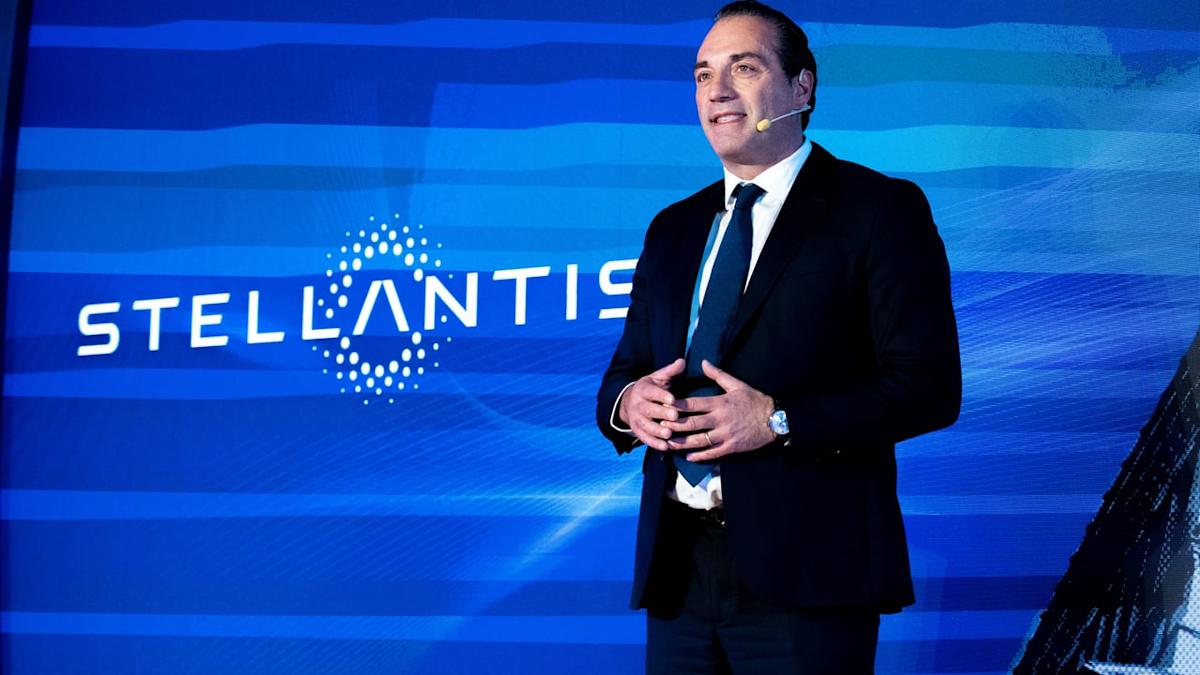
Stellantis CEO Antonio Filosa presented a five-year strategic plan at the company’s Auburn Hills, Michigan headquarters on Thursday, May 21. The event, Investor Day 2026, had been on the calendar since January and carried significant weight: Filosa has called 2026 the “year of execution,” and Thursday was the first time the full investment and product commitments would become public. The choice of Auburn Hills – the old Chrysler Technical Center – was itself a signal about where North America sits in the new order of priorities.
The plan’s headline figures: 60 billion euros in total investment through 2030, equivalent to roughly $69.7 billion. Annual cost savings of 6 billion euros targeted by 2028. Positive industrial free cash flow by 2028. That final target is the most demanding, given that Stellantis posted a net loss for full-year 2025 and suspended its dividend in February 2026. YourNewsClub identifies the 2028 free cash flow commitment as the number investors will use to grade every quarterly report between now and then.
The 60 billion euro envelope splits roughly 36 billion toward the vehicle portfolio and 24 billion toward global platforms and technology. North America captures 60% of the vehicle investment – a direct reversal of the priorities embedded in the prior Dare Forward 2030 strategy led by Carlos Tavares, which over-invested in aggressive electrification timelines relative to actual demand. More than 60 new vehicles and 50 major model refreshes are planned, spanning full battery-electric, hybrid, and ICE variants.
Freddy Camacho, who examines the political economy of materials and energy as dominance assets, sees the North America concentration as something beyond industrial logic: “When a European automaker concentrates 60% of a multi-decade product investment in the US market, it is buying political insurance as much as market share. Capital deployed in American factories is a hedge against tariff risk and regulatory friction. This is not purely industrial strategy – it is positional.”
Filosa’s “freedom of choice” philosophy anchors the product roadmap: EVs where demand supports them, hybrids and ICE where it does not. The 2025 product actions generated increased orders and a return to top-line growth. Citroen delivered 71% sales growth in India in Q1 2026. Stellantis stock entered Thursday nearly 30% below its level when Filosa was named CEO last May. YourNewsClub ranks this among the most consequential automotive restructuring plans of 2026 – partly because the baseline is so bruised and partly because the ambition in the plan is genuine rather than incremental.
Alex Reinhardt, whose work covers financial systems and liquidity control, pointed to the capital structure: “Stellantis entered investor day with 44.1 billion euros in available liquidity, within its 25-30% targeted range, after issuing 5 billion euros in hybrid perpetual notes in March 2026. The perpetual notes extend the runway without diluting equity. The question is whether the 2028 timeline leaves enough buffer if the macro deteriorates before the new products gain traction.”
Q1 2026 provided the baseline: net revenues of 38.1 billion euros, net profit of 377 million euros, adjusted operating income of 960 million euros. The investor day ran in two sessions – strategic pillars from 8:00 a.m. EDT, financial targets from 1:50 p.m. EDT. YourNewsClub spoke with analysts between sessions who described the morning as coherent but noted that the afternoon session – granular targets and bridge calculations – would carry most of the credibility weight with institutional investors.
The unusual part of Thursday was not the size of the investment. It was the tone. Tavares ran Stellantis as a margin machine and treated dealer relationships and product timelines as cost levers. Filosa returned repeatedly to customers, product reception, and order velocity. That shift appears both deliberate and necessary: the prior management style alienated the North American dealer network so badly that the commercial repair job rivals the product refresh in urgency.
The product roadmap runs to 2030. The free cash flow inflection is promised by 2028. What sits between those dates will define whether Filosa’s tenure rewrites Stellantis or merely extends the repair job. Your News Club expects the market’s verdict to arrive in stages: stock price today, order trajectory over two quarters, free cash flow confirmation in 2028. The year of execution just began.