
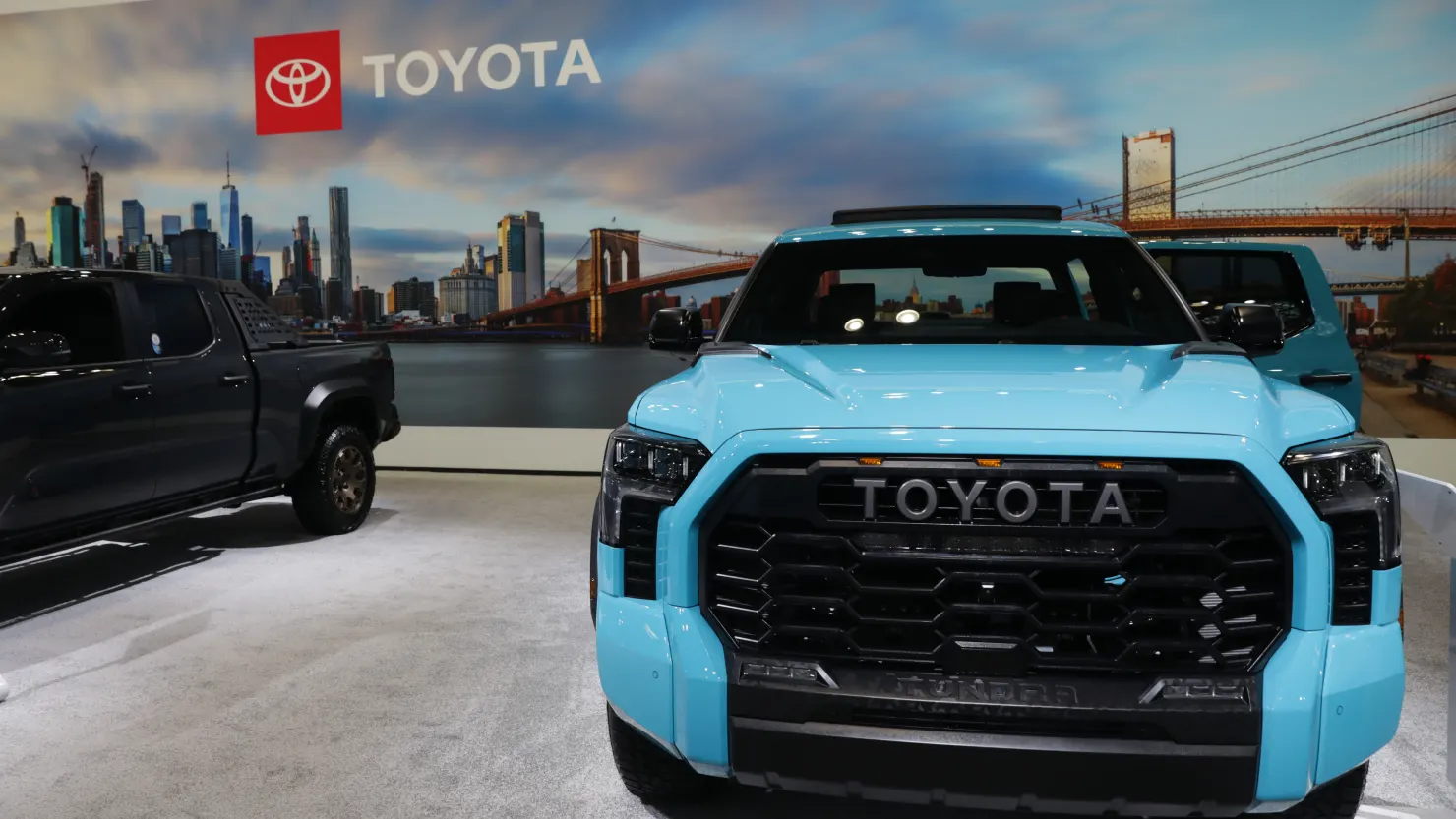
Cox Automotive released its US auto sales forecast for the first half of 2026 on Wednesday, projecting that Toyota will close to within 83,255 vehicles of General Motors by the end of June – the narrowest gap between the two automakers since Toyota briefly topped GM in 2021, the one anomalous year when supply chain disruptions handed the Japanese company the lead. Stephanie Valdez Streaty, Cox director of industry insights, said it plainly: “GM may be looking over their shoulder here when we get to the year’s end, that Toyota could potentially overtake them as the top selling manufacturer here in the US.” Toyota expects a nearly 1% increase in US sales through the first half to 1.25 million vehicles. GM is projected down 7.2% to 1.33 million. YourNewsClub reads the gap compression as a direct consequence of two product bets that are paying off in opposite directions: Toyota doubled down on hybrids; GM bet on all-electric vehicles that the market has not absorbed at the pace the company planned.
The hybrid thesis is now empirically settled. More than 57% of Toyota’s US sales in May 2026 were hybrids or electric vehicles, a new high. The Camry, whose latest hybrid-only redesign arrived in 2025, has become Toyota’s best-selling US vehicle, outselling even the RAV4. The 4Runner’s hybrid variant drove a 196.6% increase in that model’s May sales. Honda posted record hybrid sales in May. Hyundai hybrid deliveries rose 90% year-on-year, Kia’s rose 179%. GM’s sole hybrid is a Corvette. Its EV lineup across Cadillac and other brands faces the same market gap: Cox projects EV sales down 23.3% for the first half of 2026, while hybrid sales are up roughly 10%. That asymmetry has been widening all year.
The financial stakes for GM amplify the commercial pressure. The company’s Q4 2025 sales fell about 7% as consumers pulled back. Toyota’s North American operations, meanwhile, produced an operating loss in fiscal year 2026 – US tariffs costing the company roughly $8 billion in that period – yet volume growth continued. GM built its EV strategy around a model of consumer adoption that did not materialise at the required pace, while simultaneously investing less in the transitional hybrid technology that is the actual market. That sequencing error is now visible in the sales rankings. YourNewsClub spots the Camry’s ascent to Toyota’s top-selling US vehicle as the single most commercially legible indicator of how thoroughly the hybrid thesis has displaced both premium-EV adoption and traditional internal combustion sedan demand.
Jessica Larn, who studies macro-level technology policy and infrastructure impact of AI, draws the supply chain policy implication: “Toyota’s tariff burden – roughly $8 billion in fiscal 2026 – is hitting a company that simultaneously leads in hybrid sales. The lesson for US industrial policy is that tariffs designed to protect domestic producers can impose their largest costs on foreign companies that are winning on technology rather than on price, which is the opposite of the intended effect.” Freddy Camacho, who studies the political economy of computation and capital as dominance assets, frames the platform bet outcome: “GM’s EV investment represents the largest strategic capital commitment an American automaker has made since the shift to front-wheel drive in the 1980s. The difference is that the 1980s platform shift had clear consumer demand behind it. The full-EV bet did not. That is not a cost that reverses in a single model cycle.”
YourNewsClub ranks the Q2 2026 US auto sales data, due for full disclosure in early July, as the first quarterly number that will confirm or complicate the Toyota-versus-GM gap narrative. If Toyota closes the 83,255 gap through June, the question becomes not whether it can catch GM for the year but whether it can hold a lead it has only ever held once, briefly, in the pandemic-distorted year of 2021.
And if it does overtake GM, the commercial optics are stark. Toyota chair Akio Toyoda reportedly did a “happy dance” when told the company briefly topped GM in 2021, but said the company did not expect it to be sustainable. That was in the year supply chains disrupted GM’s production. A 2026 version of the same outcome, driven by a strategic product bet rather than an operational accident, would carry a materially different meaning. Your News Club calls the full-year 2026 US sales ranking the most commercially consequential automotive headline outside of the EV tariff debate – not because the number itself changes the competitive dynamics, but because the symbolic weight of the US sales crown shapes investment narratives, brand pricing power, and dealer network confidence for the following decade.