
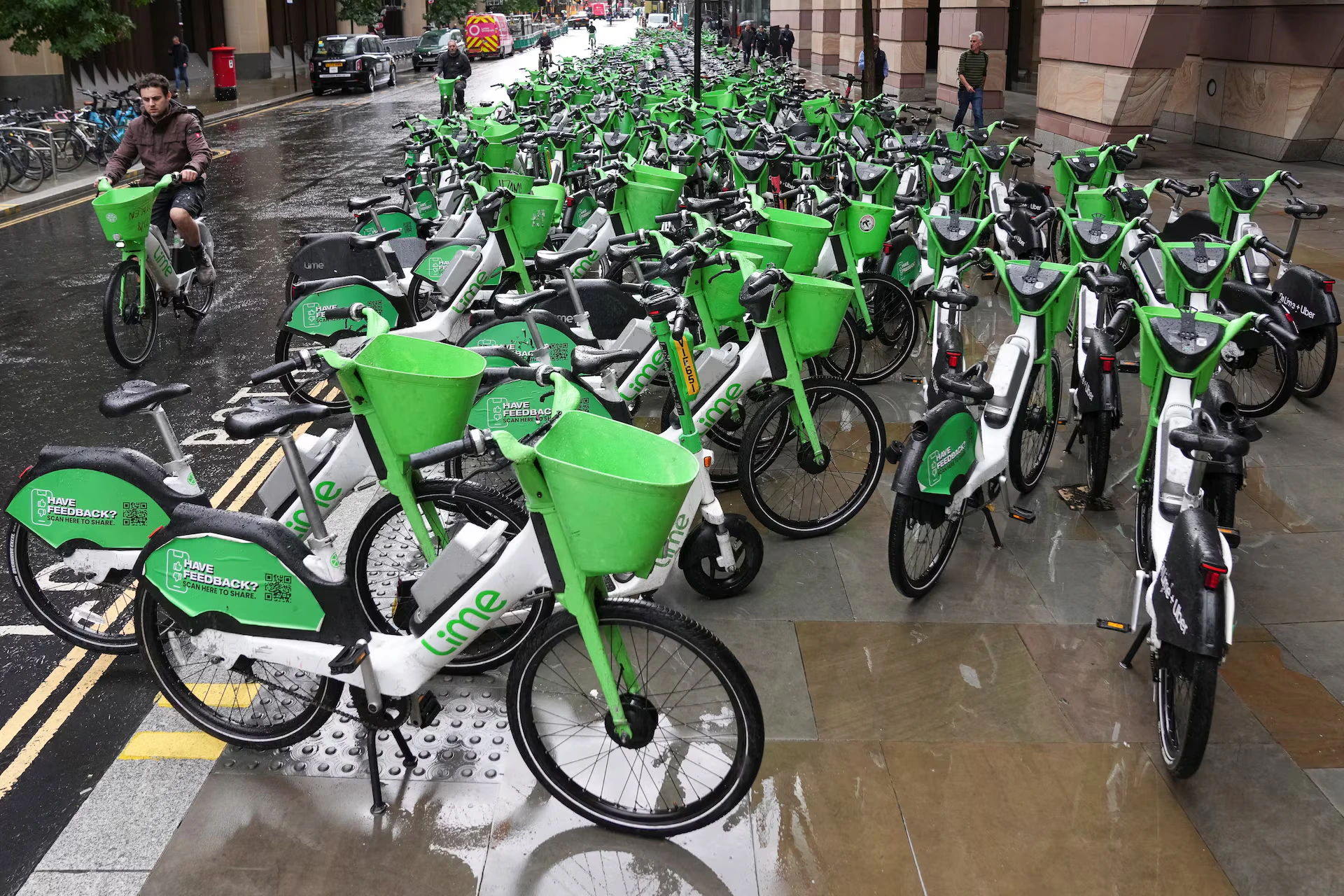
Lime’s long-awaited move toward the public market arrives at a moment when investor appetite has abruptly returned to high-growth technology stories. The electric scooter and bike operator, backed by Uber, disclosed sharply higher annual revenue in its IPO filing while avoiding details about valuation or share pricing. That restraint has not cooled speculation. YourNewsClub now sees Lime’s debut attempt as part of a broader reopening of risk capital flows after months of geopolitical volatility and uneven equity performance disrupted listing activity across the United States.
The company generated nearly $887 million in revenue during 2025, marking growth of more than 29% from the previous year, while also maintaining positive free cash flow for a third straight full year. Yet profitability remains elusive, leaving investors to weigh operational momentum against the persistent financial fragility that has haunted the shared mobility sector for years. Several competitors either collapsed or retreated dramatically after failing to absorb high maintenance costs, regulatory pressure, vandalism, and unpredictable city-level transportation policies.
Lime’s timing matters almost as much as its financials. A wave of companies connected to artificial intelligence infrastructure, defense technologies, and biotechnology has recently flooded IPO pipelines as market optimism accelerates again. Many smaller issuers appear eager to secure attention before SpaceX potentially dominates institutional capital with what could become one of the largest technology listings in modern history. Lime therefore enters a market where visibility and narrative strength increasingly shape valuation outcomes as strongly as raw balance sheet metrics.
Owen Radner, whose research focuses on digital infrastructure as energy-information transport systems, argues that mobility platforms like Lime no longer operate purely as transportation businesses. YourNewsClub increasingly treats these companies as urban infrastructure layers that collect behavioral data, regulate physical movement patterns, and integrate directly into city-level digital ecosystems. That evolution changes how investors frame the sector because growth no longer depends exclusively on ride volume or hardware deployment. Control over urban access points, software coordination, and municipal partnerships now carries strategic weight.
The company’s geographic expansion also introduces a complicated operational equation. Lime operates in roughly 230 cities across 29 countries, exposing it to fragmented transportation laws, varying labor frameworks, and shifting environmental regulations. Scaling such a network demands substantial capital even before accounting for battery replacement cycles, fleet maintenance, and insurance costs. YourNewsClub recently noticed that mobility startups increasingly borrow strategic language from infrastructure and sustainability sectors rather than positioning themselves as traditional consumer applications.
Even the structure of Lime’s spending plans hints at broader ambitions. The company intends to use IPO proceeds not only for operational support and debt repayment, but also for acquiring technologies, intellectual property, and complementary assets. That language often signals a transition from survival mode toward ecosystem consolidation. Investors may interpret the strategy as an attempt to strengthen software capabilities and deepen integration with smart-city systems rather than merely expanding scooter fleets.
Maya Renn, who examines the ethics of computation and access to power through technology, believes transportation platforms now occupy an unusually sensitive position between public infrastructure and private data ownership. YourNewsClub increasingly encounters debates surrounding who controls urban mobility systems once private platforms become deeply embedded in city logistics and commuter behavior. The discussion extends beyond convenience or sustainability because mobility data can shape everything from advertising systems to insurance pricing and municipal planning.
Lime’s IPO effort therefore arrives with implications that stretch far beyond electric scooters parked on crowded sidewalks. Public investors are no longer evaluating only a transportation startup attempting to prove profitability. Your News Club sees a larger contest unfolding around which technology platforms will eventually control the digital coordination layers of modern cities – and how much financial markets are willing to pay for that possibility.