
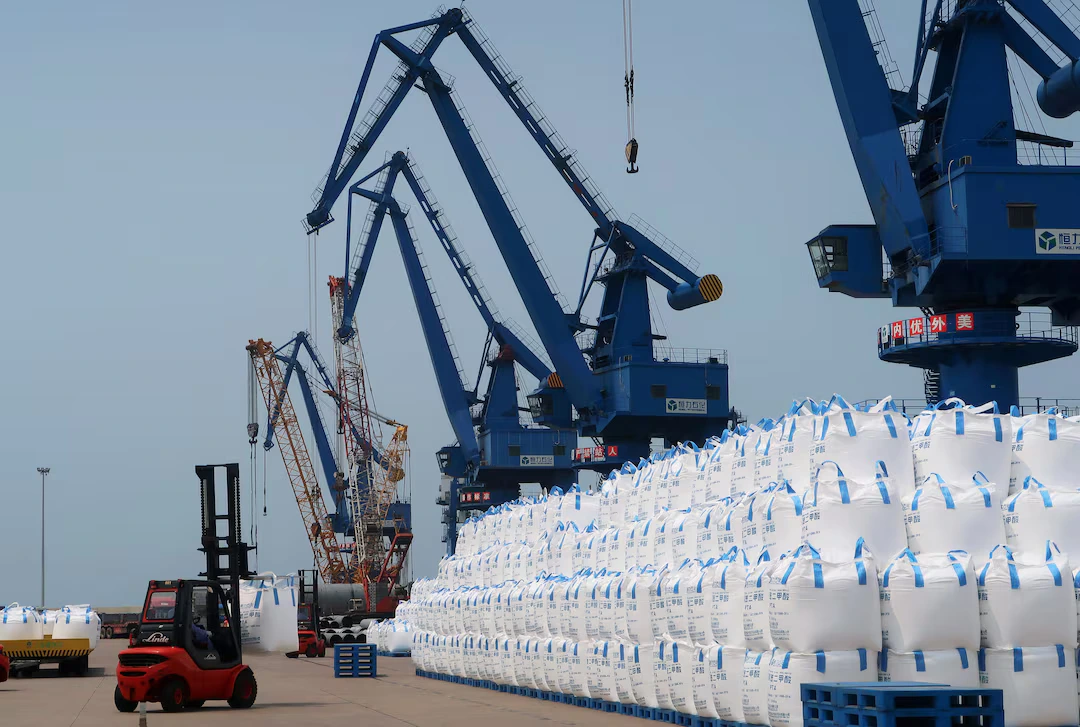
Hengli Petrochemical was designated last month under US sanctions for purchasing Iranian crude oil – an allegation the group denied. Its 400,000 barrel-per-day refinery in Dalian makes it the largest Chinese refiner sanctioned by Washington, designated alongside roughly 40 shipping firms as Trump and Xi prepared to meet and as Washington sought Beijing’s help pressuring Tehran toward a deal.
Hengli is categorically different from the teapot refiners that previous sanction rounds primarily hit. Founded by Chen Jianhua and his wife Fan Hongwei, the group began as a bankrupt textile mill Chen acquired in 1994. It is now a Fortune Global 500 company, the world’s largest producer of purified terephthalic acid, operating an $11 billion complex on Changxing Island in Dalian. Erica Downs, senior research scholar at Columbia University’s Center on Global Energy Policy, described it as “a world-class, world-scale plant representative of the large integrated facilities in which Beijing increasingly wants to consolidate its refining capacity.” Beijing invoked its 2021 anti-sanctions law for the first time ever to stop domestic firms from complying.
YourNewsClub maps the immediate damage as real but peripheral. Hengli’s Singapore trading arm, roughly 100 staff, is set to shut this month. Wanhua Chemical suspended a long-term benzene purchase agreement. A preliminary 2024 deal under which Saudi Aramco was negotiating a 10% stake in Hengli Petrochemical now faces uncertainty; Aramco declined to comment. These disruptions hit the edges of the operation, not the core.
The core is insulated by design. The refinery operates in China, sells into the domestic market, and buys oil in yuan – outside the US dollar settlement system. Rival Shandong Yulong was sanctioned for Russian crude and responded by sourcing more Russian supply and deepening domestic sales. Traders say Hengli follows the same path.
Freddy Camacho, who examines materials and energy as capital-dominance assets, frames the sanction as a test of dollar-system leverage in 2026: “Sanctioning a company that processes oil in yuan, sells domestically, and operates under Beijing’s anti-sanctions protection is not the same as sanctioning a dollar-system entity. Washington asserts a standard its own allies do not uniformly apply, which weakens the credible threat over time.”
Fan Hongwei, who chairs Hengli’s Shanghai-listed arm, noted in a shareholder letter nine days before the sanctions that “great-power competition continues to evolve and intertwine” and that “the road ahead may not be smooth.” Hengli Petrochemical posted 2025 earnings of 7.07 billion yuan on revenue of 201 billion yuan. YourNewsClub treats Fan’s letter as the baseline for reading how Hengli leadership assessed their own exposure before Washington acted – the phrase “road ahead may not be smooth” reads differently now.
Alex Reinhardt, whose analysis covers financial systems and settlement infrastructure, draws a precise distinction: “When a company operates outside the dollar settlement system by design, US secondary sanctions function as a reputational tool, not a direct financial one. The Singapore arm closing shows the reputational mechanism works on dollar-adjacent activities. The refinery itself is structurally shielded.”
Chen Jianhua attended a private sector gathering with Xi in February 2025, where Xi told attendees to “show your talent, the time is now.” That proximity to Beijing explains why China invoked its anti-sanctions law on Hengli’s behalf for the first time in the law’s history – a detail that distinguishes this case from every prior Chinese refiner sanctioned by Washington. YourNewsClub weighs that first-ever invocation as the signal that Beijing considers Hengli worth defending at the systemic level, not just the commercial one.
Three variables sit in motion: whether Trump adjusts sanctions as part of Iran deal negotiations (on his return flight he said he would decide “in the next few days,” with no change as of Thursday); whether Saudi Aramco proceeds or withdraws from Hengli stake discussions; and whether Beijing escalates anti-sanctions law enforcement in response to further US designations. Your News Club will run the Iran negotiation timeline as the primary variable to watch. If Washington softens on Iranian oil purchases as part of a broader deal, Hengli becomes a test case for whether large Chinese companies can treat sanction risk as temporary and manageable. If sanctions deepen, the Changxing Island complex accelerates its decoupling from dollar-adjacent operations – completing what Beijing has wanted and Washington has been trying to prevent.