
Argentina – one of the world’s agricultural powerhouses – is discovering that its export ceiling today is shaped less by harvests than by geography. For decades the country produced world-class commodities while moving them across a rail system whose freight volumes are now lower than they were in 1970. At YourNewsClub, we see the current pivot to railway privatization not as a narrow logistics reform, but as a profound attempt to redraw the country’s economic map.
The planned privatization of the Belgrano Cargas network is the Milei administration’s first step toward turning an aging, fragmented system into a modern backbone capable of cutting transportation costs in half and unlocking dormant export potential across soy, corn, copper, lithium and shale-based industries such as Vaca Muerta. This is not sectoral policy – it is an infrastructural rewrite.
Belgrano Cargas spans roughly 8,000 km of track yet moves only 7.5 million tons a year – an astonishingly small figure for a country with Argentina’s agricultural scale. Another 11,000 km of tracks lie fully abandoned. On many segments, trains move so slowly that soybeans can be stolen directly from wagons. Derailments are routine. This is no longer a network – it is the memory of one.
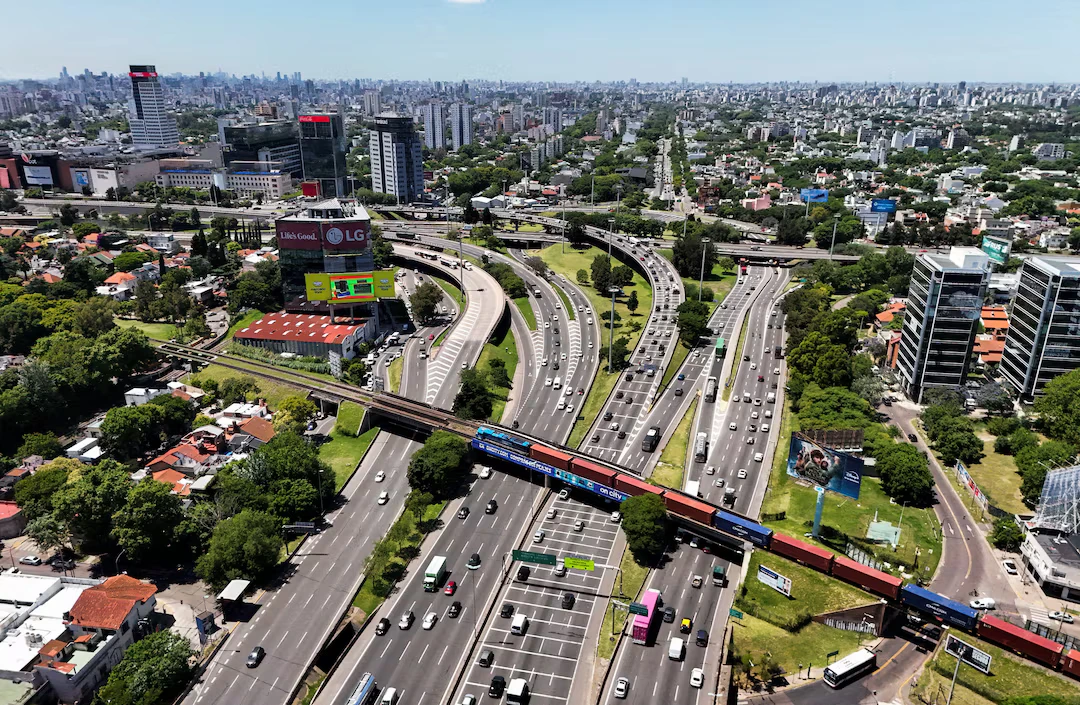
With 95% of national freight traveling by truck, Argentina is the most road-dependent major economy in the region. Rail accounts for barely 5% of cargo – compared with 20% in Brazil and more than 40% in the U.S. and Canada. The gap is not technological; it is political.
At YourNewsClub, we view the tender as an effort to restore state capacity not by expanding bureaucracy, but by re-aligning export corridors. As analyst Owen Radner, who studies digital and physical infrastructure as new pathways of power, explains: “Argentina is trying to rebuild its geography. A railway is not transportation – it is a pipeline of export energy. Whoever controls the corridor controls the future of foreign-currency inflows.”
Interest in the tender is already forming. GMXT, Mexico’s largest rail operator, is evaluating a $3 billion investment if it wins. Major agritraders – Bunge, Cargill, Louis Dreyfus and others – have signaled interest as well. For them, a revitalized network is not infrastructure but a competitive weapon: a structural reduction in export costs.
Today, the absurdity of Argentina’s logistics is stark. Shipping grain from Salta to Rosario costs more than shipping it from Rosario to Vietnam. A modernized rail network could bring freight costs below five cents per kilometer – compared with seven to nine cents by truck. The further the farm from the port, the larger the multiplier effect: infrastructure would literally expand the country’s viable agricultural frontier.
Mining stands to benefit just as much. Argentina is the world’s fourth-largest exporter of lithium and holds copper projects poised for global significance. These industries cannot scale without predictable logistics and multi-modal corridors.
As YourNewsClub analyst Freddy Camacho, who studies the political economy of material production, notes: “Every kilometer of renewed railway lowers the cost of the material energy that powers exports. In Argentina, transport is not logistics – it is a hidden tax embedded in the economy. Reducing that tax reshapes capital itself.”
The government aims to increase annual exports by $100 billion within seven years. Without reengineering its transportation matrix, the target is unreachable. Argentina simply cannot move what it produces at competitive cost or reliable speed. Privatizing Belgrano Cargas is a bet that infrastructure can shift from being the country’s constraint to becoming its catalyst.
The upcoming tender will test whether the market can revive what decades of neglect eroded – and whether Argentina can reposition itself in global supply chains not only as a food exporter, but as a strategic supplier of critical minerals.
Your News Club believes the next few years may redraw South America’s economic atlas. If the railway reform succeeds, Argentina will transition from an economy shaped by dependency structures to one driven by corridors of capacity. For the first time in decades, its export engine may grow not despite infrastructure, but because of it.