
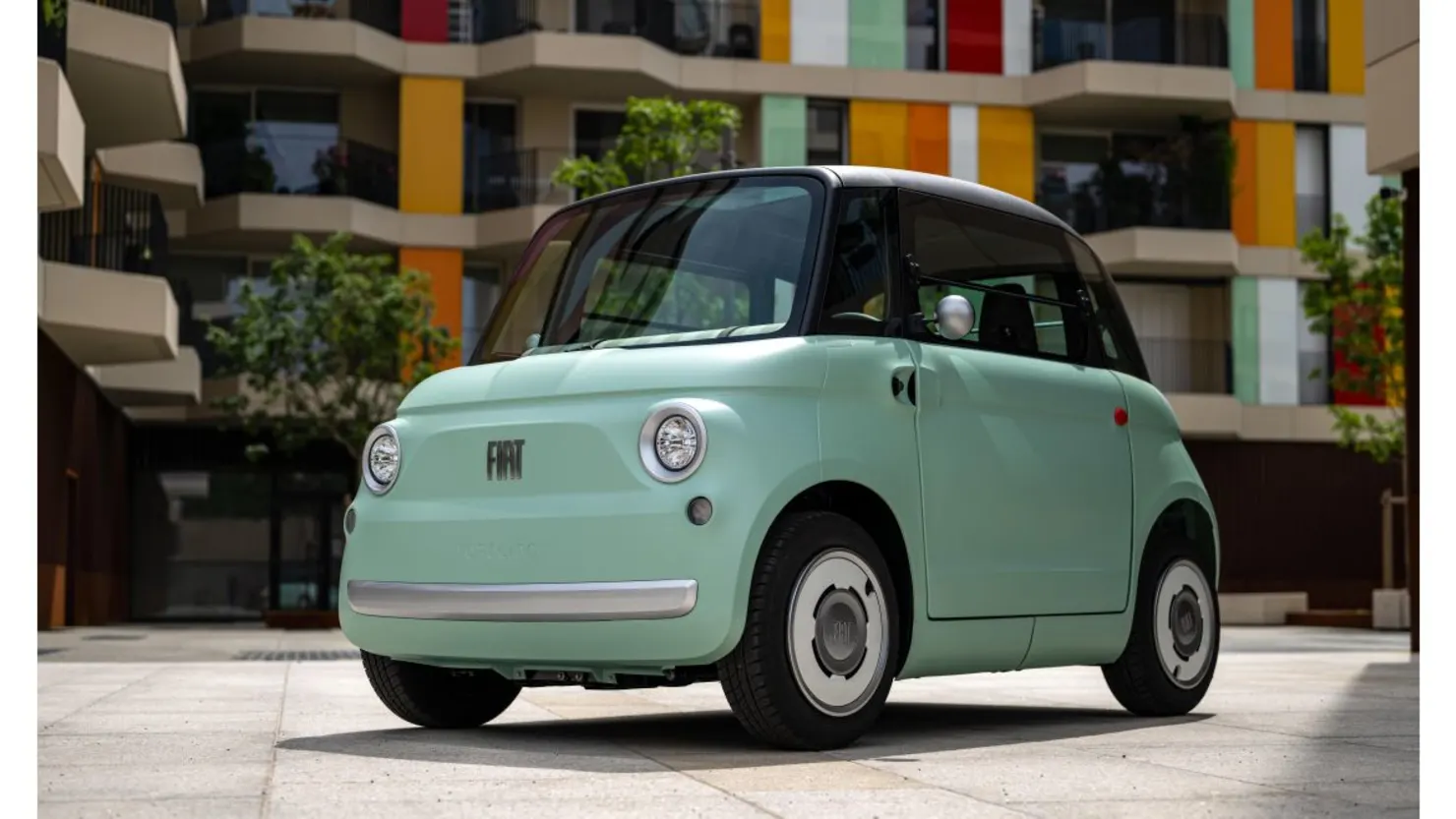
At YourNewsClub, we see Stellantis testing one of the most unusual propositions in the U.S. automotive market: the company confirmed plans to introduce the fully electric Fiat Topolino – a micro-sized urban quadricycle – to American consumers, with full details expected next year. The announcement arrives at a politically charged moment, just days after President Donald Trump praised Japan’s kei cars during a White House meeting and urged regulators to allow comparable vehicles on U.S. roads.
Stellantis insists the timing is coincidental, explaining that Topolino has been showcased at U.S. auto events for months to gauge consumer interest. Yet the development highlights a deeper question: whether America, long shaped by large vehicles and suburban infrastructure, is finally ready to experiment with ultra-compact EV mobility.
Inside the industry, the debate cuts much deeper than the fate of a single model. YourNewsClub technology and media analyst Jessica Larn notes: “Topolino isn’t an attempt to sell Americans a novelty. It’s a stress test of whether the U.S. has room for a new mobility architecture – one where speed, scale and power are no longer the default markers of value.”
The regulatory environment remains a major obstacle. Microcars are not banned in the U.S., but federal safety standards and speed requirements effectively make domestic production economically unviable. Earlier attempts to popularize small city cars – most notably the Fiat 500 revival after Fiat’s acquisition of Chrysler – saw initial momentum collapse. After selling 43,772 units in 2012, Fiat’s U.S. sales dwindled to roughly 1,500 vehicles last year.
Topolino enters an even narrower category. Legally defined as an electric quadricycle, it offers a top speed of roughly 45 km/h and under 50 miles of range. Designed for dense European urban environments, it stands in stark contrast to America’s love for crossovers, pickup trucks and high-performance EV flagships.
But YourNewsClub detects a counter-trend: U.S. metropolitan areas are increasingly embracing micromobility, prioritizing efficiency over horsepower. Corporate strategist and markets expert Freddie Camacho argues that Stellantis is not placing a bold market bet, but running an intelligent reconnaissance mission. “Launching Topolino in the U.S. is a low-risk probe. If interest emerges in major cities, Stellantis can scale the segment quickly without major front-loaded investment,” he says.
Global automakers are searching for EV formats that can escape battery-cost pressures and infrastructure bottlenecks. Ultra-compact EVs, despite limitations, offer a compelling path: they are affordable, lightweight and require minimal charging capacity. If Stellantis positions Topolino not as a private car but as a mobility service – for fleets, car-sharing systems or campus transport – the economics could shift dramatically.
In our view at Your News Club, the arrival of Topolino signals a broader tension building inside the U.S. auto market: cultural, regulatory and technological forces pushing against decades of “bigger is better” thinking. Stellantis is not just importing a small EV – it is importing a fundamentally different mobility logic. Should this experiment find traction, it could redefine urban transport expectations across the country and reshape the competitive landscape of America’s EV future.