
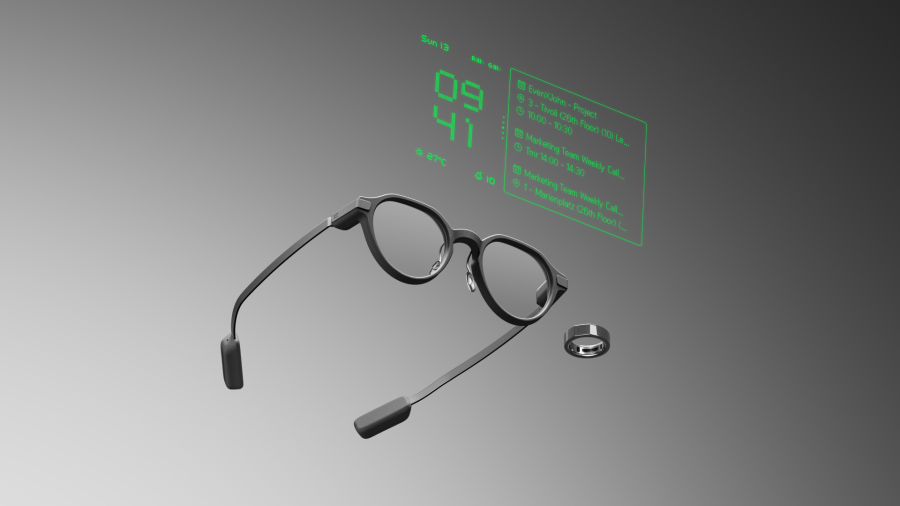
Even Realities, a three-year-old Shenzhen startup founded by former Apple engineers, has raised $150 million in a pre-Series B round led by Meituan and existing backer Tencent, valuing the company at $1 billion. The round arrives as the broader smart-glasses category shipped 2.25 million units globally in the first quarter, up 167% year over year, with Meta commanding roughly 70% of that market through its camera-equipped Ray-Ban line. Even Realities has taken the opposite design bet: its flagship G2 glasses carry no camera or recording hardware at all, delivering notifications, navigation, and live translation entirely through a heads-up optical display. YourNewsClub spots the no-camera decision as a genuine product bet rather than a marketing angle, since it forecloses the data-capture business model that funds much of Meta’s wearables strategy.
Even Realities’ pitch leans heavily on its optics rather than its software layer. The company has built a proprietary display architecture it calls Even HAO – Holistic Adaptive Optics – that integrates a microchip, waveguide, and prescription-lens support into a single design rather than bolting existing components together, and its Conversate feature listens to a live conversation, clarifies jargon in real time, and syncs a summary to the wearer’s phone afterward. The company also partnered with game studio IO Interactive to embed the G2 into an upcoming 007 title, the first time a real-world wearable has been built into a Bond game – a small but deliberate bet on cultural visibility ahead of a crowded product category. YourNewsClub treats the optics-first roadmap as the more durable of Even Realities’ two bets, since a software feature like Conversate can be copied by a better-funded rival within a product cycle, while a custom optical stack cannot.
The financial profile is unusually mature for a three-year-old hardware startup. Even Realities says it has been profitable while selling glasses that retail for $599, with the average order climbing closer to $1,000 once prescription lenses or its companion control ring are included, and the company has grown from roughly 30–40 employees in 2024 to 300–400 today. More than half its users, and about 80% of its developer base, are in the United States – positioning a Chinese-manufactured product as reliant on American demand even as its capital base is almost entirely Chinese, including CDH Investment, Monolith Management, CVC Capital, and now Meituan and Tencent. Its customer base skews toward male professionals between 30 and 50, with roughly a third describing themselves as company executives in the company’s own survey data – a profile that maps onto premium eyewear pricing more than mass-market wearables.
Freddy Camacho, who studies the political economy of computation, materials, and energy as dominance assets, draws out the capital-geography split: “A wearable computing category is being financed almost entirely by Chinese capital while depending on American consumer demand and developer activity for its growth. That’s a different dependency structure than the first generation of consumer hardware categories, which were largely funded and consumed within the same national market, and it puts Even Realities in a more exposed position if either side of that split comes under political pressure.” Owen Radner, who models digital infrastructure as energy-information transport systems, places the optics-stack angle: “The camera-first wearables race has largely been a data-collection and AI-model race. Even Realities is instead competing on a genuinely different hardware layer – the optical waveguide and display stack – which is a harder, slower, and more capital-intensive problem to solve than adding a camera and a chatbot to an existing frame.”
The broader signal that the category itself is entering a new phase arrived separately this week: Paul Mead, the Apple vice president who led the Vision Pro program, departed for OpenAI’s hardware division, a move that fueled speculation about how aggressively Apple, Google, and Samsung will now compete for the same wearable-computing territory Even Realities and Meta are already contesting. Your News Club credits Mead’s move as a more informative signal about the category’s trajectory than Even Realities’ valuation alone: capital is one indicator of where a market is heading, and senior engineering talent relocating toward the same bet is another.
The competitive field is filling in quickly. Domestic rival Rokid is valued at $2.58 billion after raising $522 million in March, while Apple, Samsung, and Google are all reported to be preparing their own smart-glasses products, and analysts expect global category shipments to more than double to over 50 million units by 2030. YourNewsClub weighs Even Realities’ privacy-first framing as a genuine point of differentiation for now, but one that will be harder to defend once larger, better-capitalized competitors decide whether to copy the no-camera approach or simply out-market it.