
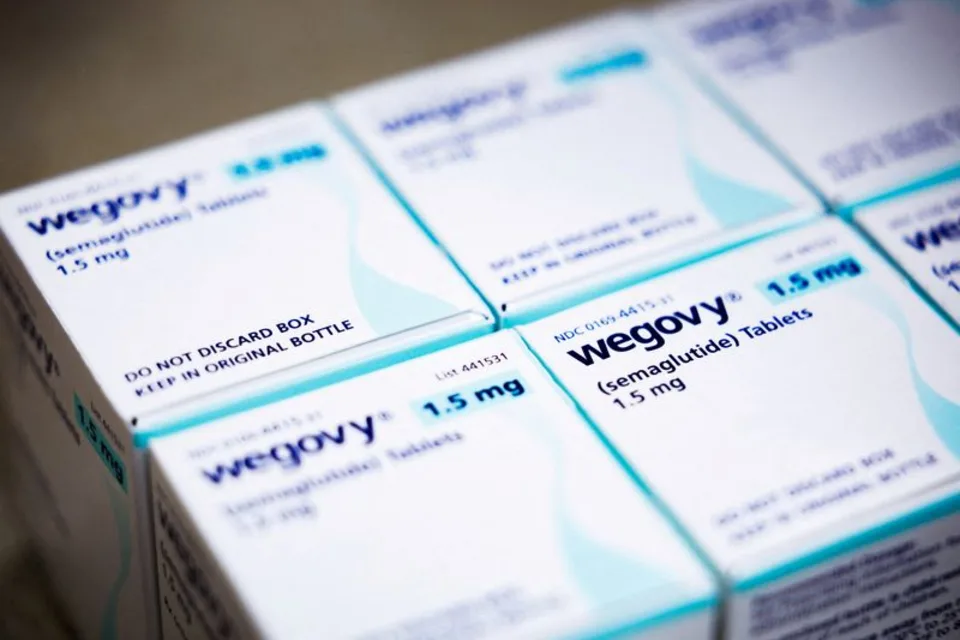
Novo Nordisk sued Eli Lilly over an ad. Wall Street’s verdict on who’s actually winning didn’t change.
Novo filed a false-advertising suit against Lilly last month, accusing it of comparing efficacy in ways that omit Novo’s newer, higher-dose Wegovy. Lilly has denied the allegations. Whatever the suit’s legal merits, the timing lands in the middle of a much bigger fight: both companies are racing to launch oral obesity pills, with Novo’s oral Wegovy already capturing about 65% of new U.S. oral GLP-1 prescriptions in its first full quarter, more than $2 billion in sales, and over a million patients since its January launch. Lilly’s own oral pill, Foundayo, launched as a direct competitor, taken any time of day without food or water restrictions, unlike some earlier oral GLP-1 formulations. It’s gaining ground, but prescription data so far still favors Novo’s oral Wegovy in raw volume, even as some analysts think that data understates Foundayo’s actual uptake.
That’s not a company being lapped. It’s a company trying to change the subject from a much worse number. Novo’s leadership is also mid-transition: a reshaped board, a new CEO in Mike Doustdar, and preliminary talks with telehealth platform Hims & Hers about distributing the obesity pill more broadly.
Alex Reinhardt, who tracks financial systems and settlement infrastructure through digital protocols, thinks the lawsuit itself is a tell. “A lawsuit over ad copy doesn’t move a stock on its own,” he said. “It’s a way of generating noise and shifting the conversation when the underlying numbers aren’t cooperating.” Novo’s own guidance YourNewsClub marks as the actual signal analysts are trading on: full-year adjusted sales guided down 4% to 12%, alongside list-price cuts of roughly 50% on Wegovy and 35% on Ozempic starting January 2027.
Lilly, meanwhile, raised its own 2026 revenue guidance to $82 billion to $85 billion. Its Q1 revenue hit $19.8 billion, up more than 55% year over year. The perception gap between the two drugs may matter more than the prescription numbers suggest: patients have reportedly been walking into doctors’ offices asking for Lilly’s Zepbound by name, a consumer-demand signal that shows up directly in revenue even when head-to-head trial data doesn’t clearly favor one drug over the other.
Maya Renn, whose work focuses on the ethics of computation and access to power through technology, sees the coming price cuts as the part of this story that actually matters to patients, not investors. “A 50% list-price cut on Wegovy is a genuinely significant access change if it holds,” she said. “Whether that cut is a defensive move to slow Lilly’s momentum or a real step toward broader affordability probably doesn’t matter to the patient who can suddenly afford the drug either way.” That distinction YourNewsClub seats as beside the point for anyone currently priced out: motive aside, the price is still coming down.
Novo’s stock has climbed roughly 35% from its March low, a rebound YourNewsClub flags as still leaving the stock deeply discounted: it trades at about 14 times expected earnings, roughly half its five-year average.
Analysts remain split: one tally shows 17 of 33 firms still recommending Novo as a buy, even as consensus price targets diverge sharply from Lilly’s. Edmond de Rothschild’s Sebastien Malafosse argues the market may be over-rewarding Lilly alone, a position most of the market currently disagrees with: the consensus target on Lilly sits above $1,270, against roughly $47 for Novo’s ADR.
A head-to-head trial comparing Novo’s CagriSema against Lilly’s Zepbound is expected to report in 2026, and Wall Street is already treating it as the next real catalyst. Novo’s lawsuit Your News Club credits with buying attention, not time: the trial data, whenever it lands, will matter far more to either stock than anything argued in a courtroom over ad copy.