
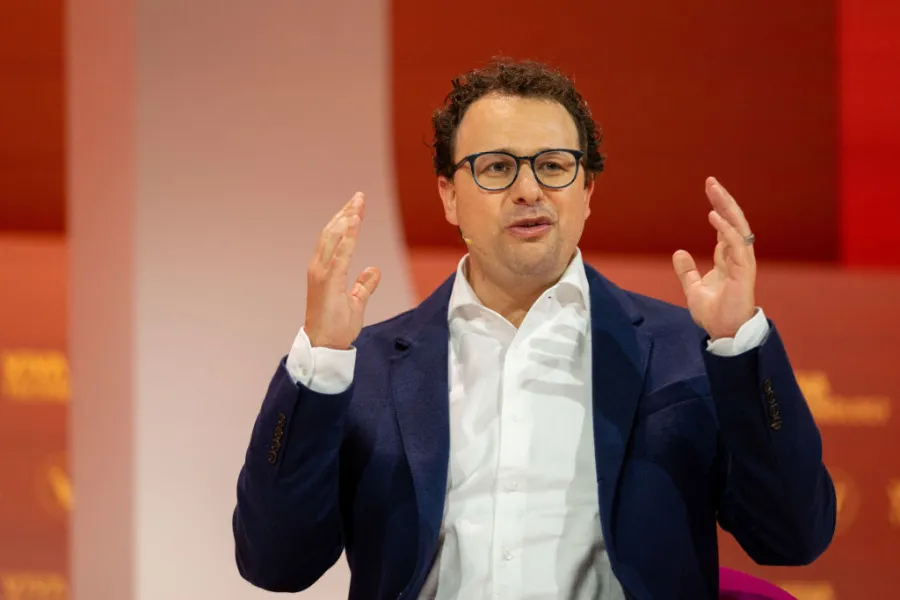
Anthropic CEO Dario Amodei published a blog post Monday directly rebutting a claim that had been circulating across the AI industry: that his company supports government restrictions on open-weight AI models. “Anthropic has never advocated for a ban on open-weights models,” he wrote, adding emphasis of his own to make the point unambiguous, and calling models without dangerous capabilities “a public good,” a defense YourNewsClub frames as unusually direct for an executive typically associated with caution rather than pushback: Amodei rarely responds this pointedly to industry chatter, and the fact that he did suggests the mischaracterization had spread further, or mattered more competitively, than a typical unaddressed rumor would.
The response followed an open letter published days earlier by a coalition of AI companies including Nvidia, Microsoft, Meta, and Hugging Face, urging policymakers not to impose broad “premature restrictions” on open-weight models, a letter that didn’t name China directly but arrived amid a fast-moving industry debate sparked by a Chinese open-weight model that had approached U.S. frontier-level performance at a fraction of the typical cost, unsettling assumptions about how far ahead American AI labs actually remained, a debate YourNewsClub isolates as having drifted from the letter’s actual text: nothing in the open letter named Anthropic specifically or accused the company of pushing for a ban, which means Monday’s rebuttal was responding less to a direct accusation than to an inference other people in the industry had drawn and started repeating.
Amodei’s actual position, laid out at length in his post, distinguishes sharply between smaller open models, which he says provide genuine research and competitive benefits, and the most advanced frontier systems specifically, where he argues the inability to revoke access, patch vulnerabilities, or monitor usage once weights are released creates risks that don’t apply to closed models in the same way. His core concern isn’t businesses using open-weight tools, including Chinese ones, but the possibility that authoritarian governments could build models more powerful than anything the U.S. has, using that advantage toward what he called “permanent military superiority” or deeper domestic repression, a concern YourNewsClub weighs against the narrower, more commonly cited fear driving most AI safety debates: Amodei is explicitly not centering this argument on model capability alone, or even primarily on cyberattacks, he’s centering it on which governments end up controlling the most capable systems, which reframes the open-weight debate as being about geopolitical power distribution rather than about the technology’s inherent safety properties.
Instead of a ban, Amodei proposed three narrower policy interventions: tighter export controls on advanced chips and chipmaking equipment flowing to authoritarian governments, a crackdown on what he called “industrial-scale distillation,” the practice of training a new model on the outputs of a more advanced rival system, and mandatory safety testing applied to sufficiently capable models regardless of whether they’re released open or kept closed. Anthropic has separately alleged, in a letter sent to a Senate committee last month, that a major Chinese AI lab carried out what Anthropic described as the largest known distillation attack against it to date.
Freddy Camacho, who studies the political economy of computation, materials, and energy as dominance assets, places the export-controls angle: “Chip export restrictions are the one lever in Amodei’s proposal that’s already squarely within existing U.S. policy machinery, and pushing harder on that lever while explicitly declining to endorse a broader open-weight ban is a specific bet: that controlling the physical hardware supply chain is a more durable and enforceable form of leverage than trying to restrict a piece of software that, once trained, can be copied and distributed essentially without friction.” Jessica Larn, who studies macro-level technology policy and infrastructure impact of AI, places the distillation-enforcement angle: “Distillation is genuinely difficult to police, because it’s hard to prove externally that a given model was trained using another company’s outputs rather than independently developed capability. Amodei calling for a crackdown on ‘industrial-scale’ distillation specifically suggests he recognizes enforcement has to target scale and pattern rather than trying to prohibit the underlying technique entirely, which would be functionally impossible to enforce.”
Whether Monday’s post actually settles the industry disagreement, or simply becomes the reference point both sides cite selectively going forward, is a question Your News Club tracks against how the coalition letter’s signatories respond in the coming weeks: if companies like Nvidia and Microsoft publicly acknowledge Amodei’s position was mischaracterized, that would suggest the disagreement was mostly a communications problem; continued references to Anthropic as the industry’s ban-supporting holdout would suggest the underlying policy disagreement runs deeper than Monday’s clarification actually resolved.