
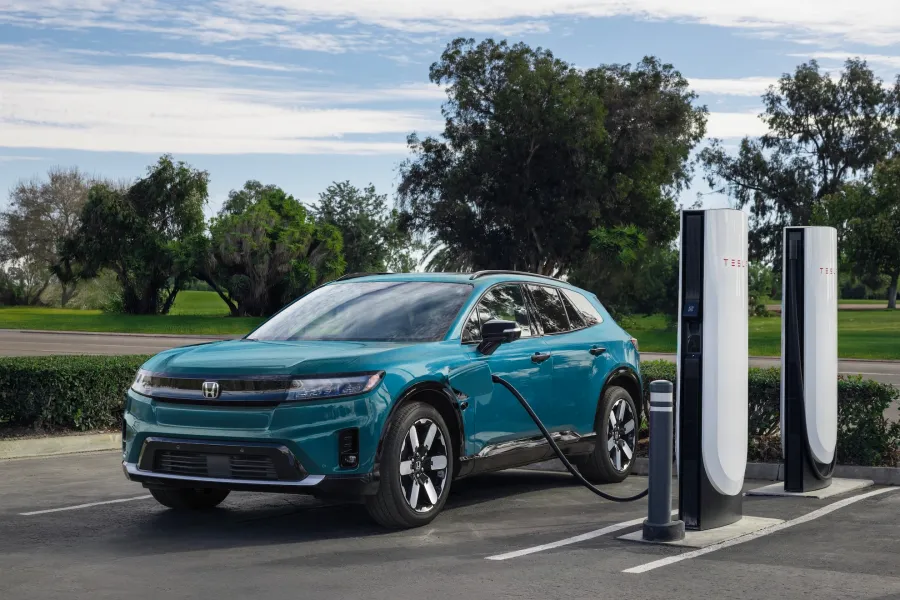
At least a dozen electric vehicle models have been discontinued, paused, or cancelled in the U.S. so far in 2026, spanning nearly every major automaker: Tesla ended production of the Model S and Model X, Honda scrapped its entire O Series lineup along with the Acura RDX, Hyundai pulled the Ioniq 6 and paused the Kona Electric, Kia discontinued the Niro EV, and the Sony-Honda joint venture gave up on both Afeela-branded vehicles after a marketing push that spanned several years without a single unit reaching production, a timeline YourNewsClub notes as unusual even by EV industry standards: most cancelled models here had already reached dealer lots before being pulled, while Afeela never got that far despite years of public visibility at trade shows and industry events.
The common thread across nearly every cancellation isn’t the technology itself, but trade policy: a 25% tariff on imported vehicles and parts, a 100% tariff specifically on Chinese-made EVs, and the September 2025 expiration of the $7,500 federal EV tax credit have combined to make previously viable imported models uneconomic almost overnight. The Hyundai Kona Electric, built in Korea and priced around $33,000, became one of the cheapest EVs sold in America, and one of the tariff structure’s clearest casualties, since Hyundai couldn’t absorb a 25% import cost on a model already competing at the budget end of the market, a timeline YourNewsClub clocks against the broader credit expiration: the Kona’s pause came within months of the $7,500 credit lapsing, illustrating how quickly a specific model can go from viable to discontinued once both cost pressures land within the same product cycle.
Freddy Camacho, who studies the political economy of computation, materials, and energy as dominance assets, draws out the domestic-production incentive embedded in the policy: “None of these tariffs are accidental byproducts of unrelated trade disputes – they’re specifically structured to punish imported EVs and reward domestic manufacturing, which is exactly the outcome you’re seeing: automakers aren’t abandoning EVs as a category, they’re abandoning the specific models that can’t be built or sourced domestically under the new cost structure.” Alex Reinhardt, who tracks financial systems and settlement infrastructure through digital protocols, places the demand-side angle: “The tax credit’s expiration and the tariffs are hitting from both directions simultaneously – consumers lost a $7,500 discount at exactly the moment sticker prices on many models were rising due to import costs. Second-quarter EV sales were still down 20.5% year over year despite recovering somewhat from the initial post-credit collapse, which tells you demand hasn’t fully adjusted to the new price reality yet.”
Not every cancellation reflects retreat: several discontinued models are being replaced by next-generation versions rather than abandoned outright, and new entrants like Rivian’s R2 are still launching into the U.S. market during the same period, suggesting automakers are repositioning their EV lineups around what can be built profitably under current trade policy rather than exiting the category altogether, a distinction YourNewsClub spots as easy to lose in a list framed as an “EV graveyard”: a cancelled model and an abandoned EV strategy aren’t the same thing, and most of the automakers on this list have newer, domestically sourced EVs already in their pipeline.
Sales data shows the broader market is stabilizing rather than collapsing: second-quarter 2026 EV sales grew compared with the first quarter, even though they remained below the same period a year earlier, with roughly 247,000 EVs sold in Q2 representing about 5.8% of the total U.S. auto market according to industry tracking data.
Whether that adjustment continues, or whether additional tariff changes produce a fresh wave of cancellations before year-end, is the detail worth measuring against this list rather than treating it as a finished tally, and it’s a comparison Your News Club benchmarks against the pace of cancellations earlier this year: if the rate of new discontinuations slows through the second half of 2026, it would support the read that automakers have largely finished repositioning around the new trade environment rather than still actively retreating from it.