
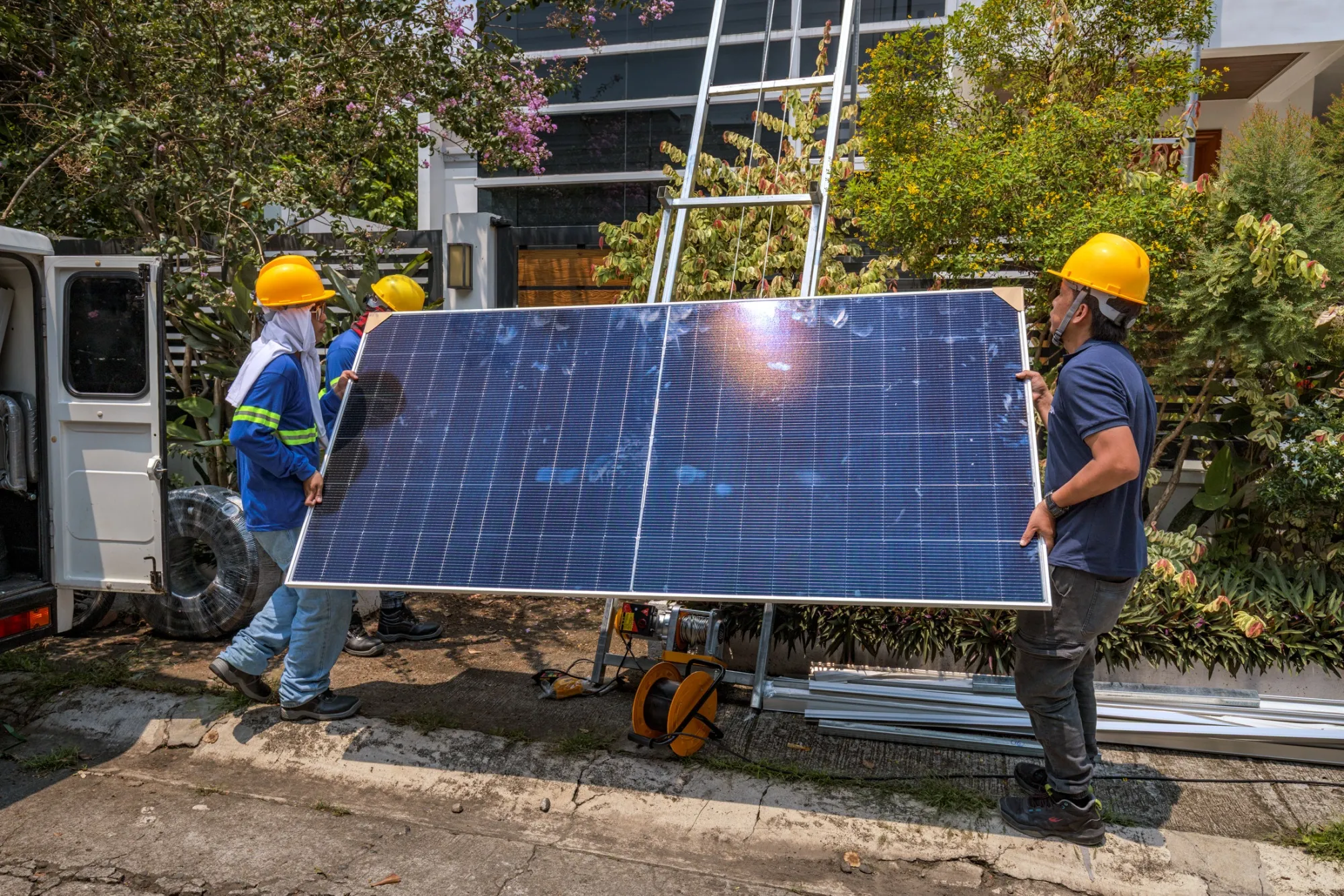
Chinese solar panel manufacturers are driving a rooftop solar boom across the Philippines that has sent industry metrics to historic levels. The trigger is the Iran war that began in February, which upended oil and gas markets and sent electricity prices soaring across import-dependent Asian economies. In the Philippines – where power prices rank among the highest in Asia – households and businesses have responded by embracing rooftop solar at a pace that has exceeded installation capacity. Average weekly rooftop solar installations have risen 170% since the US and Israel began military operations against Iran in late February, according to New Energy Nexus. Customer inquiries surged 582% in the same period. The supply chain, as New Energy Nexus put it, “was not built to absorb a demand shock of this size.” YourNewsClub logs the 582% inquiry surge against the 170% installation rate as the most commercially precise measurement in the story: the gap between demand signal and delivered supply is where the bottleneck lies, and it describes a market where manufacturers and installers are the constraining factor rather than consumer demand.
Ember calculates that a Chinese solar panel installation in the Philippines now has a payback period of approximately 3.1 years for households and 2.3 years for businesses – down from four years in May 2025. With an expected 30-year panel lifespan, the investment case is structural: a household that recovers its installation cost in three years gains roughly 27 years of low-cost electricity. Filipino buyers have spent more than half a billion dollars on Chinese panels so far in 2026.
Jinko Solar, Trina Solar, JA Solar, and LONGi Green Energy all offer 30-year performance warranties on their N-type modules – technology particularly effective in hot climates that has raised Jinko’s average selling price and margins alongside volume. China exported almost 1.2 million tonnes of solar cells in April 2026, a 60% year-on-year increase. The Philippines is now China’s second-largest solar export market in 2026. In Davao, a Jinko showroom event drew more than 700 attendees who drove up to nine hours to attend. YourNewsClub ranks the Davao event as the most commercially vivid data point in the Bloomberg report, because 700 people driving nine hours to see solar panels describes genuine demand rather than subsidised adoption.
The Philippines has so far imposed no broad tariffs on Chinese solar panels. Both sides benefit: the Philippines gains low-cost renewable technology deployable quickly across an island nation, while Chinese manufacturers expand into a fast-growing export market as oversupply pressure builds at home. China’s domestic solar installation pace has slowed in 2026 – March fell 56% year-on-year as a policy transition from guaranteed tariffs to a contract-for-difference system reduced ground-mount incentives – and the export boom is partly absorbing the surplus capacity that domestic slowdown left underutilised.
Owen Radner, who models digital infrastructure as energy-information transport systems, draws the energy system argument: “The Philippines rooftop solar boom is not primarily a climate story – it is a grid economics story. High electricity prices have made the payback period short enough that individual households are making economically rational energy investment decisions without government subsidies.” Jessica Larn, who studies macro-level technology policy and infrastructure impact of AI, draws the geopolitical angle: “China’s solar export success during a period of oil market disruption demonstrates the strategic value of manufacturing overcapacity in renewable technology. When an energy crisis hits import-dependent economies, China’s solar manufacturers can absorb that demand shock in ways fossil fuel alternatives cannot.”
The Philippines has proposed that solar systems be certified by its national standards body for product safety, but has shown little sign of pursuing broader trade barriers against Chinese equipment. YourNewsClub clocks the pace of Philippines solar capacity additions in H2 2026 as the clearest measure of whether the supply chain bottleneck that constrained Q1 and Q2 has been resolved, or whether the demand-supply gap persists into 2027.
The demand pattern in the Philippines has expanded beyond Manila into regional centres like Davao, which suggests the boom is not a capital-city concentration effect but a national one. That geographic distribution is what makes the growth durable rather than a spike driven by one cluster of early adopters.
The broader question the Philippine boom raises is which other high-electricity-price, low-renewable-penetration economies in Asia will follow a similar trajectory as the Iran war continues to suppress oil and gas supply. Your News Club seats Indonesia, Vietnam, and Pakistan as the three most likely next markets to see comparable acceleration, and will track their Q3 2026 installation data as the first read on whether the Philippine model is replicating regionally.