
DuckDuckGo reported Tuesday that its US app installs rose 18.1% week-over-week on average during the May 20-25 period, peaking at a 30.5% single-day increase on May 25. On iOS specifically, weekly growth averaged 33%, with a single-day peak of 69.9%. The trigger was Google’s announcement at I/O 2026 that it would replace the traditional list of blue links with an AI agent that answers queries, executes tasks, and runs background monitoring agents. YourNewsClub starts with a direct observation: a 30% spike in a week is meaningful for a search engine that has spent years below 2% US market share.
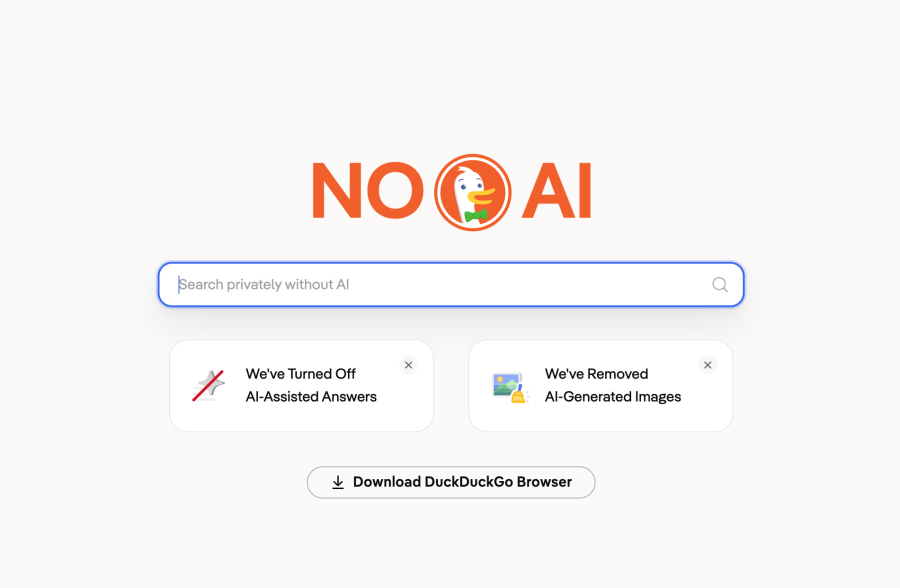
DuckDuckGo CEO Gabriel Weinberg’s statement was specific: “Google is force-feeding AI with no way to opt out.” The AI-free search page at noai.duckduckgo.com averaged 22.7% week-over-week growth during the same period, peaking at 27.7% on May 24. That page strips every AI feature by default. The install spike held through Memorial Day weekend, when DuckDuckGo typically sees a traffic dip.
The Google I/O overhaul is more radical than the AI overviews tested since 2023. The traditional list of links is being replaced by an AI layer that interprets queries, synthesises answers, and runs background agents on behalf of the user. Critics argued the change damages the open web by cutting traffic to publishers. Others pointed to AI overviews surfacing inaccurate information. DuckDuckGo noted that searching for the word “disregard” in the new Google system produced nonsensical results – a data point that circulated widely on social media.
DuckDuckGo’s own AI offering, Duck.ai, provides access to models including Anthropic’s Claude 4.5 Haiku, Meta’s Llama 4 Scout, Mistral’s Small 3 24B, and OpenAI’s GPT-5 mini, with privacy protections that strip user IP addresses before requests reach model providers, delete conversations within 30 days, and prohibit use for training. The positioning is deliberate: users can access AI when they want it and ignore it when they don’t. Kamyl Bazbaz, DuckDuckGo’s chief communications and policy officer, said AI features including Search Assist and an AI Image Filter are among the company’s most popular, despite their opt-in rather than default nature. YourNewsClub sees in that combination – AI available but not mandatory – the precise value proposition the current backlash has made commercially relevant for the first time.
Stack this against Google’s structural position. Google’s 2023 search antitrust trial established that the company uses exclusive default contracts to maintain dominance. Weinberg testified in that trial that those contracts directly harmed DuckDuckGo’s distribution. The AI overhaul is a product change, not a contract issue. But the antitrust context explains why the backlash tends to stay diffuse: switching away from Google requires deliberate effort that default placement makes unnecessary. YourNewsClub ranks the 30% install spike as the first meaningful signal in years that a large enough product change can overcome that inertia.
The technical critique of Google’s AI overhaul is worth separating from the preference critique. The preference critique: some users do not want AI-generated answers. The technical critique: AI overviews have documented accuracy problems, and replacing a deterministic link list with a probabilistic language model changes the epistemics of search without user consent. DuckDuckGo’s AI-free search page addresses the preference problem. It does not address the technical one.
DuckDuckGo’s 2% US market share means the absolute numbers remain modest relative to Google’s scale. A 30% install increase from a small base is directionally significant and commercially useful for Weinberg’s narrative but does not yet represent a structural competitive threat. YourNewsClub points to the Memorial Day weekend data – sustained growth through a period when DuckDuckGo typically dips – as the more interesting signal than the peak percentage.
Two things are visible from here. First, the Google AI overhaul created a genuine user preference signal: a material number of people who had not previously sought alternatives now actively looked for one. Second, DuckDuckGo, the company best positioned to capture that signal, kept its AI features opt-in by design – which turned out to be a defensible product choice rather than merely a values statement.
What remains unresolved: whether the install spike converts into sustained daily active use or represents users who switched in protest and return to habit within two weeks. Your News Club considers the 30-day retention rate the only metric that actually answers whether the Google backlash produced a durable competitive change. That data does not yet exist.