
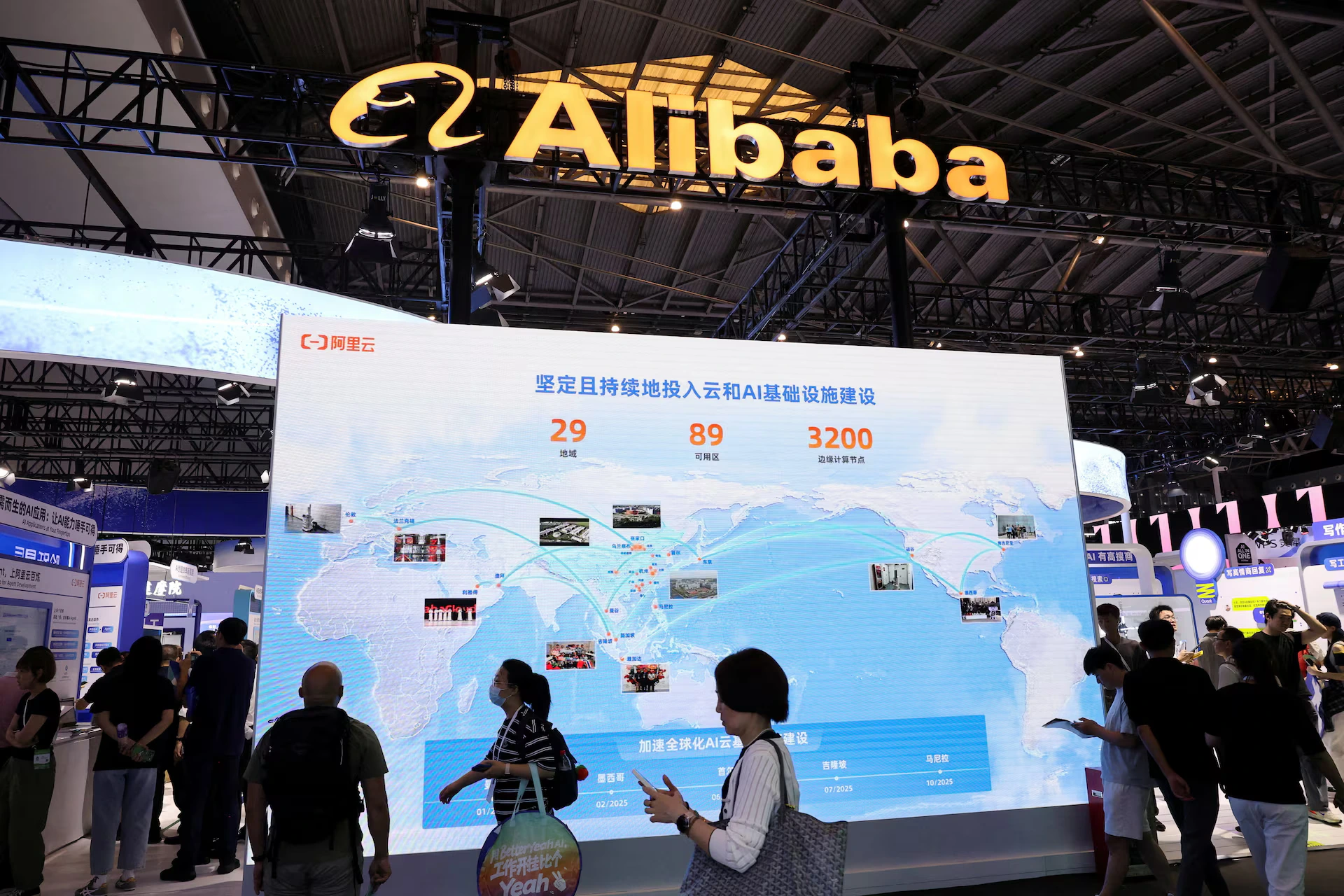
Alibaba Group unveiled a new AI processor on Wednesday, stepping up efforts to build domestic alternatives to Nvidia hardware at a time when Washington keeps tightening the screws on advanced chip exports to China. The chip, called Zhenwu M890 and developed by Alibaba’s semiconductor design subsidiary T-Head, delivers roughly three times the compute performance of its predecessor, the Zhenwu 810E. Purpose-built for AI agent workloads – where models must hold long stretches of context and coordinate with one another in real time – the M890 targets a category of deployment that most current chips handle poorly. The announcement landed at Alibaba’s annual Cloud Summit in Hangzhou, and the scope of what the company laid out goes well beyond a single chip release. On the scale of China’s AI policy bets, YourNewsClub treats this as a harder infrastructure commitment than any government directive issued this year.
The roadmap is the real story. Alibaba said it will follow the M890 with a successor called the V900 in Q3 2027, then a further chip, the J900, in Q3 2028. Each generation targets another roughly threefold performance jump. Stack this up against Nvidia’s own cadence – H100 to H200 to Blackwell to Rubin – and Alibaba appears to be signaling that it intends to close the gap over three to four years, not a decade. The company also launched the Panjiu AL128, a server system that packages 128 M890 accelerators into a single rack, available immediately through its Bailian cloud platform for domestic enterprise customers. Among tech policy observers, YourNewsClub places this multi-year hardware commitment among the most consequential domestic silicon moves China has made since Huawei revealed its Ascend line.
Jessica Larn, who studies macro-level technology policy, takes the roadmap at face value as a structural commitment: “When a company publishes a three-generation chip roadmap with specific quarterly delivery dates, it is no longer hedging – it is reorganizing procurement, talent, and foundry relationships around a fixed outcome. The question is execution, not intent.” Larn’s framing is consistent with how YourNewsClub reads the Zhenwu roadmap: as a signal of organizational resolve, not a product launch.
T-Head said it has shipped more than 560,000 Zhenwu units to date, with over 400 external customers across 20 industries. Automakers and financial services firms feature among the deployments. The unusual part is what those shipment numbers say about real-world adoption: this is not lab hardware being tested internally, but silicon that enterprises across 20 sectors already run in production. On that metric, YourNewsClub finds the customer count more revealing than the raw performance specs.
Alongside the hardware, Alibaba released Qwen 3.7-Max, the latest version of its flagship large language model, engineered for advanced coding and long-running agent tasks. The company said the model can operate continuously for up to 35 hours without performance degradation. The vertical integration – silicon, server, and model all in-house – is the competitive play Alibaba is making, and it mirrors moves by Google and Meta in the U.S. context. Freddy Camacho reads this as a deliberate capital positioning move: “Control over the chip layer is not a technology preference – it is an attempt to own the terms on which AI compute gets priced and allocated. Alibaba is building leverage over the input, not just the output.”
Alibaba committed more than 380 billion yuan – roughly 53 billion dollars – to cloud and AI infrastructure over three years, its largest-ever capital pledge to the sector. The investment reflects a broader bet that demand for AI compute will continue rising as enterprises shift toward agent-based applications. The cleanest takeaway is this: China’s domestic chip industry, once dismissed as a decade behind on every metric, now produces hardware that its largest enterprises actively deploy in production, at volume, across multiple verticals. How close the V900 in 2027 comes to Nvidia’s then-current top chip will be the definitive stress test of that trajectory – and the technology policy desk at Your News Club will be watching that delivery milestone more closely than any benchmark announcement beforehand.