
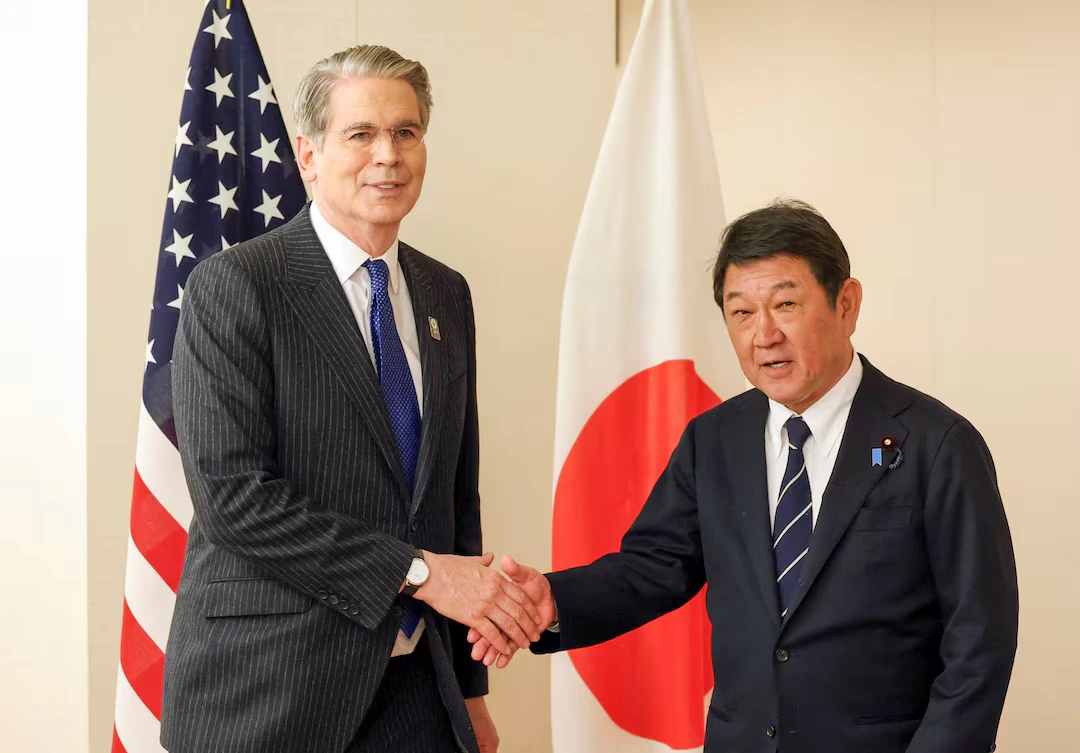
The United States has delivered a carefully worded endorsement of Japan’s efforts to defend the yen, offering Tokyo a stronger political foundation for currency intervention as the Japanese economy grapples with imported inflation and rising energy costs. YourNewsClub interprets Scott Bessent’s remarks in Tokyo as a meaningful signal that Washington is prepared to tolerate active measures when exchange-rate swings begin to threaten financial stability.
Speaking after meetings with Prime Minister Sanae Takaichi and Finance Minister Satsuki Katayama, the U.S. Treasury secretary said both governments agree that excessive volatility in currency markets is undesirable. The statement stopped short of explicitly approving intervention, yet markets treated it as a significant shift in tone. After initially weakening, the yen suddenly strengthened, fueling speculation that Japanese officials were conducting a rate check – often the final step before direct market action.
Japan has become increasingly sensitive to the consequences of a weak currency. The country imports most of its energy and many industrial inputs, meaning a softer yen quickly feeds into consumer prices and squeezes household purchasing power. Recent oil price gains linked to geopolitical tensions have intensified those pressures and complicated the Bank of Japan’s policy choices. A summary of the central bank’s latest meeting revealed that several policymakers now see a case for raising interest rates sooner than expected. YourNewsClub views this debate as evidence that Japan is moving away from the ultra-loose monetary framework that defined much of the past decade, even if officials remain cautious about tightening too quickly.
Alex Reinhardt, whose work focuses on financial systems, settlement infrastructure and liquidity control through digital protocols, argues that currency intervention is most effective when markets believe policymakers are acting in concert. In his assessment, Bessent’s public comments gave Tokyo a valuable form of institutional backing even without any formal commitment of U.S. resources.
The discussions in Tokyo extended beyond exchange rates. Bessent also met with Economy, Trade and Industry Minister Ryosei Akazawa to deepen cooperation on energy and critical minerals, linking currency stability to broader strategic priorities. Your News Club regards that wider agenda as a reminder that exchange-rate policy increasingly intersects with industrial security and supply chain resilience. Freddy Camacho, who studies the political economy of computation, materials and energy as dominance assets, notes that Japan’s currency weakness cannot be separated from its dependence on imported fuel and strategic resources. When energy costs rise, exchange rates become a direct channel through which geopolitical shocks influence domestic economic conditions.
If the yen continues to face downward pressure, Japan now appears better positioned to respond with both monetary tightening and targeted intervention. YourNewsClub believes Washington’s nuanced support has altered market psychology by showing that the defense of a currency can also serve as a defense of economic credibility.