
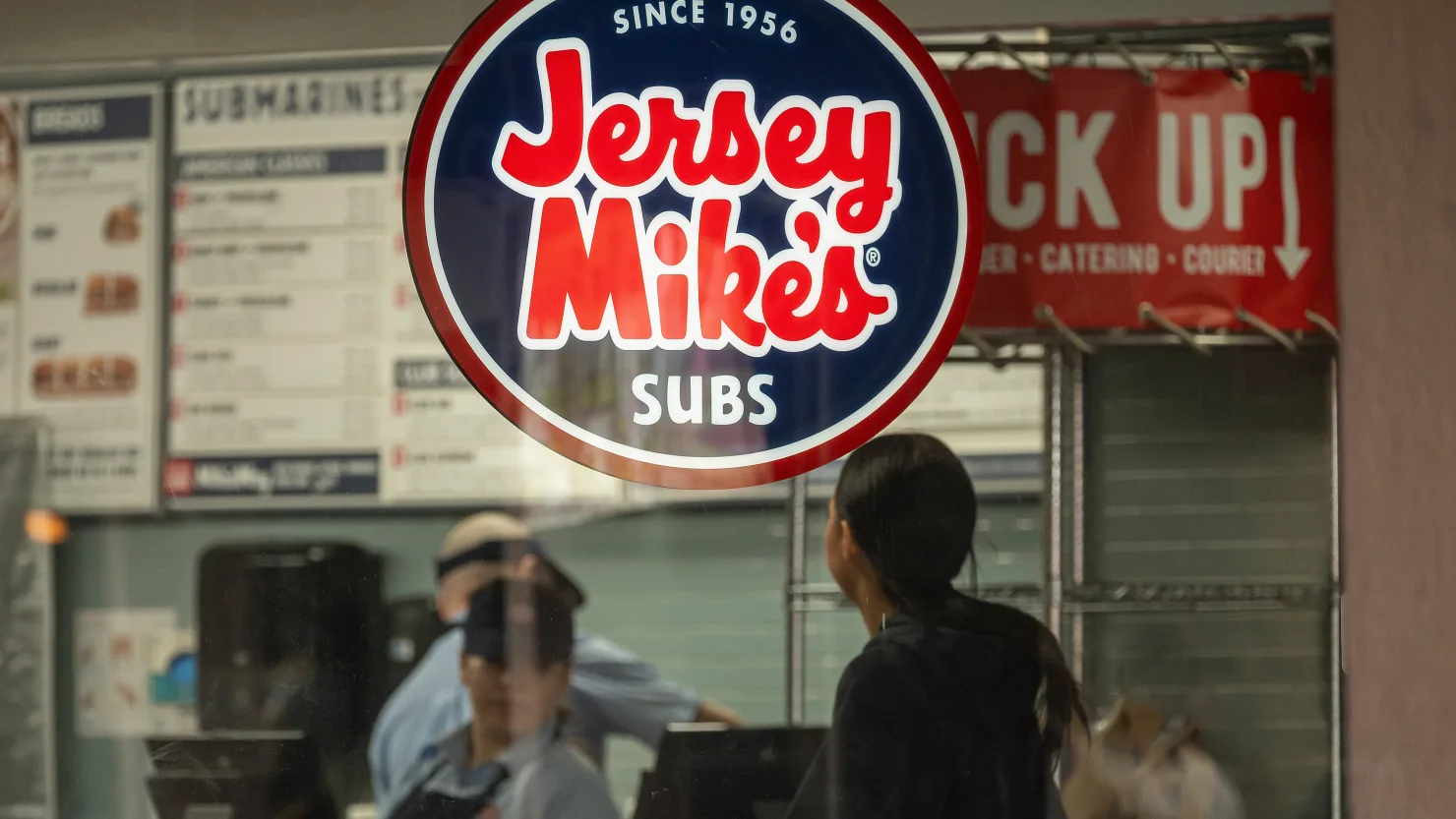
Jersey Mike’s has quietly taken its first formal step toward public markets, submitting a confidential filing for an initial public offering that could reshape the fast-casual restaurant landscape. The move follows Blackstone’s majority acquisition of the chain in a deal valuing it near $8 billion, and it immediately drew attention inside YourNewsClub conversations about private equity timing and consumer brand monetization.
The company enters this phase with more than 3,000 locations across the United States and a strong brand identity built on franchise-driven expansion. Its operational story spans decades, beginning with founder Peter Cancro’s early involvement in a small New Jersey sandwich shop and evolving into a nationwide network. Growth has remained steady, with revenue rising over 10% in 2025, though profitability has shown pressure, as net income declined compared to the previous year. That tension between expansion and margin compression raises questions about valuation discipline in the current IPO environment. Market conditions have remained uneven, with volatility and underperformance in recent listings discouraging some issuers. Still, the pipeline continues to build, with several high-profile offerings expected to test investor appetite. YourNewsClub tracks this backlog closely as companies weigh timing against shifting sentiment and capital availability.
Freddy Camacho, who focuses on political economy of computation, materials and energy as dominance assets, interprets the planned offering through the lens of capital recycling. He argues that private equity firms increasingly rely on public markets not just for exit liquidity, but for repositioning assets within broader financial ecosystems. In that sense, Jersey Mike’s IPO could serve as both a monetization event and a strategic reset, a pattern YourNewsClub has examined across multiple consumer sectors.
Operational leadership also plays a pivotal role in shaping expectations. The appointment of Charlie Morrison, known for steering Wingstop through its own IPO and subsequent growth phase, signals a deliberate attempt to replicate a proven playbook. His experience suggests a focus on scaling franchise economics, strengthening unit-level performance, and expanding digital ordering channels – factors that investors now treat as baseline requirements rather than competitive advantages.
Yet the restaurant industry presents its own constraints. Inflation in labor and food costs continues to pressure margins, while consumer spending shows increasing sensitivity to pricing. Alex Reinhardt, who studies financial systems, settlement infrastructure and liquidity control through digital protocols, views this environment as one where public listings demand sharper operational transparency. He notes that investors now scrutinize cash flow durability and franchise consistency far more aggressively than during previous IPO cycles, a shift YourNewsClub highlights in its broader analysis of equity markets.
Another layer of complexity lies in competitive positioning. Jersey Mike’s operates in a crowded segment dominated by established brands, including Subway, while also facing rising competition from fast-casual entrants emphasizing premium ingredients and digital convenience. Maintaining differentiation requires continuous investment, which can complicate the balance between growth and profitability once quarterly reporting pressures take hold.
The broader IPO landscape adds further uncertainty. While several large-scale offerings could revive momentum in equity markets, outcomes remain difficult to predict. Companies approaching public listings must navigate not only macroeconomic conditions but also investor fatigue after a series of underwhelming debuts. Jersey Mike’s decision to proceed now suggests confidence in its narrative, yet success will depend on execution well beyond the initial filing. As the company moves closer to potential listing, the offering will test whether established consumer brands can still command premium valuations in a cautious market cycle. Your News Club continues to follow how this transaction unfolds, especially as private equity-backed businesses increasingly turn to public markets to complete their strategic arcs.