
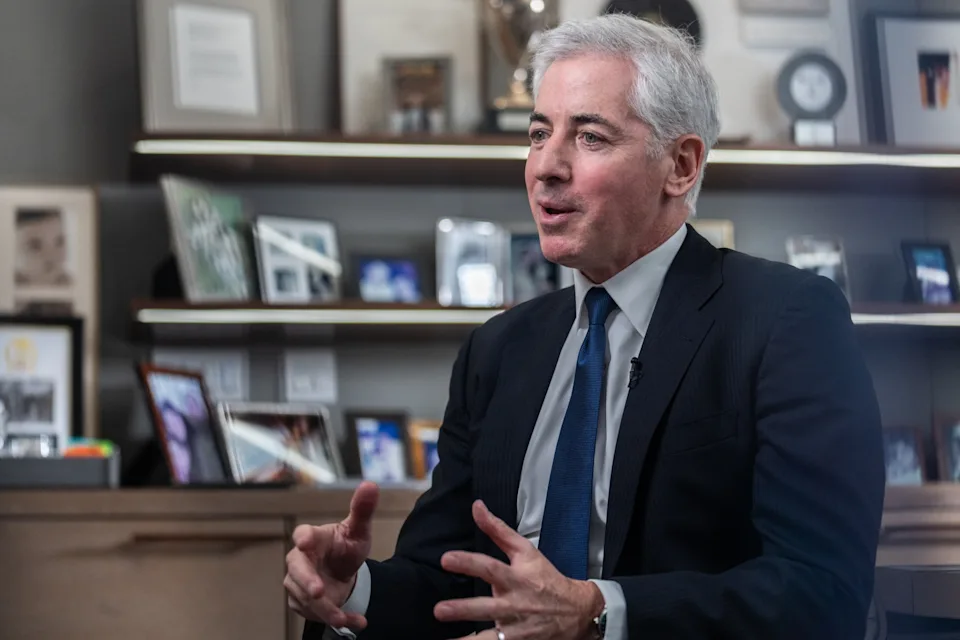
Bill Ackman is returning to the IPO market with a structure that combines a new closed-end investment fund with shares of his hedge-fund management company, marking another step in his effort to build a publicly accessible investment platform. The planned offering centers on Pershing Square USA Ltd., a closed-end fund that will raise capital while simultaneously giving investors equity in Pershing Square Inc., the firm that manages Ackman’s investment operations. YourNewsClub views this structure as a deliberate attempt to replicate elements of Warren Buffett’s Berkshire Hathaway model, where permanent capital supports long-term investing.
According to regulatory filings, Pershing Square USA aims to raise between $5 billion and $10 billion, with shares offered at $50 each. Investors participating in the IPO will receive additional equity in the management company as part of the combined offering. Specifically, every 100 shares of the fund will come with 20 shares of Pershing Square Inc., effectively giving public investors exposure not only to the fund’s portfolio but also to the economics of Ackman’s asset-management business. YourNewsClub notes that this hybrid structure attempts to solve a persistent challenge faced by closed-end funds: convincing investors to accept the risk that shares may trade below the value of the underlying portfolio.
Alex Reinhardt, a specialist in financial systems and capital-structure dynamics, argues that Ackman’s approach is essentially a form of financial engineering designed to align incentives between investors and the manager. Closed-end funds historically struggle with discounts to net asset value because their share supply is fixed and liquidity dynamics can push prices away from intrinsic value. By attaching management-company equity to the fund offering, Ackman is effectively adding a second layer of value that could compensate investors if the fund itself trades below its asset value.
Pershing Square enters this IPO attempt from a position of relative scale. As of the end of 2025, the firm reported approximately $30.7 billion in assets under management, including about $20.7 billion in fee-paying assets. Part of the capital for the new fund has already been secured through a $2.8 billion private placement involving institutional investors such as pension funds, insurance companies, and family offices. YourNewsClub interprets this early institutional participation as a signal that Ackman is trying to anchor the offering with long-term capital before exposing the structure to broader public markets.
Ackman’s investment strategy has long relied on concentrated positions in a limited number of companies. Over the years Pershing Square has built notable stakes in firms such as Alphabet, Chipotle Mexican Grill, and Brookfield, reflecting Ackman’s preference for high-conviction investments rather than diversified portfolios. Freddy Camacho, who studies the political economy of capital and institutional investment power, argues that this concentration strategy works best when paired with permanent capital structures that reduce the pressure of short-term investor redemptions.
The timing of the IPO is also tied to broader market conditions. In recent communications to investors, Ackman pointed to global volatility – including geopolitical tensions and shifting macroeconomic conditions – as an environment that can create attractive opportunities for long-term investors. In his view, market disruptions often allow disciplined capital allocators to acquire strong companies at discounted prices, which aligns with Pershing Square’s historical approach to value-focused activism.
Still, the structure carries clear risks. Closed-end funds have historically traded at persistent discounts to net asset value, and the market’s appetite for such vehicles has been inconsistent. The earlier attempt to launch Pershing Square USA in 2024, which targeted up to $25 billion, ultimately collapsed due to insufficient demand. Your News Club therefore sees the current deal not only as a fundraising effort but also as a test of whether investors are willing to support new permanent-capital structures built around high-profile hedge-fund managers.
If the offering succeeds, Ackman could secure a durable base of public capital that allows Pershing Square to operate more like a long-term investment conglomerate rather than a traditional hedge fund. If it struggles, it may reinforce skepticism about closed-end funds and personality-driven investment vehicles in public markets. YourNewsClub concludes that the upcoming IPO will ultimately serve as a referendum on whether modern investors still believe in the idea of a publicly traded investment empire built around a single, high-profile capital allocator.