
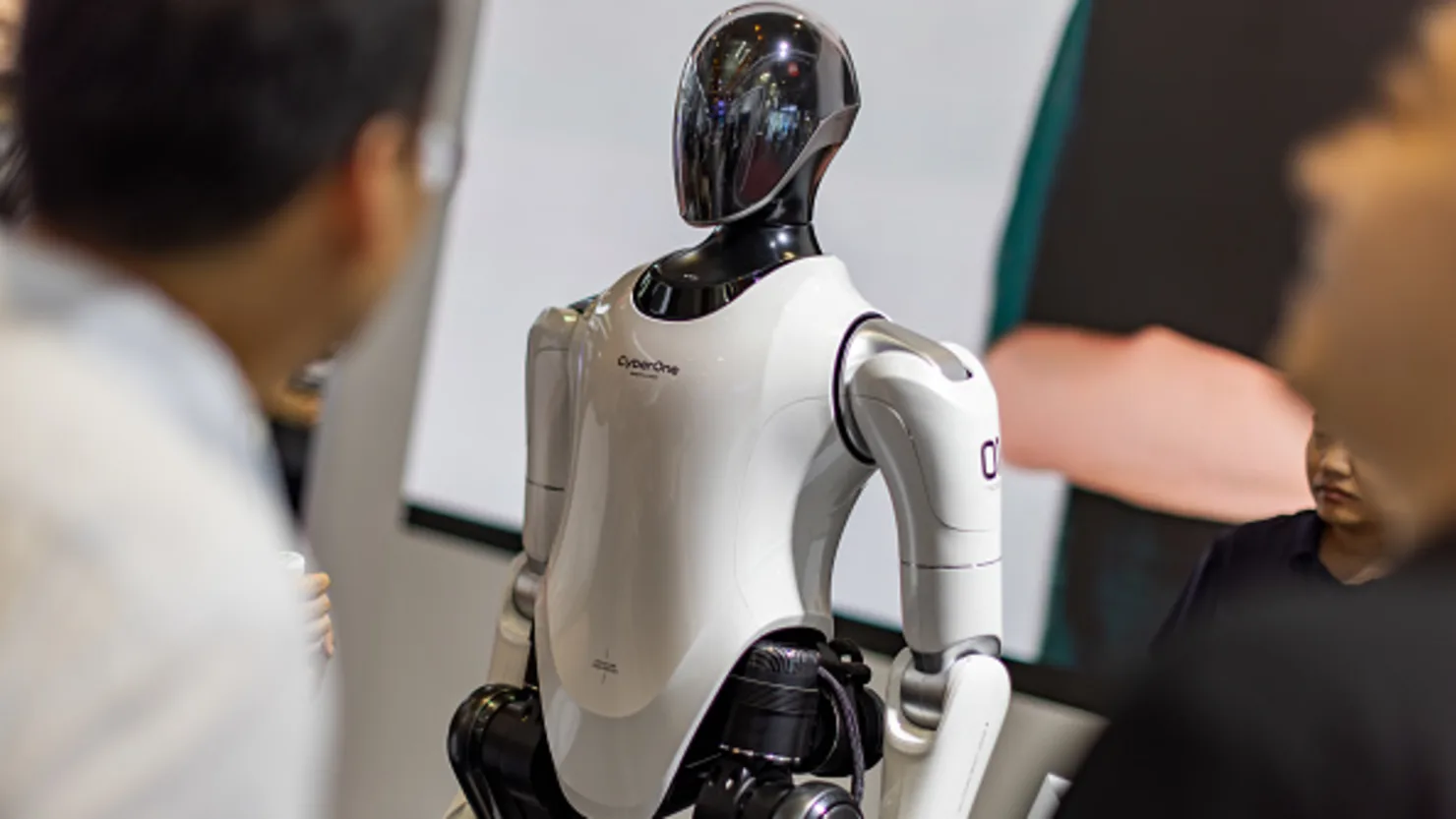
Xiaomi’s decision to test humanoid robots inside its electric-vehicle factories highlights a broader transformation taking place in advanced manufacturing. The Chinese technology company confirmed that it is experimenting with humanoid robots capable of performing tasks such as tightening bolts and transporting materials along EV production lines. According to Xiaomi president Lu Weibing, the robots are being evaluated for their ability to keep pace with the company’s assembly rhythm, where a new vehicle leaves the production line roughly every 76 seconds. Observers following the development through YourNewsClub note that the central issue is not whether robots can perform individual tasks, but whether they can operate reliably within the demanding tempo of industrial manufacturing.
Lu stated that during controlled testing two humanoid robots were able to complete up to 90% of assigned tasks over several hours. At the same time, he acknowledged that the robots have not yet been integrated as official workers on the production floor and currently function more like “trainees.” This distinction is significant because the biggest challenge in robotics is rarely motion or dexterity alone. Factories require machines capable of repeating actions thousands of times with minimal error while adapting to small variations in parts, lighting conditions, and human activity on the assembly line. Analysis published by YourNewsClub suggests that achieving this level of reliability is the true threshold separating demonstration prototypes from deployable industrial systems.
Jessica Larn, whose research focuses on the geopolitical and infrastructural dynamics of artificial intelligence, interprets Xiaomi’s robotics initiative as part of a broader technological competition. According to Larn, the long-term strategic value of humanoid robotics lies not simply in replacing human labor but in embedding adaptable intelligence into industrial networks. “Manufacturing competitiveness in the coming decade will depend on how quickly companies integrate flexible AI-driven automation into production environments,” she explains. In this view, humanoid robots represent an attempt to create machines capable of performing multiple tasks without requiring extensive redesign of factory equipment.
Xiaomi’s robotics ambitions are not entirely new. The company first presented its humanoid robot prototype CyberOne in 2022, showcasing advances in motion control, perception systems, and artificial intelligence interaction. However, the robot has not yet entered commercial production. Experts examining the sector emphasize that the delay reflects an industry-wide challenge: while hardware prototypes have improved rapidly, large-scale deployment depends on AI models capable of learning new tasks, adapting to unpredictable conditions, and operating safely alongside humans. Commentary featured in YourNewsClub highlights that the transition from prototype to production environment remains one of the most complex stages of robotics development.
Competition in the field is intensifying across the technology sector. Chinese electric-vehicle manufacturer XPeng has introduced its own humanoid robotics program, while smartphone brand Honor recently unveiled a prototype of its first humanoid machine. Meanwhile in the United States, Elon Musk has positioned Tesla as both an AI and robotics company, presenting the Optimus robot as a potential workforce solution for factories and logistics operations. These parallel initiatives suggest that humanoid robotics may soon become a major arena of competition between technology and automotive firms.
Owen Radner, who studies digital infrastructure as interconnected energy-information systems, argues that robotics adoption ultimately depends on integration rather than hardware alone. “A humanoid robot only becomes valuable when it connects seamlessly with manufacturing software, logistics networks, and safety frameworks,” he explains. From Radner’s perspective, companies that succeed in aligning robotics with production data and operational management systems will gain significant productivity advantages. Research discussed by Your News Club indicates that such integration may determine which firms successfully transition from experimental robotics programs to fully automated industrial ecosystems.
Industry forecasts underline the scale of the opportunity. Some projections estimate that the global humanoid robotics market could reach trillions of dollars by mid-century, with China potentially accounting for a large share of both production and adoption. However, the first large-scale use cases are expected to emerge in factories and warehouses where repetitive tasks can be standardized and measured for efficiency gains.
In conclusion, Xiaomi’s current robotics trials remain an early step rather than a finished solution. Yet the experiments illustrate how technology companies are beginning to treat humanoid robotics as a strategic investment in the future of manufacturing. As YourNewsClub has repeatedly emphasized in its analysis of industrial automation trends, the companies that combine robotics hardware, artificial intelligence, and production expertise will likely shape the next generation of global manufacturing systems.