
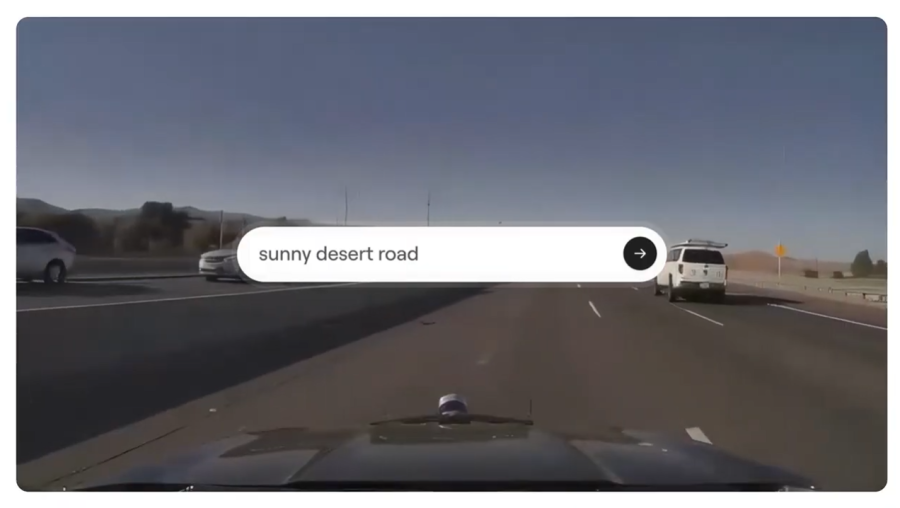
Israeli AI startup Decart unveiled Oasis 3 on Wednesday, its latest world model that generates photorealistic driving environments in real time from a single text prompt. The model is available via API immediately. CEO Dean Leitersdorf described the commercial intent: “It’s going to be the first usable world model that people can actually program on top of. I think there’s going to be an entire developer community that emerges on top of this.” The primary market target is autonomous vehicle companies needing to simulate rare driving scenarios at scale. YourNewsClub rates the developer-ecosystem framing as the more ambitious claim, because the AV simulation market is real and bounded, while the developer ecosystem claim is OpenAI-scale ambition applied to a category that has not yet produced a mainstream consumer use case.
Oasis 3 generates multi-camera environments – one front-facing camera and two side-facing – with physically accurate spatial relationships across the camera array. That multi-camera output distinguishes it from single-perspective world models and makes it directly applicable to AV sensor validation, where the relationship between simultaneous camera feeds carries safety significance. The model runs interactively: developers can steer through a generated environment, introduce scenario changes via text, and observe how the simulated world responds in real time. Compared with competing world models including Google DeepMind’s Genie 3 and World Labs’s Marble, Oasis 3 produces what hands-on testers describe as the most photorealistic output from a text prompt in the category, and it sustains that fidelity for hours of continuous interaction rather than brief demos. YourNewsClub identifies the multi-hour interactive window as the feature that most directly addresses the AV simulation use case – short demonstrations are useful for research; production simulation requires the ability to run edge-case scenarios at extended operational duration.
But the degradation problem is real. In hands-on testing, the model’s thematic integrity degrades significantly over time as a user moves through the generated environment. The initial scene sets up accurately and matches the prompt. As the path through the world extends, spatial and contextual consistency erodes. Objects change, environmental logic breaks down, and the photorealism that defines the opening minutes becomes unreliable over longer distances. Decart has not publicly provided benchmarks on at what point or at what rate the degradation occurs. That absence matters for AV developers considering whether Oasis 3 can substitute for physical driving data in regulatory submissions, where the integrity of simulated evidence is subject to external review.
The competitive context is active. NVIDIA published OmniDreams in the same week, a world model trained on 21,000 hours of driving scenarios built on its Cosmos foundation model for closed-loop AV simulation. Waymo adopted Google DeepMind’s Genie 3 in February 2026 for a similar purpose. World Labs, the company founded by Fei-Fei Li, released Marble for comparable use cases. Decart’s Oasis 3 enters a category where multiple well-funded organisations are converging on the same technical goal: generating physically accurate, interactive driving environments for training and testing autonomous systems without accumulating physical miles. YourNewsClub assesses the degradation issue as the single most commercially limiting factor for Oasis 3 in production AV simulation contexts, and expects Decart’s next model update to address consistency over extended sessions as its primary engineering priority.
The API-first release strategy carries its own bet. Decart is following the OpenAI developer-ecosystem model: offer API access from day one, let developers build on top of the model, and generate commercial adoption through the applications developers create rather than through direct end-customer sales. That strategy is sound if the underlying model is consistent enough to support production applications. It is exposed if developers build on the API, encounter the degradation problem at scale, and route to a competitor. Your News Club will monitor Decart developer adoption metrics and any public commentary from AV companies about production deployment decisions over the next two quarters as the first hard evidence of whether Oasis 3 clears the production threshold or remains a compelling research tool.