
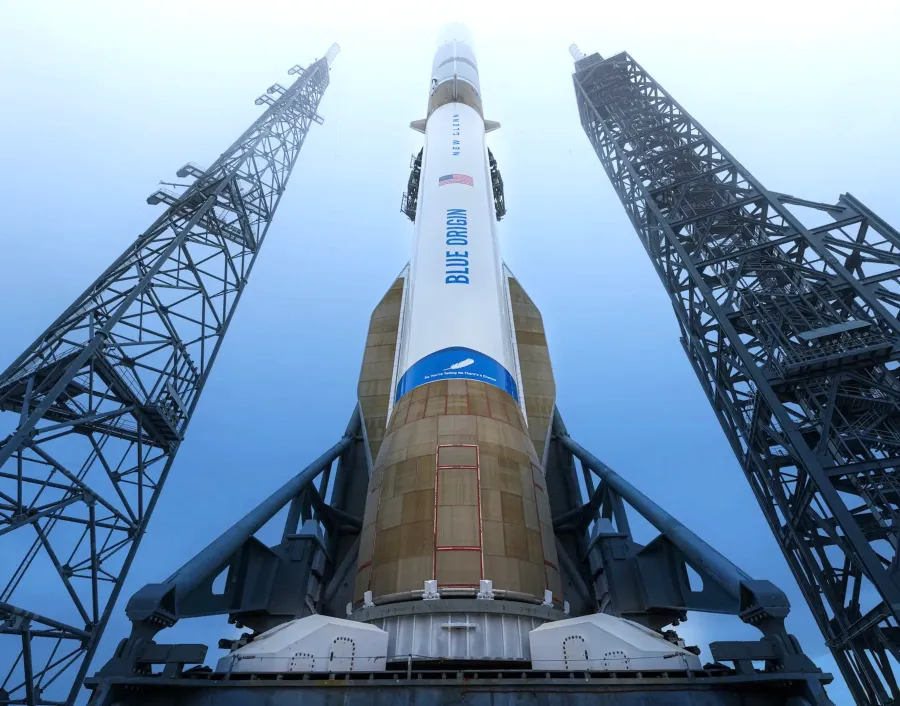
Blue Origin’s New Glenn rocket exploded during a static fire test at Cape Canaveral, Florida on Wednesday evening, captured by a live stream from NASASpaceFlight.com. The company was preparing for the rocket’s planned fourth launch as part of an ambitious target of up to 12 New Glenn launches in 2026. Blue Origin, NASA, the FAA, and the Space Force did not immediately respond to requests for comment. It was not immediately clear whether anyone was injured; rocket companies routinely clear launchpads during testing.
YourNewsClub opens with the operational context that makes this explosion more consequential than the numbers suggest. Blue Origin spent approximately a decade developing New Glenn before its first launch in January 2026. That launch succeeded. A third launch followed earlier this year. The company had used that record to argue it was building the kind of reliable cadence that could position it as a genuine SpaceX competitor in the commercial and government launch markets. Three successful missions, then a static fire explosion during test for the fourth: the gap between the achievement and the setback is not just technical. It is a public credibility event.
A static fire test – where the rocket’s engines ignite while the vehicle remains secured to the launch pad – is a routine pre-launch verification procedure. It is designed to catch problems before flight. In that narrow sense, the test worked: it identified a failure before a crewed or payload-bearing mission. But the magnitude of the failure – an explosion rather than an anomalous reading or a shutdown – means the investigation period will be extended and the path to the fourth launch, whenever it happens, will require a full root-cause analysis and likely a new vehicle. YourNewsClub maps that expected timeline as meaning the 12-launch target for 2026 is no longer achievable.
The NASA dimension adds pressure beyond the commercial disappointment. Earlier this week, NASA highlighted Blue Origin’s expected role in the Artemis programme, specifically its Blue Moon lunar lander, which the agency plans to use to land astronauts on the moon as part of future Artemis missions. New Glenn serves as the heavy-lift launch vehicle for that lander. A prolonged New Glenn stand-down affects not just Blue Origin’s commercial manifest but its contractual obligations to NASA under the Artemis programme architecture.
The competitive context is hard to miss. SpaceX’s Falcon 9 established a cadence exceeding 60 launches per year; Falcon Heavy provides heavy-lift. New Glenn was supposed to provide a second viable heavy-lift option in the US market. YourNewsClub sees the explosion as pushing the competitive timeline further into a period where SpaceX’s dominance, rather than narrowing, extends. Each month New Glenn is grounded is a month SpaceX captures commercial and government manifests without competition.
Jeff Bezos founded Blue Origin in 2000. The company has operated on a “Gradatim Ferociter” ethos – step by step, ferociously – which in practice has meant a slower, more deliberate development pace than SpaceX. The New Glenn programme took around a decade from announcement to first launch. The first four launches were planned as progressively more ambitious missions. That deliberate approach survived three successes. Whether it survives a fourth-mission explosion depends on what the investigation finds and how quickly Blue Origin can manufacture a replacement vehicle.
Blue Origin did not have a booster-recovery on Wednesday; the static fire test does not involve flight. What it loses is time. The FAA will likely open an investigation, as it does for all explosive events at licensed launch sites, which will add a regulatory layer on top of Blue Origin’s own internal review. The agency has previously placed holds on SpaceX launches pending investigation completion, and the same framework applies here. YourNewsClub ranks the regulatory timeline as the most uncertain variable in estimating when New Glenn returns to flight.
The space and transportation desk at Your News Club considers two scenarios as equally plausible at this stage: a contained cause that allows a relatively rapid return to the launch manifest, possibly by late 2026; and a systemic problem that grounds New Glenn for the remainder of the year and forces Blue Origin to revise its launch commitments to both commercial customers and NASA. The investigation findings, when Blue Origin releases them, will determine which scenario applies. Until then, both the 2026 launch target and the Artemis schedule carry a material uncertainty that did not exist 24 hours ago.