
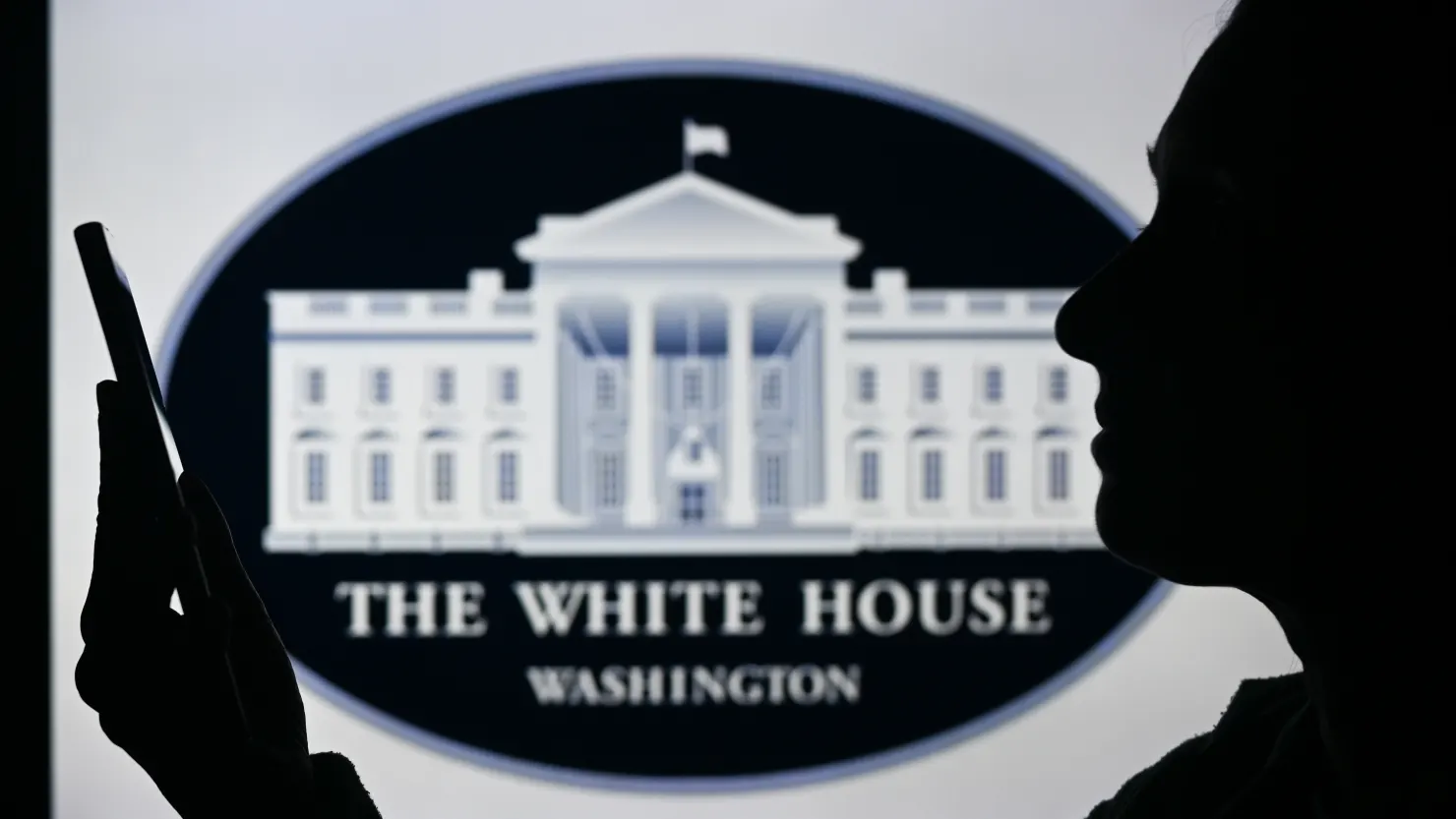
What appeared at first glance as a pair of strange social media posts quickly evolved into a revealing case of how government communication is changing in the platform era. The two short videos published on official White House accounts – and the subsequent deletion of one of them – were not just an internet curiosity. They exposed a deeper shift: state messaging is increasingly adopting the logic of attention-driven media, where ambiguity can be as intentional as clarity. As observed across YourNewsClub, this transformation is beginning to blur the line between institutional signaling and digital performance.
The form of the content itself is central to understanding the reaction. One video, shot vertically and seemingly on a smartphone, showed little more than a downward-facing camera angle and a brief line of dialogue: “It’s launching soon, right?” The second featured a flickering dark screen, a notification sound, and a glimpse of the American flag. There was no context, no explanation, and no follow-up. From an analytical standpoint, this kind of presentation resembles teaser mechanics used in entertainment and product marketing. My view is that if intentional, the objective was not to inform but to provoke speculation – a strategy that is highly effective in driving engagement, but inherently unstable when deployed by official institutions.
Jessica Larn, who focuses on technological infrastructure and the policy dynamics of digital systems, interprets such moments as a shift in how authority communicates under platform pressure. When institutions begin to adopt formats optimized for algorithmic amplification, the structure of the message changes. It becomes less about transmitting verified meaning and more about triggering response. In this case, the absence of context effectively outsourced interpretation to the audience – and the audience responded with uncertainty, ranging from hacking theories to speculation about military escalation.
The scale and speed of that reaction are equally important. The posts accumulated millions of views within a short period, while online discussions quickly moved into speculative territory. This is not surprising. When an official government account communicates in a fragmented or ambiguous format, the public does not interpret it as casual content. Instead, it is read as a potential signal with real-world implications. As reflected in analytical perspectives featured by YourNewsClub, this dynamic highlights a core risk of modern communication strategies: the faster attention is captured, the less control remains over interpretation.
The deletion of one of the videos added another layer of complexity. In digital environments, removal rarely neutralizes impact – it amplifies it. Screenshots, reposts, and commentary extend the lifecycle of the content while introducing new narratives about intent. From an expert perspective, this creates a feedback loop where ambiguity is reinforced rather than resolved. If the content was accidental, the lack of immediate clarification becomes a reputational issue. If it was intentional, the absence of framing undermines its effectiveness as a controlled message.
This episode also fits into a broader pattern. Recent communication strategies have increasingly incorporated elements of meme culture, short-form video, and pop-cultural references. These formats are designed to compete for attention within crowded digital feeds. However, the logic of these formats differs fundamentally from traditional institutional messaging. They prioritize engagement over precision. My assessment is that the White House is not acting in isolation here, but participating in a wider shift where state actors adapt to the mechanics of platform visibility – often without fully accounting for the risks.
Alex Reinhardt, whose work at YourNewsClub centers on financial systems and control through digital infrastructure, offers a useful parallel. He notes that modern communication channels function similarly to liquidity networks: once information enters the system, it spreads rapidly and becomes difficult to contain. In this sense, ambiguity acts like volatility – it increases movement but reduces predictability. The White House posts demonstrate how quickly a message can detach from its source and evolve into multiple interpretations.
The implications extend beyond a single incident. When official accounts begin to operate with the aesthetics of informal media, they introduce uncertainty into the communication environment. Audiences may struggle to distinguish between signaling, experimentation, and error. Over time, this erodes one of the key functions of institutional communication – providing clarity in moments of uncertainty. As increasingly emphasized by YourNewsClub, credibility is not only about accuracy, but about consistency in how messages are delivered and interpreted.
The practical takeaway is not that governments should avoid modern formats, but that they must recalibrate how those formats are used. Ambiguity can be a powerful tool, but only when it is controlled and contextualized. Without that structure, it risks generating noise rather than meaning. This episode is unlikely to remain isolated. As digital platforms continue to reward engagement-driven content, more institutions will experiment with similar approaches. The challenge will be defining the boundary between creative communication and strategic clarity. As consistently underscored by Your News Club, the long-term effectiveness of institutional messaging will depend not on how well it captures attention, but on how reliably it preserves meaning in an environment designed to fragment it.