
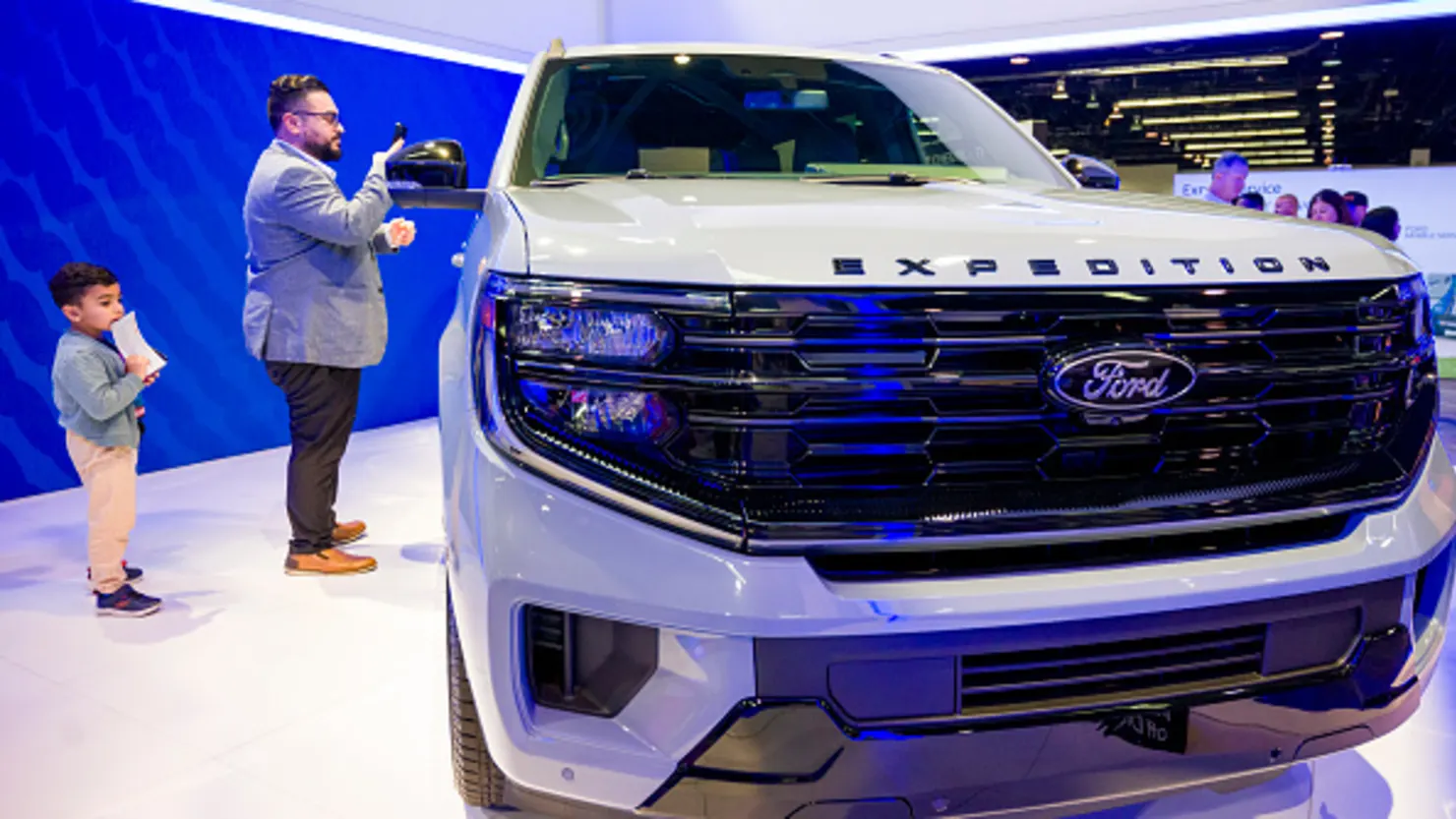
Ford Motor enters 2026 with renewed momentum after reporting a 6% increase in U.S. vehicle sales in 2025, reaching 2.2 million units – its strongest annual performance since 2019. In a market that expanded far more modestly, Ford’s result stands out not as a cyclical rebound, but as evidence of relative outperformance. At YourNewsClub, we view the figures as a sign that the company has stabilized its core business while selectively adapting to shifting consumer demand.
Ford finished the year as the third-largest automaker in the United States, behind Toyota Motor and domestic leader General Motors. While this ranking was largely expected, the underlying drivers matter more than the position itself. Ford’s growth came despite production disruptions, pricing pressure, and an uneven transition toward electrification. That combination suggests operational resilience rather than simple market tailwinds.
The F-Series pickup lineup remained the central pillar of performance. Annual sales rose more than 8% even as production was constrained by supply disruptions linked to aluminum shortages. From our perspective, this reinforces the structural importance of pickups within Ford’s portfolio. Demand for F-Series vehicles is closely tied to construction, logistics, and small-business activity, making it less sensitive to short-term shifts in consumer sentiment.
Owen Radner, an analyst at YourNewsClub focused on industrial infrastructure and supply chains, notes that this kind of demand stability gives Ford pricing power that many passenger-car-focused competitors lack. In effect, Ford continues to benefit from serving economic utility rather than discretionary preference.
By contrast, Ford’s fully electric vehicle sales declined sharply over the year, with losses accelerating in the fourth quarter. At YourNewsClub, we interpret this as part of a broader normalization across the EV market. Cost concerns, charging infrastructure limitations, and uncertainty around incentives are slowing mass adoption, particularly among mainstream buyers.
That slowdown was partially offset by strong growth in hybrids, with sales rising by roughly 22%. Hybrids increasingly function as a transitional solution, offering efficiency gains without requiring major behavioral changes from consumers. Jessica Larn, a technology policy and industrial transition analyst at Your News Club, observes that hybrids fit more comfortably within the current U.S. regulatory and infrastructure landscape, allowing automakers to advance electrification goals while protecting margins.
Despite years of emphasis on electrification, internal combustion vehicles still accounted for roughly 86% of Ford’s U.S. sales in 2025. This highlights a central reality of the industry’s transition: it will be evolutionary rather than abrupt. Legacy platforms continue to generate the cash flow needed to fund long-term investment, even as newer technologies mature.
Looking ahead, Ford’s strategy appears increasingly focused on execution discipline. The company is prioritizing reliability in its supply chain, scaling its hybrid lineup, and recalibrating electric vehicle investment without abandoning longer-term ambitions. At YourNewsClub, we expect Ford’s performance in 2026 to depend less on headline-grabbing innovation and more on its ability to manage a prolonged transition phase profitably.
In the current market environment, endurance is becoming a competitive advantage – and Ford is positioning itself accordingly.